Table of Contents
A thousand likes on an employee post feels great, but it doesn’t pay the bills (or hire the talent, or close the deals).
Measuring employee advocacy success means tracking the KPIs that actually move the business forward, like reach, engagement, leads, hires, and ad spend saved.
Here’s your guide to measuring success, proving ROI, and turning your program into a repeatable growth engine.
Key takeaways
- Track what matters. Measure KPIs like reach, engagement, and conversions to prove your employee advocacy program drives real business results.
- Show the impact. Use data to highlight wins, from boosted brand awareness to money saved on ads or recruiting.
- Make it easy to join in. Tools like Hootsuite Amplify help employees share approved content, track results, and stay motivated through friendly competition.
- Build a sharing culture. Advocacy works best when employees feel proud to post and know their voices make a difference.
What does it mean to measure employee advocacy success?
Measuring employee advocacy success means evaluating your program’s business impact through key performance indicators (KPIs). A complete measurement approach tracks:
- Reach and brand visibility: How far employee posts extend your brand beyond corporate channels
- Engagement: Whether audiences are interacting with employee-shared content
- Employee participation: How many employees are actively sharing, and how often
- Business impact: This includes leads, conversions, hires, and ad spend saved
Tracking results turns fluffy numbers into evidence you can take to leadership. And with the right data, you can sharpen your strategy into a repeatable advocacy machine.
Real-world example: Victoria Samways, Marketing & Brand Manager at Major Tom, used employee advocacy measurement to prove a three-figure ROI on a single campaign.
- The approach: Samways paired Hootsuite Amplify with UTM tracking codes, then encouraged employees to share campaign content.
- The result: Amplify landed in Major Tom’s top 5 traffic sources for the campaign, generated over $100k in pipeline, and delivered a higher-than-average win rate.
“Thanks to the UTM tracking links, over the coming weeks, we saw a healthy amount of leads that we attributed back to this campaign,” Samways shares. “This resulted in over $100k in our pipeline and, as a channel, provided a higher-than-average win rate due to the referral-like context of these leads.”
Why is it important to measure employee advocacy success?
Measuring employee advocacy success is important because advocacy programs compete for budget, attention, and headcount like every other initiative. Without data, they almost always lose that competition.
Here are three specific risks of running an unmeasured employee advocacy program:
- You can’t defend your budget. Measurement shows how your program moves the needle on reach, leads, and recruiting.
- You can’t fix what’s broken. Without data, you don’t know if low participation is a content problem, a platform problem, or a culture problem.
- You can’t replicate what’s working. Measurement shows you which campaigns, content types, and brand advocates are driving the strongest results. When you know what’s working, you can streamline your efforts and scale the wins.
There’s another upside that’s easy to underestimate: measurement makes employees take the program more seriously.
When employee advocates can see their own impact, they participate more and stick with the program longer. In other words, the act of measuring is itself a participation lever.
The bottom line: A social media post that racks up a thousand likes feels great, but if those likes aren’t turning into top talent, qualified leads, or customers, what’s the point? Measurement is what makes the impact of employee advocacy visible.

Source: Balaji Mohanty
What are the key metrics to measure employee advocacy success?
The key metrics for measuring employee advocacy success fall into seven categories. Here’s a quick overview:
| Category | Metrics to track | What it tells you |
| Awareness and reach | Reach, impressions, share of voice | How far company content travels when employees share it |
| Engagement | Likes, comments, shares, click-through rates, sentiment | Whether employee posts drive more interaction than branded content |
| Recruiting | Applicant volume, applicant quality, time-to-hire | How employee advocacy affects the strength and speed of your hiring pipeline |
| Sales and lead generation | Site traffic, leads, conversions, pipeline influence | How advocacy contributes to revenue and bottom-line business outcomes |
| Employee participation | Adoption rate, participation rate, average shares per employee | How many employees are actively using and engaging with your program |
| Cultural impact | Employee survey scores, thought leadership growth, qualitative feedback | How advocacy affects employee pride, career growth, and program sentiment |
| Employee retention | Retention rate, voluntary turnover rate, recruitment cost savings | Whether advocacy correlates with employees staying at your company longer |
Before diving in, decide how you’ll benchmark these numbers. You can measure against competitors, or against your own company’s historical performance. Both are valid, and the right choice depends on the maturity of your program.
Awareness and reach metrics
Awareness and reach metrics measure how far company content travels when employees share it to their personal channels. The core metrics to track include:
- Reach: Unique people who saw a post
- Impressions: Total times posts were viewed
- Share of voice: Your brand’s portion of industry conversation
How you communicate these metrics matters, too. Saying “Our employees’ posts reached 100,000 people” is fine. Following it up with “That’s the equivalent of $15,000 in paid impressions we didn’t spend” will blow the socks off your C-suite.
Engagement metrics
Engagement metrics measure how audiences interact with employee-shared content. Track likes, comments, shares, click-through rates, and sentiment to see whether employees spark more authentic engagement than branded content.
The data supports employee advocacy as an engagement driver, too: LinkedIn reports that the click-through rate (CTR) on a piece of content is typically 2x higher when an employee shares it compared to a brand.
Recruiting metrics
Recruiting metrics measure how employee advocacy affects your hiring pipeline. Here’s what to track:
- Applicant volume: How many people apply
- Applicant quality: Whether candidates are stronger fits
- Time-to-hire: How quickly roles get filled
The logic is simple: the more potential candidates know about what it’s like to work at your company, the more likely they are to apply (and the easier it becomes to close the right hires).

Source: Shawna Olsten
Sales and lead generation metrics
Sales and lead-gen metrics measure how employee advocacy contributes to revenue. Monitor site traffic from employee shares, leads generated, conversions, and pipeline influence. These prove advocacy is an ROI engine.
“Along with tracking social impressions, we also track the traffic and conversions generated on our website from Amplify traffic,” says Samways. “Conversions can be newsletter sign-ups, job applications, or leads.”
Psst: Your salespeople also benefit from being active social sharers. LinkedIn says that sales reps who share content regularly are 45% more likely to beat their sales quota.
Employee participation metrics
Employee participation metrics measure how many employees are actively using your advocacy program. Here’s what to track:
- Adoption rate: Percentage of employees signed up
- Participation rate: Percentage of signed-up employees who are actually sharing
- Average shares per employee
“Major Tom tracks the percentage of people sharing, and sees if the employees with the largest followings are participating,” says Samways.
When reporting participation, frame it as a cultural win. For example, “Half our workforce is actively building their thought leadership.”
You can also boost these numbers by offering incentives to the brand ambassadors and advocates who post most consistently.
Cultural impact metrics
Cultural impact metrics measure how advocacy affects employee pride, career growth, and overall sentiment toward the program. Here are the key metrics to track:
- Employee survey scores
- The number of employees building thought leadership brands
- Qualitative feedback about the program
These metrics answer questions like: Does advocacy make employees prouder to work at your company? Does it help them develop their reputation as thought leaders? Do they actually enjoy participating?
Strong cultural impact metrics often predict stronger participation and retention down the line.
Employee retention metrics
Employee retention metrics measure whether advocacy correlates with employees staying at your company longer. To see if your advocates are also more loyal employees, track the following metrics:
- Retention rate
- Voluntary turnover rate
- Recruitment cost savings
Pride in your brand often translates into loyalty to the workplace. When employees feel valued enough to advocate, they’re more likely to invest their future with you.
If your retention rate improves alongside advocacy efforts, you can tie that indirectly to your program in your reports as money saved on recruitment.
How can businesses measure the ROI of employee advocacy?
Businesses can measure the ROI of employee advocacy by assigning a dollar value to the program’s outcomes, then comparing that total against the program’s costs (e.g., platform fees, incentives, etc.). You can use the standard ROI formula:
ROI (%) = [(Value generated − Program costs) ÷ Program costs] × 100
To calculate the “value generated” side of the equation, add up the dollar value across these four categories:
- Revenue: For every lead, demo request, or closed deal from an employee share, calculate the attributed revenue. Use UTM tracking on employee links so you can connect clicks to conversions in your CRM.
- Recruiting savings: For every qualified hire sourced through employee advocacy, calculate what you would have paid an external recruiter or job board.
- Paid media savings: For every impression employees generate, calculate what it would have cost to buy that same reach through paid ads. This number is called earned media value (EMV).
- Retention savings: For every employee who stays because they feel proud to advocate for your brand, calculate what you would’ve paid to replace them (e.g., recruiting fees, onboarding, and lost productivity).
An example: If your advocacy program generates $120,000 in attributed revenue, $40,000 in recruiting savings, and $30,000 in earned media value — and your total program cost is $20,000 — your ROI is ([$190,000 − $20,000] ÷ $20,000) × 100 = 850%.
What tools help measure employee advocacy success?
The tools that help measure employee advocacy success include:
- Employee advocacy platforms, which provide a library of on-brand content for employees to share
- Social media analytics tools, which measure reach and engagement on shared content
- Web analytics tools like Google Analytics, which connect employee shares to website traffic via UTM tracking.
An all-in-one employee advocacy tool like Hootsuite Amplify covers the first two categories — advocacy and social analytics — in a single dashboard.

Amplify lets your admins distribute pre-approved content that employees can share in one click, then tracks adoption rates, employee engagement, post impact, and employee vs. branded channel performance.
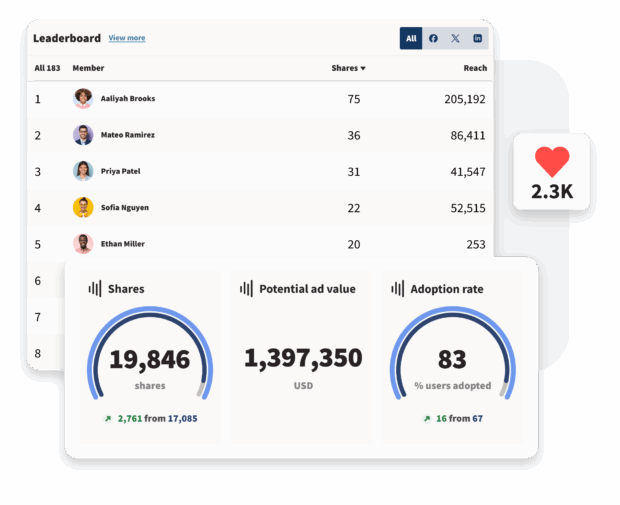
With Amplify, employees can also compete on a public leaderboard, which Major Tom uses to drive participation:
“We promote Amplify during company-wide meetings, and we gamify our employee advocacy initiative by doing two draws the week the content is published,” says Samways. “For each share, the employee’s name goes into the draw for a gift card, charity donation, or swag of their choice.”
We love this tool so much that we actually published a case study on our own strategy and success using it.
Our own employee advocacy program — built on Amplify — achieved:
- 250% year-on-year growth in generated revenue
- 80% Amplify sign-up rate (+9% year-over-year)
- 4.1M brand impressions in Q1, all attributed to employee posts from Amplify
The success of your employee advocacy program can sometimes depend on how easy and intuitive your tools are.
Meet the Suite
Understand what matters, decide what to do next, and take action across every social workflow — all from one connected suite.

What are the best practices for measuring employee advocacy success?
The best practices for measuring employee advocacy success center on building the right culture, tracking the right metrics, and connecting advocacy to real business outcomes.
Here are 11 best practices, according to experts:
- Build a culture that naturally supports advocacy
- Be careful with mandates
- Track adoption and activity rates
- Use UTM tracking on all links
- Measure engagement metrics
- Calculate earned media value (EMV)
- Make sure employees understand the “why”
- Connect advocacy to business goals
- Stay on top of tech
- Analyze content performance
- Identify and reward top advocates
1. Build a culture that naturally supports advocacy
Build an environment where employees are genuinely proud to share.
“If your employees view their work as a point of pride, and the content as a valuable way to build their personal brand, rather than a corporate requirement, they’ll feel more naturally inclined to share,” Samways shares.
2. Be careful with mandates
The best advocacy programs are opt-in. Your employees’ personal feeds are exactly that (personal), so leave room for them to share on their own terms.
If you want to nudge participation upward, Samways has a tip: “Focus more on LinkedIn, where work-related content aligns with the social media platform.”

Source: Lyn Bryan
3. Track adoption and activity rates
Two numbers tell you whether your program is thriving or flatlining: Adoption rate (how many employees signed up) and activity rate (how many are actually sharing).
Watch both. A high sign-up rate with low activity means you’ve got a ghost town on your hands.
4. Use UTM tracking on all links
UTMs are how you turn “employees posted some stuff” into “advocacy drove X-amount in revenue.”
Tag every link your program distributes, and you’ll be able to attribute traffic, conversions, and leads back to specific employee shares. This is the receipt you bring to the boardroom.
5. Measure engagement metrics
Likes, comments, shares, and clicks tell you which content is actually landing with audiences. Track engagement across employee posts to figure out what to produce more of, where to publish it, and which topics deserve a sequel.
6. Calculate earned media value (EMV)
EMV is your “what we would’ve spent on ads” number. It turns the organic reach your employees generate into a dollar figure you can show leadership.
Use the formula EMV = (Impressions ÷ 1,000) × CPM to calculate this number.
7. Make sure employees understand the “why”
Nobody shares content for a program they don’t believe in. During the initial rollout and onboarding, share exactly why advocacy exists, what’s in it for the company, and what’s in it for the employee. This helps you secure buy-in.
8. Connect advocacy to business goals
Hook your advocacy platform up to your CRM to track how many leads, influenced sales deals, and even new hires originate from employee advocacy touchpoints.
9. Stay on top of tech
Nothing kills momentum like a broken integration.
“Repeated issues, like social profiles disconnecting, can erode the trust and ease of using the platform,” says Samways.
If employees keep getting kicked out of the platform or their social profiles keep disconnecting, they’ll stop showing up. Treat tech issues as a top priority and resolve them fast.
10. Analyze content performance
Pay attention to which posts your employees actually want to share. The articles, blog posts, and updates that get the most love are basically a free focus group telling you what content to make next — and a clear signal for shaping your content strategy.
11. Identify and reward top advocates
Find your power users (aka, the employees who share the most and have the biggest networks) and treat them like the stars they are.
Hootsuite Amplify, for example, shows you the follower count of every registered employee, so you can focus your gamification efforts on the segment with the most amplification firepower.
FAQ: Employee advocacy measurement
How do companies measure the success of employee advocacy programs?
What metrics matter most for tracking employee advocacy performance?
How do businesses calculate ROI from employee advocacy initiatives?
What tools help enterprises measure employee advocacy success?
How can brands optimize employee advocacy programs based on performance data?
Start a winning employee advocacy program at your company with Hootsuite Amplify. Curate engaging content, reward top sharers, measure business impact, and more — all in one, easy-to-use dashboard. Try it today.