Table of Contents
A good productivity tool gives you time back. A bad one just gives you another login (and probably a headache).
Here’s how to put your tech stack to the test, plus nine tools worth considering for your marketing or social team in 2026.
Key takeaways
- Most marketing teams need tools in a few core categories. Think campaign tracking, content creation, and analytics.
- Fewer, well-connected tools usually win. Every extra login adds up, especially when your tools don’t talk to each other.
- Pay attention to the quiet signs of tool overload. Shadow work, low adoption, and unclear ownership are all signs that something isn’t working.
- Hootsuite helps social teams do more with fewer tools. From scheduling to reporting to replying to DMs, the work happens in one place.
What makes a tool a “productivity tool” for marketers?
A productivity tool is any software that helps marketers get work done with less time and effort. It does this by automating boring tasks, simplifying workflows, or making your day-to-day work easier to manage.
But a tool with a long list of features isn’t automatically productive. To earn that title, it should help your team:
- Save time: Take repetitive tasks off your plate, like pulling the same numbers for a weekly report.
- Stay organized: Track campaigns, deadlines, and assets with ease.
- Collaborate better: Give everyone a place to leave feedback and manage handoffs.
- Make decisions faster: Get the information you need without spending hours digging through dashboards.
- Scale their work: Manage more campaigns or channels without doubling your workload.
Do it better with Hootsuite, the all-in-one social media tool. Stay on top of things, grow, and beat the competition.
Most marketing teams need a handful of tools to keep work moving. The exact setup will look different for every team, but these are the categories that matter most:
- Social media management: Plan and schedule posts, manage your content calendar, monitor brand mentions, and coordinate activity across channels.
- Project and time management: Keep projects moving by assigning work, tracking deadlines, and keeping people accountable.
- Content creation: Design graphics, edit videos, write copy, and repurpose content for different platforms. AI tools can be a big help here.
- Collaboration and approvals: Share updates, collect feedback, manage revisions, and get the right sign-offs before anything goes live.
- Analytics and reporting: Measure campaign performance, audience growth, competitors, and social ROI.
You probably don’t need a tool from every category. Focus on the parts of your workflow that create the most friction, and build around those first.
The best productivity tools depend on where your team loses the most time. Some help you get content out the door faster. Others make it easier to collaborate, understand performance, or simply stay focused.
Here’s the quick version:
| Tool | Best for | Category | Cost (as of 2026) |
| Hootsuite | Managing the full social publishing workflow | Scheduling and publishing | From $149/month |
| Canva | Fast social graphics and templates | Content creation | Free; paid plans from $144/year |
| Grammarly | Polishing marketing copy | Content creation | Free; paid plans from $12/month |
| Notion | Organizing campaign docs and workflows | Collaboration and approvals | Free; paid plans from $10/month |
| Slack | Fast team communication | Collaboration and approvals | Free; paid plans from $7.25/month |
| Hootsuite | Social media reporting | Analytics and reporting | From $149/month |
| Google Analytics | Website and traffic analytics | Analytics and reporting | Free |
| Todoist | Lightweight task management | Focus and time management | Free; paid plans from $5/month |
| RescueTime | Understanding where your workday goes | Focus and time management | From $7/month |
Scheduling and publishing
Hootsuite: Best for managing the full social publishing workflow

Perch by Hootsuite is built for teams with a lot of social content in motion. You can plan posts, send them for approval, schedule across channels, and keep tabs on brand conversations all in one place.
Favorite features:
- Drag-and-drop content calendar: See what’s going live across channels, then move things around as plans change.
- Bulk scheduling: Queue hundreds of posts at once instead of scheduling them one by one.
- Custom approval flows: Send content to the right people before it goes live (no more chasing feedback across email and Slack).
- Best posting times: Schedule around the times your audience is most likely to engage.

Cost: $149 per month. Grab your free trial here!
Content creation
Canva: Best for fast social graphics and templates

Canva is a visual design tool for creating social graphics, presentations, videos, and other marketing assets. It’s easy enough for a solo marketer to pick up quickly, but its brand controls also make it useful for larger teams that need to keep visuals consistent.
Favorite features:
- Ready-made templates: Access thousands of templates for social posts, presentations, and more.
- Brand Kits: Keep your logos, fonts, and colors together so nobody has to guess which shade of blue is the official one.
- Background remover: Cut out backgrounds in one click. Handy when you need a clean product shot, headshot, or cutout.
Cost: Free. Paid plans start at $144 per year.
Grammarly: Best for polishing marketing copy

Grammarly is an AI-powered writing assistant. Besides catching grammar mistakes, it can adjust tone, rewrite awkward sentences, and even detect AI writing.
It works well for solo marketers who want a second set of eyes on a draft, but it also has team features that keep copy consistent across multiple writers.
Favorite features:
- Humanizer agent: Reworks AI-written copy to sound more natural.
- Tone suggestions: Flags when your writing sounds more formal, casual, confident, or blunt than you meant it to.
- Style guides and brand tones: Give teams the same guardrails for how your brand should sound.
Cost: Free. Plans start at $12 per month, billed annually.
Collaboration and approvals
Notion: Best for organizing campaign docs and workflows

Notion is a workspace app, and it can be almost anything you want it to be: a project tracker, content calendar, note-taking space, and more.
It takes more setup than other tools on this list, but that’s also the appeal. Teams can build a workspace around the way they actually work instead of squeezing everything into a basic checklist.
Favorite features:
- Databases: Build a tracker for campaigns, assets, tasks, or just about anything else.
- Teamspaces: Give different teams or projects their own corner of the workspace.
- AI meeting notes: Capture meeting notes and send key takeaways over email, Slack, and more.
Cost: Free. Paid plans start at $10 per month, billed annually.
Slack: Best for fast team communication

Slack is a messaging platform built around channels, direct messages, and shared workspaces. It’s a great option for teams that need to send quick status updates or stay in sync throughout the day.
Favorite features:
- Channels: Keep conversations organized by campaign, project, client, or team.
- Slack Connect: Work in shared channels with clients, agencies, or freelancers without opening up the rest of your workspace.
- Lists: Turn conversations into trackable tasks so action items don’t disappear once the convo moves on.
Cost: Free. Paid plans start at $7.25 per month, billed annually.
Analytics and reporting
Hootsuite: Best for social media reporting

Hootsuite brings cross-channel performance into one place, making it easier to see what’s working and compare campaigns. Want to go deeper? You can drill down into individual post performance too.
Favorite features:
- Cross-channel tracking: Compare performance across multiple social networks in one view.
- Competitive benchmarking: See how your performance stacks up against competitors or broader industry benchmarks.
- Custom and template reports: Start with a ready-made report or build one around the metrics you care about.
Cost: $149 per month. Grab your free trial here!
Turn customer conversations into your next breakthrough product
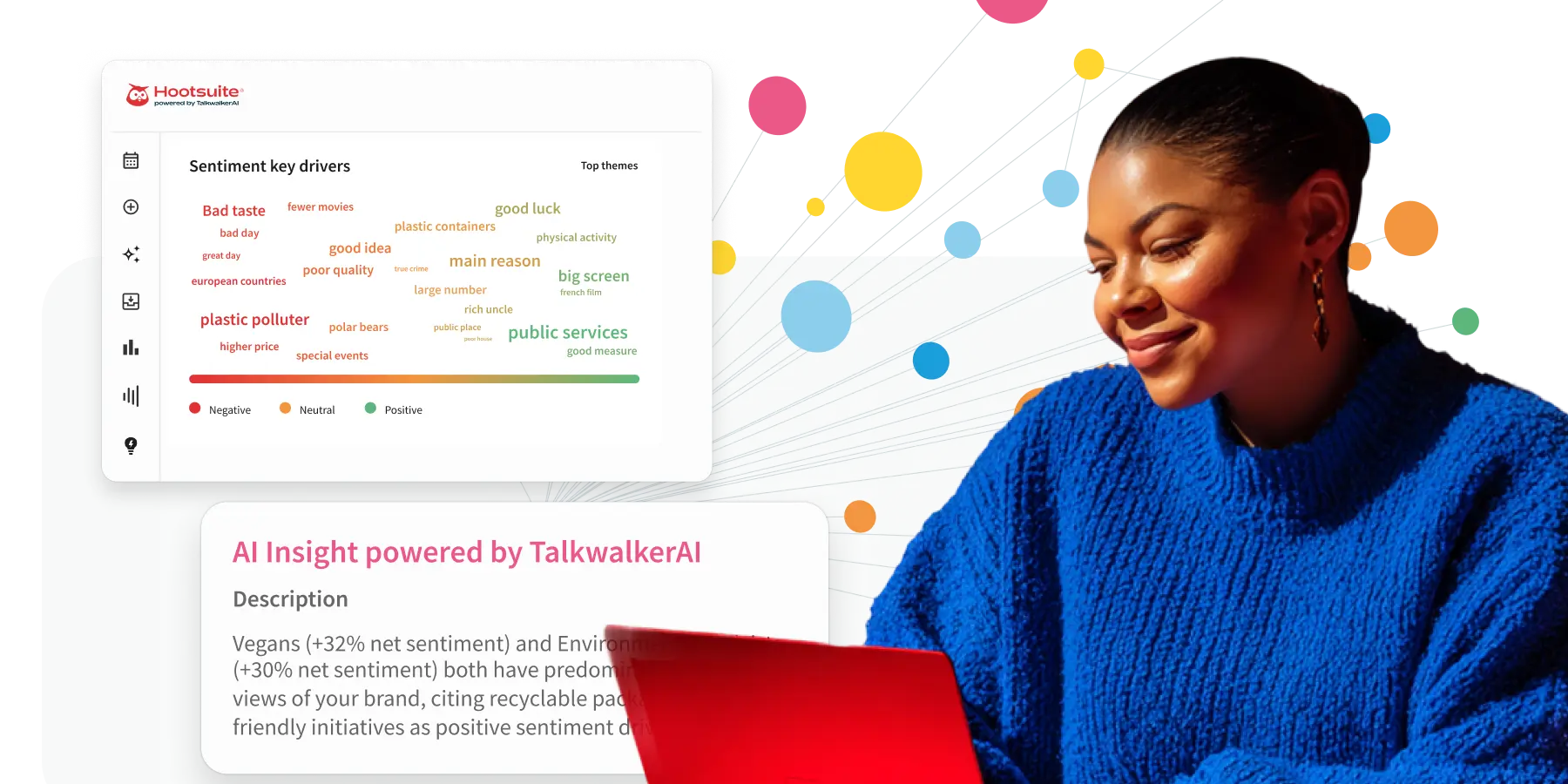
Request a demo to see how Hootsuite can help your product team discover emerging trends, validate ideas with real customer insights, and bring better products to market faster.
Google Analytics: Best for website and traffic analytics

Google Analytics is an analytics platform that shows how people find your site and what they do once they arrive. It’s especially useful for marketers who want to connect campaigns with website behavior, whether that means seeing which channels send the most traffic or which visitors actually convert.
Favorite features:
- Acquisition reports: See which channels, campaigns, and sources are actually sending people to your site.
- Event tracking: Measure actions like purchases, sign-ups, downloads, and other behaviors that matter.
- Explorations: Dig into funnels and user journeys when the standard reports don’t quite answer the question.
Cost: Free
Focus and time management
Todoist: Best for lightweight task management

Todoist is a task and project management tool for organizing to-do lists, deadlines, and priorities. It’s a good fit for solo marketers who want something simple, but it can also scale to smaller teams.
Favorite features:
- Ramble: Talk through what’s on your mind, and Todoist turns your thoughts into tasks.
- Daily digests: Get a morning email with your top tasks for the day.
- Board views: Organize work visually with Kanban boards.
Cost: Free. Paid plans start at $5 per month, billed annually.
RescueTime: Best for understanding where your workday goes

RescueTime is a time-tracking tool that runs in the background and automatically shows where you spend your day. It’s useful if your problem isn’t remembering what to do, but figuring out why a supposedly quiet morning vanished into email, meetings, and 17 random tabs.
Favorite features:
- Automatic time tracker: See where your time goes without manually starting and stopping a timer.
- Website and app blocking: Block distracting sites when you need to focus.
- Productivity insights: See when you’re most productive, then adjust your schedule around those hours.
Cost: Solo plans start at $7 per month, billed annually. Team plans start at $10 per month, billed annually.
How do you build a lean tool stack instead of tool sprawl?
The best way to avoid tool sprawl is to be selective about what gets added in the first place, and honest about what’s no longer pulling its weight.
Here are our top tips:
Map your workflow first
Before you shop for another tool, look at how the work actually gets done.
Take a typical social post. How does it move from idea to draft, through approvals, onto the feed, and into a report?
Once you can see the whole path, the weak spots become pretty obvious. You can tell where a tool might genuinely save time, and where it would just add another step.
Set rules for adding new tools
Most stacks grow because nobody said no. A few simple rules can help keep that from happening.
For example, Allison Flood, Marketing Team Leader at GPI, runs every new tool through the same check: “Before we add something new, I want to know what problem it solves, who will actually use it, and whether it simplifies the process for the team.”
Those questions are a good filter. If the problem is too vague, or only one person will actually use the tool, it gets harder to justify.
Consolidate where you can
Every extra tool comes with another login, another tab, and another stream of notifications. Consolidating cuts down on all three.
Sometimes that means letting go of a tool you like. Mark Mashaw, VP of Marketing at Campus, did exactly that:
“We cut a creative performance tool we actually liked because our paid social platforms, with a little AI on top, could recreate what it did. If tools you already pay for can do the job, the standalone tool gets hard to justify,” he shares.
Make sure everything connects
Even a great tool can become a headache if it lives on an island.
If you’re constantly exporting CSVs or copying numbers between dashboards, that work adds up fast. Look for tools that connect with the other tools in your stack, so information can move freely between them.
What mistakes lead to tool overload on marketing teams?
The biggest mistakes usually happen after a tool is added to the stack. Teams create workarounds, nobody takes responsibility for whether the tool is still useful, and training falls by the wayside.
Here are the top mistakes to look out for:
Ignoring shadow work
When a tool doesn’t fit how your team works, they don’t stage an intervention. They just quietly work around it.
Someone manages a spreadsheet on the side. Approvals drift into Slack DMs. This is called shadow work, and it’s a sign that something in the stack isn’t working.
Flood’s team ran into this with campaign tracking: “My team used to maintain a separate spreadsheet to track campaigns, even though much of the same information was also being entered into our CRM.”
“Once we realized we were maintaining two tools for essentially the same purpose, we consolidated the process into one system. If a tool is creating more work than it’s eliminating, it’s probably time to rethink it,” she observes.
Not assigning an owner
Tools have a funny way of sticking around when nobody is responsible for deciding whether they still deserve to.
Give every major platform an owner who keeps an eye on cost, adoption, data quality, and renewal. Otherwise, a tool can quietly survive for years because everyone assumes someone else is using it.
Underestimating the learning curve
Teams can spend weeks comparing tools and almost no time thinking about what happens after the contract is signed.
If you’re investing in a new platform, make room for training too. Otherwise, you can end up paying for a lot of capability your team never gets around to using.
How does Hootsuite help marketing teams stay productive?
Hootsuite brings the core parts of social media work into one place, so your team spends less time switching between tools and more time on the work itself.
Plan and publish everything from one calendar with Perch

Perch is Hootsuite’s content planning and publishing app. It gives your team one place to plan posts, manage approvals, create content, and schedule everything across your social accounts.
With Perch, you can:
- See everything from one calendar: Drag and drop posts to reschedule them, spot gaps, and see what’s coming up across your channels.
- Keep approvals in one place: Route posts to the right people automatically, so feedback doesn’t get lost in Slack threads or email chains.
- Schedule in bulk: Queue up to 350 posts at once, or pause scheduled content in a few clicks if your plans change.
- Post at the right time: Get recommended posting times based on your audience, then schedule content to go live in those windows.
The big win is that you can move from idea to approved, scheduled post without bouncing between a bunch of different tools.
Ask Wisdom instead of switching tabs

If you’ve ever opened three reports just to answer one simple question, Wisdom is built for that.
Wisdom is Hootsuite’s social-first AI agent. Want to know how a campaign did or which posts are pulling their weight? Ask in plain language, and Wisdom finds the answer for you from your real social data.
Handle inbox and comments without leaving the platform with Nest

Nest is Hootsuite’s social customer care app. It brings those conversations into one inbox, so your team can see what needs attention, route messages to the right person, and keep track of what’s already been resolved.
And because it lives in the same platform as your content and analytics, your team doesn’t need yet another tool just to keep up with replies.
FAQ: Productivity tools for marketers
What are the best productivity tools for a small marketing team?
From there, you can add more specialized productivity apps as you grow. That might mean Notion, Asana, or Trello for project management, Hootsuite for social media, or Dropbox for extra file storage. Many of these tools offer free or lower-cost plans, so you can start simple and upgrade when your workflow gets more complex.
What productivity tools do social media managers use?
Many teams also lean on an AI assistant, like ChatGPT, to brainstorm ideas and draft content. And Loom is handy for recording a quick video walkthrough instead of booking yet another meeting.
What types of productivity tools are there?
For example, Notion and Todoist help teams manage projects and tasks, while calendar apps help with scheduling and time blocking. Other useful categories include digital whiteboards, timesheets (like Clockify), and note-taking apps.
What integrations should I look for in productivity tools?
How does Hootsuite help marketing teams stay productive?
Do more social work with fewer tools using Hootsuite. Use Perch to plan, approve, schedule, and publish content, Wisdom to get answers from your social data, and Nest to manage customer conversations — all from one connected platform. Try Hootsuite free today.