Table of Contents
If your paid team and your social team have never met, you probably have a silo problem.
Silos have a way of turning one marketing department into a bunch of separate little worlds. This guide breaks down why they form, what they cost, and how to bring teams together.
Key takeaways
- Marketing silos come with a real cost. They make it harder to share plans, data, and ideas.
- Not every silo needs to disappear. Some boundaries are useful, as long as they don’t get in the way of shared work.
- Good teams stay connected on purpose. Shared calendars, clear handoffs, and regular check-ins keep information flowing.
- Hootsuite keeps teams on the same page. Perch brings planning and approvals into one place, while Lumen helps audience insights move beyond the social team.
What are marketing silos?
Marketing silos are barriers between teams that make it hard to share information, ideas, and plans.
Sometimes the separation is obvious: paid media has one plan, social has another, and neither knows what the other is doing.
Other times, the silo is less visible. Customer support is sitting on a goldmine of audience feedback, for example, but none of those insights ever make it to the content team.
Do it better with Hootsuite, the all-in-one social media tool. Stay on top of things, grow, and beat the competition.
Common types of marketing silos
Marketing silos can form around teams, channels, tools, or even different stages of the customer journey. Here are the most common types:
| Marketing silo | What it looks like | What can go wrong |
| Paid media | Paid campaigns are planned separately from organic, content, or brand activity | Teams compete for attention, messaging gets out of sync, and winning creative insights stay trapped in ad accounts |
| Organic social media | Social runs its own calendar without much visibility into bigger campaigns | Posts feel disconnected from what the rest of the brand is doing |
| Content marketing | Blog, SEO, email, and social teams plan content separately | The same topics get recreated several times, while better opportunities slip through the cracks |
| Customer service | Support teams hear customer questions and complaints that marketing never sees | Marketers miss useful language, pain points, and FAQs |
| Data and analytics | Each team tracks performance in its own platform or dashboard | Nobody has a complete view of the customer journey, and teams can end up arguing over whose numbers are “right” |
Why do marketing silos form?
Marketing silos happen when specialization turns into separation. Teams have different goals, tools, reporting lines, or processes that make collaboration harder.
Several factors can push teams in that direction:
- The org chart creates natural boundaries. In larger companies, marketing is often split by product, region, business unit, or channel. Those divisions make sense, but they can make collaboration harder.
- Teams optimize for different goals. Social may care about engagement while paid is focused on conversions. When each team is measured differently, it’s easy to focus inward.
- Tools and data live in separate places. One team has the CRM data, another owns campaign performance. Useful context gets trapped in different tools.
- Ownership gets blurry. If nobody is responsible for sharing insights across teams, it often just doesn’t happen.
- Fast growth creates gaps. As companies add channels and markets, coordination doesn’t always scale at the same rate.
- Processes become team-specific. Different approval flows, calendars, and planning cycles can make collaboration feel harder than staying in your own lane.
In short, silos form when teams become so separate that useful information and decisions stop moving between them.
How do marketing silos hurt a business?
Marketing silos make it harder for teams to build on each other’s work. The result is usually more wasted effort, slower decisions, and a customer experience that feels disjointed.
Here’s what to look out for:
Lost opportunities
Silos can quietly cap what your marketing is capable of. When teams work separately, good ideas and insights don’t get the chance to build on each other.
“As a CMO, the biggest problem I see when teams operate in silos is the opportunity cost,” says Andrea Linehan, Chief Marketing Officer at Supermetrics.
The real magic in marketing comes from orchestrating motions so they compound each other. Teams that operate in chorus can produce incredible results that no single marketing team could pull off alone.
Inconsistent messaging
When teams plan separately, your brand ends up telling different stories depending on where a customer happens to meet it.
An ad might lead with affordability while the website is pushing premium quality. Your sales team may be talking about one use case while social is building the brand around another.
None of those brand messages are wrong on their own. The problem is that, together, they leave customers wondering what your company is actually trying to say.
Duplicate work
Silos make it surprisingly easy for two teams to solve the same problem twice.
Maybe paid and content both research the same audience. The work still gets done, but time and budget get spent twice.
That kind of duplication is especially easy to miss in larger organizations, where teams may not have much visibility into what everyone else is working on.
Contradictory numbers
Marketing silos can make it hard for teams to agree on what the numbers are actually saying.
Paid says your website had 30,000 sessions last week. Organic says 26,000. Instead of deciding what to do next, everyone ends up debating whose numbers are right.
This isn’t a data problem. It’s that teams are working from different tools and dashboards without a way to reconcile them.
A bumpy customer experience
When teams work in silos, the customer journey can start to feel stitched together.
For example, a customer might read a highly technical article, sign up for more information, and immediately get a nurture sequence written for a completely different buyer.
“Customers don’t experience our org chart, but they do trip over the cracks and gaps it creates in their experience, and that’s an inevitable byproduct of marketing silos,” says Linehan.
Should you break down silos completely, or build better bridges?
You don’t need to tear down every boundary between marketing teams. Some boundaries get in the way, while others give specialists the focus and autonomy they need.
The question is whether that separation is helping people focus or blocking the flow of work.
Break down silos when the work is truly shared
If two teams are working toward the same goal, using the same data, or constantly stepping on each other’s work, it makes sense to bring them closer together. That could mean shared workflows or clearer ownership.
The test is pretty simple: If the boundary keeps slowing decisions or creating unnecessary work, it may not be doing much for you.
Build bridges when specialization matters
Other boundaries are worth keeping.
“Some separation is necessary for highly specialized teams,” says Christina Minshull, CEO of The Brand Audit. Social is one example. The work depends on a deep understanding of platform algorithms, cultural timing, creator ecosystems, and more.
That expertise needs room to operate, but Minshull is careful to draw a line between autonomy and isolation.
Leading teams across various industries, I’ve seen how specialist teams need the autonomy to do their jobs properly. But they cannot operate as separate mini-businesses. There needs to be a connective center of gravity.
That connective center can be as simple as shared goals, clear handoffs, and regular check-ins to compare notes.
How do you fix marketing silos?
You fix marketing silos by giving teams enough shared context and structure to stay connected when their work overlaps. Start with these seven moves:
- Create shared goals and metrics across teams
- Put every team on one shared calendar
- Build bridge roles with real accountability
- Create a few deliberate connection points
- Bring approvals into one workflow
- Make social insights travel
- Establish a feedback loop
Create shared goals and metrics across teams
Anchor each team to the same goal, even if they measure success differently.
If paid is rewarded for conversions while social is chasing engagement, each team can “win” while marketing collectively loses. Channel KPIs still matter, but they should ladder up to a goal everyone recognizes.
That also makes tradeoffs easier. When priorities compete, teams have a shared way to decide what matters most.
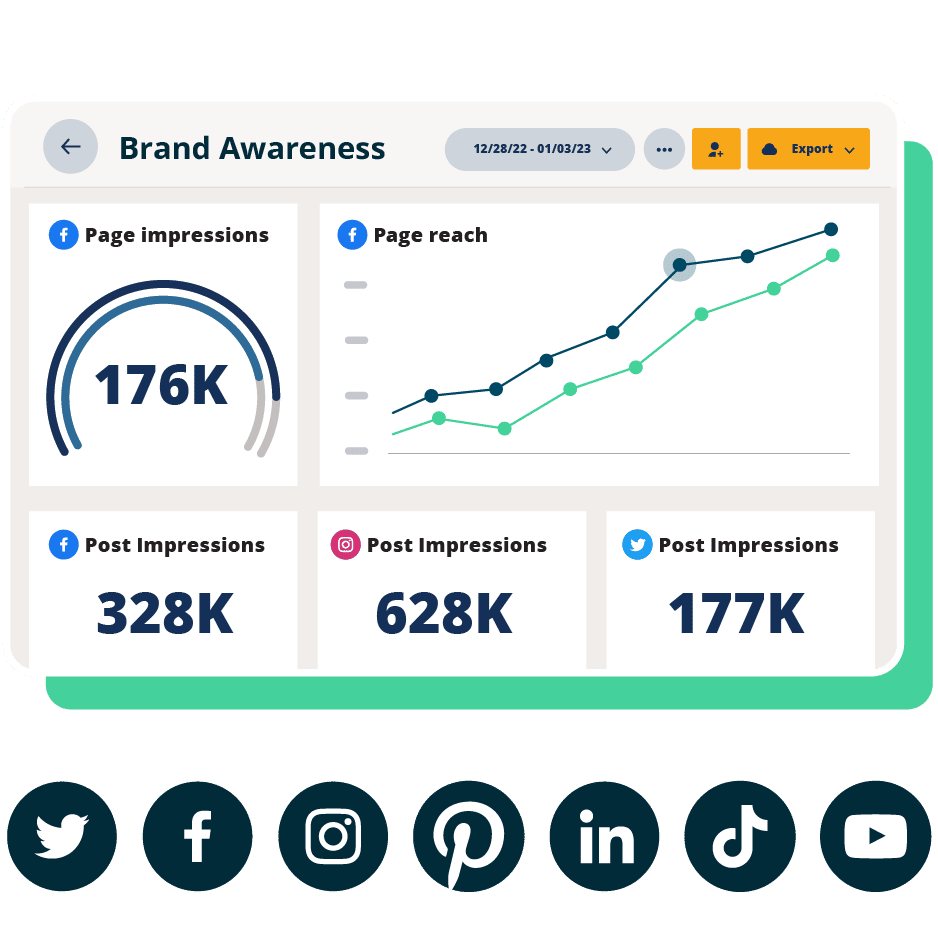
Beautiful reports. Clear data. Actionable insights to help you grow faster.
Start your free trialPut every team on one shared calendar
Give teams one place to see what’s happening across marketing, including campaigns, launches, content, and other key moments.
That visibility alone can prevent a lot of avoidable disconnects. Social can see when paid is launching a campaign. PR knows when a product announcement is coming. And customer support isn’t surprised when customers ask about a new promotion that dropped on social that morning.

A tool like Perch gives teams a bird’s-eye view into every post, every network, and every campaign on one calendar.
Build “bridge” roles with real accountability
When a project spans several teams, make one person responsible for keeping the pieces connected.
They don’t need to own every decision. They just need enough visibility to catch the gaps, follow up on missing handoffs, and make sure nobody is working with stale information.
Create a few deliberate connection points
Chances are, nobody needs another weekly meeting.
Instead, bring teams together when coordination is actually useful: campaign kickoffs, before something big launches, or once the results are in and it’s time to debrief.
Bring approvals into one workflow
Approvals become their own silo when feedback is spread across Slack, email, and random Google Docs.
Move reviews into one shared workflow so everyone can see what’s waiting and who needs to act next. With a tool like Perch, teams can route social content through custom approval workflows in the same place they plan and publish it.

Make social insights travel
Social teams have a front-row seat to what customers are saying. And with social listening, they can also spot the bigger patterns behind those reactions.
Make those insights travel outside the social team.
If customers keep using the same phrase to describe a problem, that could shape campaign messaging. If one feature suddenly becomes the thing everyone is talking about, product marketing wants to know.
The point is to get those observations out of the social dashboard and into the rooms where decisions happen.

Establish a feedback loop
Make it easy for one team’s lesson to become another team’s advantage.
Create one place for useful learnings to live, then build sharing them into the normal rhythm of the work. Otherwise, teams end up paying to learn the same lesson twice.
What does a marketing team without silos look like in practice?
A silo-free marketing team still has specialists, separate channels, and different KPIs. The difference is that those teams stay connected through shared goals and better visibility into each other’s work.
Here’s what that looks like in practice:
- Everyone works toward the same business goals. Their own channel numbers still matter, but they’re not the whole point.
- Customers get one coherent brand experience. Several teams may be behind it, but the handoffs are seamless.
- Insights move freely. A useful insight from social can influence product marketing, creative, paid, or content (and vice versa).
- Specialists stay specialized. They own their area, but they stay connected to the people and decisions around them.
- Handoffs are clear. People know what they need, who they need it from, and when.
- Teams come together at the moments that matter. They don’t sit through meetings for the sake of it.
- Learnings get shared. When one team figures something out, another team gets to build on it.
How does Hootsuite help teams break down silos?
Hootsuite helps reduce marketing silos by giving teams shared visibility into content, approvals, and audience insights. Perch connects the planning side, while Lumen connects the intelligence side.
Plan and approve content across teams with Perch

Perch helps teams plan, create, approve, schedule, and publish content from one shared workflow. That’s especially handy when social touches multiple teams, like brand, comms, legal, product, and regional teams.
Plus, with built-in approval workflows, feedback stays attached to the content itself. Nobody has to dig through an old Slack thread to figure out whether the latest version was actually approved.
Share real-time insights across departments with Lumen

Lumen helps social intelligence travel further than the social team.
It monitors conversations across 150+ million sources and 30+ social channels, giving teams a live read on things like brand mentions, sentiment, and competitor activity. More importantly, those insights can be shared with the teams who need them.
For example, comms can use Lumen to spot reputation risks, product teams can track recurring feedback, customer success can track common complaints, and marketing can see how brand perception is shifting in real time.
FAQ: Marketing silos
What is a marketing silo?
What causes marketing silos?
Is it better to break down silos or build bridges between them?
Does organizational structure create silos?
How does Hootsuite help teams break down silos?
Keep your marketing teams connected with Hootsuite. Use Perch to plan, approve, schedule, and publish content from one shared workflow, and Lumen to share real-time audience insights across the teams that need them. Try Hootsuite free today.