Table of Contents
Key takeaways
- Social media competitor analysis tools help teams benchmark performance, track competitor content, and uncover strategic gaps across platforms.
- The best options for 2026 include Hootsuite, Brandwatch, Sprinklr, SEMrush, and BuzzSumo, each suited to different team sizes and needs.
- Key metrics to track include engagement rate, follower growth, posting frequency, share of voice, and content performance by format.
- Perch by Hootsuite combines competitor tracking, industry benchmarking, and social listening in one connected workflow alongside Lumen and Wisdom.
Social media competitor analysis is the practice of tracking and evaluating how other brands in your category perform on social, then using that context to shape your own strategy. It’s less about spying and more about establishing a baseline: what’s normal in your industry, what’s working, and where you have room to move.
It differs from broader market research in scope. Market research looks at customers, category demand, and buying behaviour. A social media competitor analysis stays focused on the channels themselves: the content competitors publish, how audiences respond, and how your numbers stack up in comparison.
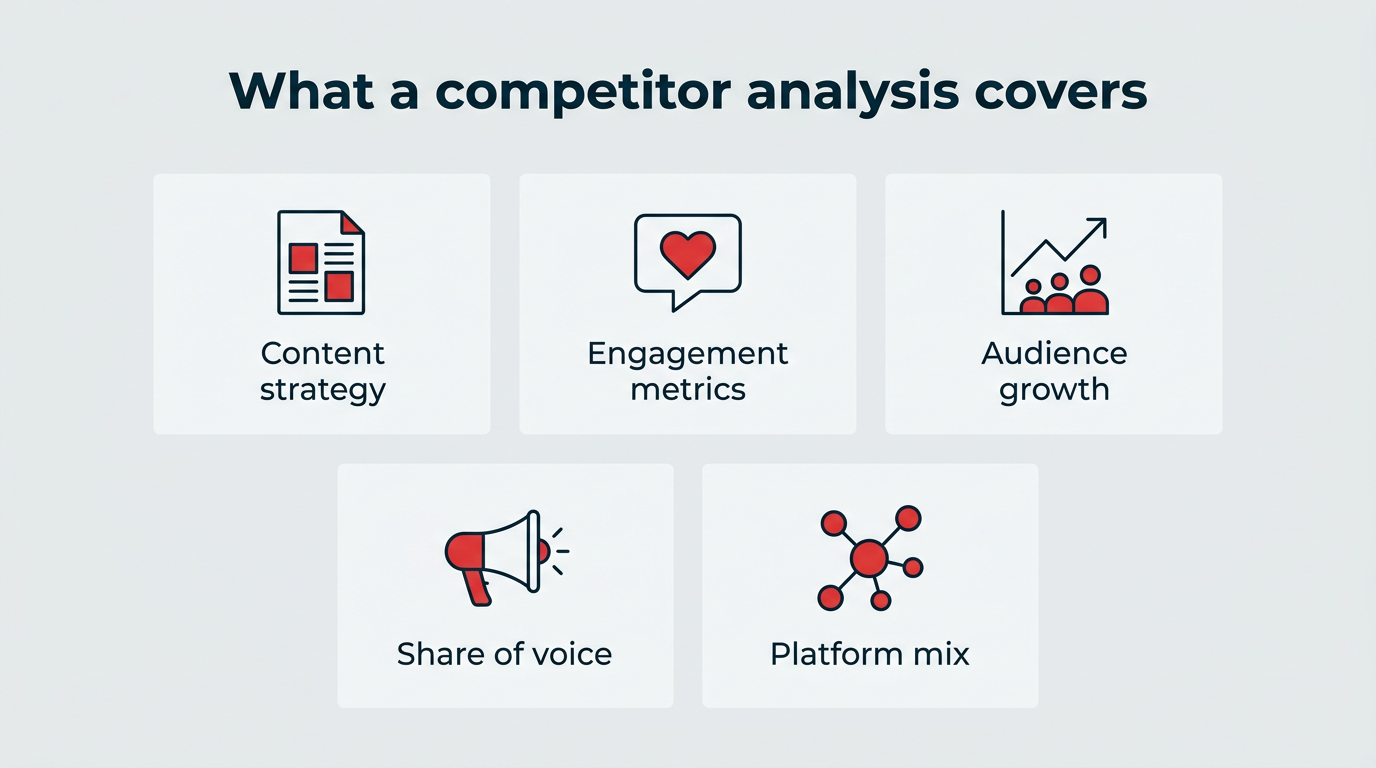
A typical analysis covers:
- Content strategy: Formats, themes, posting cadence, and campaign patterns
- Engagement metrics: Engagement rate, comments, shares, and saves
- Audience growth: Follower counts and growth rate over time
- Share of voice: How much of the category conversation belongs to each brand
- Platform mix: Which networks competitors prioritize, and how performance varies between them
Why does social media competitor analysis matter in 2026?
Competitor data gives your own numbers meaning. A 2% engagement rate looks very different depending on whether the category average is 0.8% or 4%, and without that comparison it’s hard to say whether a dip reflects your content or a shift across the whole industry.
For marketing leaders, that context is also how you defend decisions. With $338.75 billion in global social ad spend projected for 2026, showing where you sit against industry benchmarks makes budget conversations easier and goal-setting stops being guesswork.
The pace of change adds another reason to keep watching. Formats, algorithms, and AI-generated content are reshaping feeds quickly, and with social media time spent peaking in 2026, competitor activity is often the earliest signal that something in your category has moved.
How to choose the right competitor analysis tool
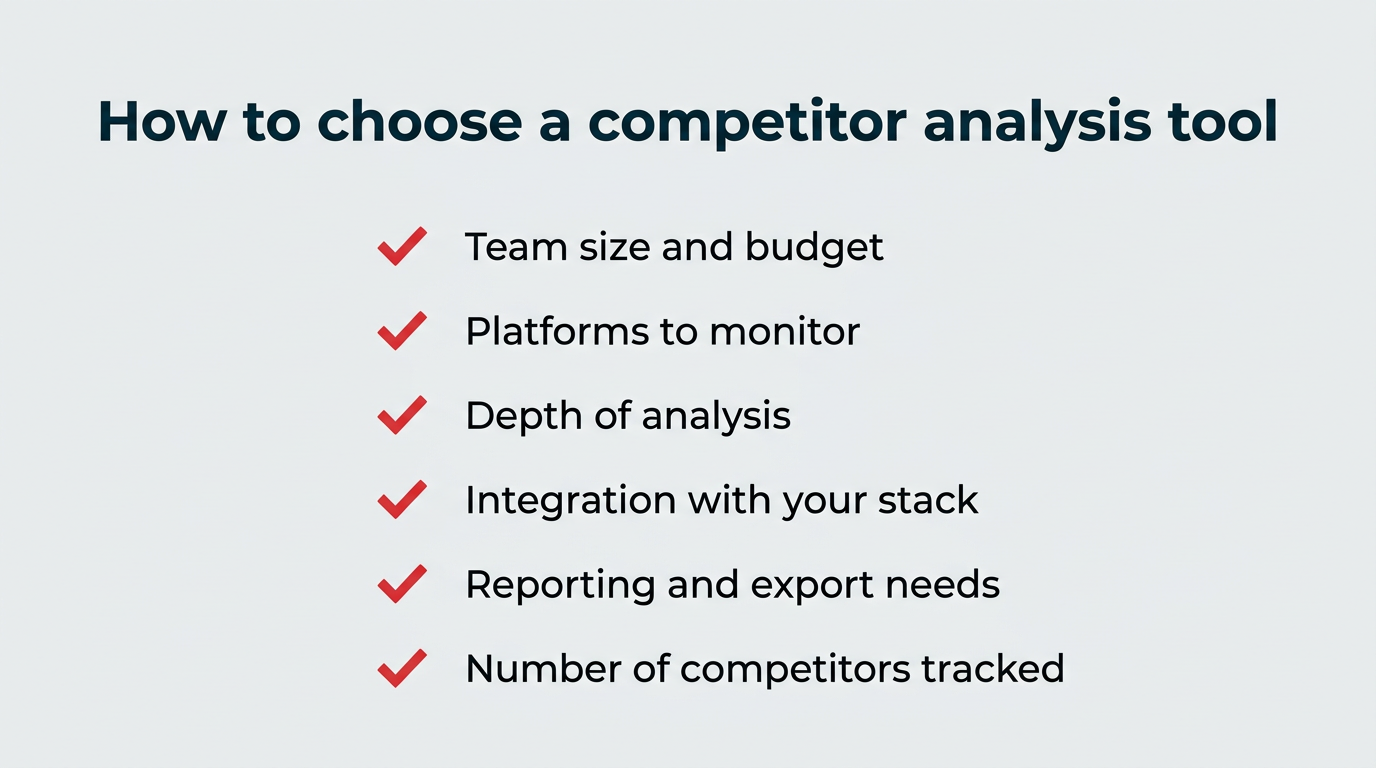
The right tool depends less on feature count and more on fit. Before you work through the list below, it helps to narrow the field against a few practical criteria.
- Team size and budget: Free tools handle basic tracking for one or two people. Enterprise platforms make sense when multiple teams need shared reporting and governed access. Compare what’s included at each tier on the Hootsuite pricing page.
- Platforms you need to monitor: Coverage varies a lot. Plenty of tools handle Facebook, Instagram, and X well but skip TikTok or LinkedIn entirely.
- Depth of analysis: Decide whether you need surface-level benchmarking or deeper social listening with sentiment and theme analysis.
- Integration with your existing stack: A tool that lives beside your publishing and reporting workflow gets used. A separate login usually doesn’t.
- Reporting and export needs: If you present to leadership, check for customizable reports, scheduled exports, and white-label options.
- Number of competitors tracked: Some tools cap watchlists at three to five accounts, which gets limiting fast in crowded categories.
Here’s a quick look at the top social media competitor analysis tools and what each does best. Pricing reflects publicly listed starting rates and can change by region and contract.
Tool | Best for | Platforms supported | Starting price | Who it’s for |
|---|---|---|---|---|
Full social media management, competitor analysis, and industry benchmarking | Facebook, Instagram, X, LinkedIn, TikTok, Bluesky | $99/user/month | Mid-market to enterprise teams | |
Consumer intelligence and share of voice analysis | X, Instagram, Facebook, Reddit, blogs, forums | Contact for pricing | Enterprises | |
Deep competitor insights and sentiment tracking | Facebook, Instagram, X, YouTube | Contact for pricing | Enterprises | |
Combining SEO and social competitor insights | Facebook, Instagram, X, LinkedIn | $139.95/month (Pro, billed monthly) | Integrated marketing teams | |
Advanced analytics, reporting, and competitor benchmarking | Facebook, Instagram, X (competitor analysis features) | $199/seat/month (Standard) | Agencies, growing teams | |
Analyzing top-performing content and trends | Facebook (primary) + web | $199/month | Content-focused teams, agencies | |
Hashtag and keyword tracking | X, Instagram, Facebook, YouTube, web | Contact for pricing | Campaign and influencer teams | |
Brand monitoring and sentiment analysis | X, Instagram, Facebook, YouTube, Pinterest, web | Contact for pricing | Small to mid-sized teams | |
Quick engagement comparisons across channels | Instagram, YouTube, X, Twitch | Free tools available | Creators, solo marketers | |
Instagram-led benchmarking, plus multi-network scheduling | Instagram, plus additional networks through Later’s social media management and competitive benchmarking features | Plans listed publicly on Later’s pricing page | Creators, small businesses | |
Free, high-level tracking of performance | YouTube, Instagram, TikTok, Twitch, Facebook | Free | Creators, small businesses | |
Understanding social traffic in the full journey | Facebook, Instagram, YouTube, web | Contact for pricing | Analytics and growth teams |
Each entry below covers what the tool does, who it suits, which platforms it supports, and where it falls short.
1. Perch by Hootsuite
Perch is a content planning, publishing, and analytics tool. It helps teams manage their social content workflow from one place, including scheduling, reporting, and performance analysis across major social networks.
Because Perch sits inside Hootsuite Social OS, competitor data stays connected to the rest of your workflow. Lumen, the integrated insights and listening app, extends that view into wider conversations, and Wisdom lets you ask questions about your data in plain language instead of building a report from scratch.
Best for: Mid-sized to enterprise teams that need a full social media management and competitor analysis solution
Platforms: Facebook, Instagram, X, LinkedIn, TikTok, Bluesky (varies by feature)
Pricing: Starts at $99/user/month on the Standard plan
Key limitation: Competitor analysis reporting covers X, Facebook, and Instagram, so pure TikTok-first teams will lean more on industry benchmarking.
Competitor analysis
In Perch, build your competitor watchlist by adding up to 20 hand-picked competitive accounts. (The number you can add varies depending on your Hootsuite plan — see the Hootsuite plans page for what’s included at each tier.)

Then, generate a competitive benchmarking report that includes the following social media metrics for every competitor:
- Number of posts published
- Posting frequency
- Average engagement rate
- Number of fans or followers
- Audience growth rate
- Estimated total engagement
You can also dive into even deeper insights, including:
- Content performance: Take a look at the top and lowest-performing posts based on your chosen metric.
- Performance by content type: How different formats perform based on your chosen metric.
- Trending hashtags: A word cloud of the most-used hashtags from your competitors’ top posts based on your chosen metric.
- Post length: Average character count and number of hashtags in your competitors’ posts.
Competitor analysis is available for X (formerly Twitter), Facebook, and Instagram.
Industry benchmarking
Perch’s industry benchmarking tool is especially useful if you’re not sure yet who your top competitors are. Just choose your industry, and this social media management tool does the rest.

It benchmarks results against industry averages, tracks trends over time, and provides recommendations to improve strategy.
Industry benchmarking is available for Facebook, Instagram, X, LinkedIn, and TikTok.
Social listening
Perch helps you spot competitor mentions, trending topics, and conversations your audience cares about.

Within Perch, use Quick Search to analyze things like:
- Results. See popular posts related to your search terms, then filter by channel, sentiment signals, and more.
- Key metrics. Are more people talking about you this week? What’s the vibe of their posts? Perch doesn’t just track what people are saying. It uses enhanced sentiment analysis to tell you how they really feel.
- Top themes. How are people talking about you? What are the most popular positive and negative posts about? Which other conversations are you showing up in?
Learn more about how to use social listening for business.
Meet the Suite
Understand what matters, decide what to do next, and take action across every social workflow — all from one connected suite.

2. Brandwatch

Source: Brandwatch
Brandwatch is a consumer intelligence tool that offers powerful competitive analysis features. See how Brandwatch compares with Hootsuite. One of the most useful is its easy-to-understand visualization of your brand’s social share of voice.
Share of voice is a measure of how much people talk about your brand online compared to how much they talk about your competitors. This is one of the metrics you should track in your social media competitive analysis template.
Best for: Deep consumer insights and share of voice analysis
Platforms: X, Instagram, Facebook, Reddit, blogs, and forums
Pricing: Contact for pricing
Key limitation: Built for enterprise research teams, so it can be more platform than smaller teams need.
3. Sprinklr
Source: Sprinklr
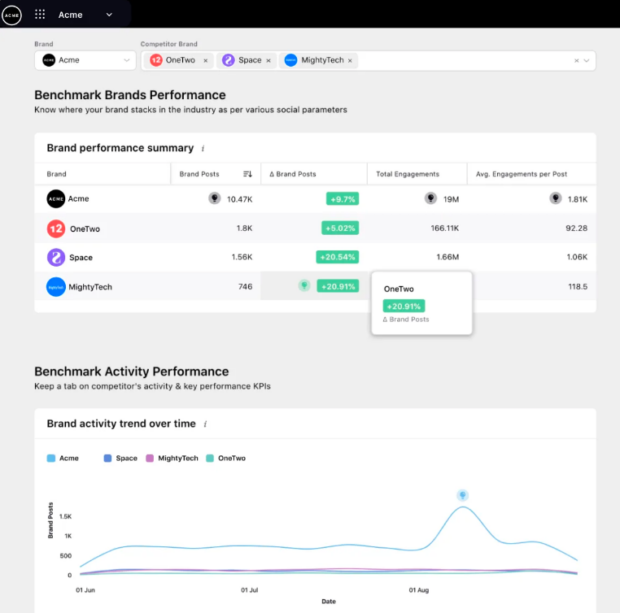
Sprinklr provides competitor analysis across platforms like Facebook, X, Instagram, and YouTube. It analyzes competitor content, themes, post categories, and sentiment. However, it doesn’t support LinkedIn or TikTok.
Sprinklr is an enterprise-level solution, and pricing reflects that. See how Sprinklr compares with Hootsuite.
Best for: Large teams that need multi-platform insights
Platforms: Facebook, Instagram, X, and YouTube
Pricing: Contact for pricing
Key limitation: No LinkedIn or TikTok competitor coverage, and setup typically requires implementation support.
4. SEMrush
Source: SEMrush
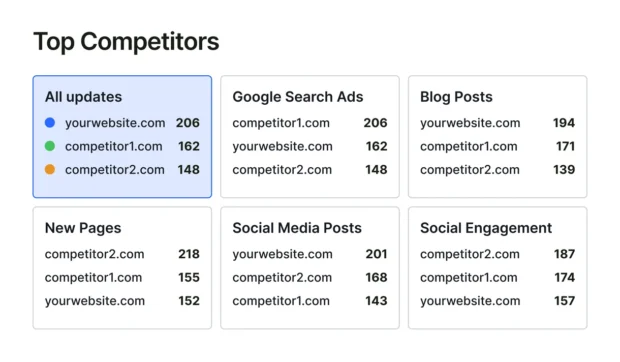
SEMrush is more widely known for its SEO and digital marketing capabilities, but it also packs a serious punch when it comes to social competitor analysis.
The platform lets you track and compare your competitors’ social media performance across Facebook, Instagram, X, and LinkedIn.
What makes SEMrush stand out is its deep data analysis and reporting features. The downside? Due to its expansive range of features, it can be a bit overwhelming for beginners.
Best for: Teams that want to combine SEO and social insights
Platforms: Facebook, Instagram, X, and LinkedIn
Pricing: Starts at $139.95/month on the Pro plan (billed monthly)
Key limitation: Social features are secondary to SEO, so the learning curve is steep if social is your only use case.
5. Sprout Social
Source: Sprout Social
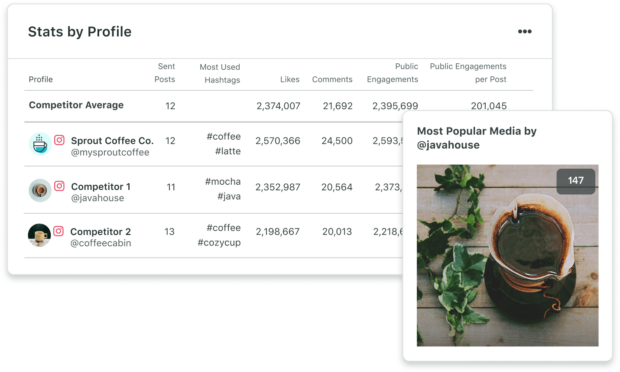
Sprout Social offers a suite of competitor analysis tools, helping you benchmark and compare your performance as part of your reporting workflow. It also includes social listening to identify top keywords and hashtags.
The analytics are strong, but it lacks some of the customization options savvy social marketers may look for. See how Sprout Social compares to Hootsuite.
Best for: Mid-sized to large teams focused on analytics and reporting
Platforms: Facebook, Instagram, and X for competitor analysis reports (the wider platform supports more networks)
Pricing: Starts at $199/seat/month on the Standard plan
Key limitation: Limited report customization and per-seat pricing that adds up quickly for larger teams.
6. BuzzSumo
Source: BuzzSumo
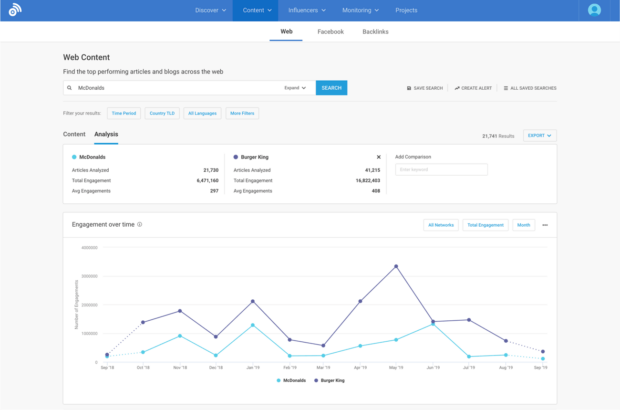
BuzzSumo is a content marketing tool with competitor analysis features.
It tracks key competitor metrics across the web, with a particular focus on Facebook for social insights. You can analyze engagement based on post type, post length, and time published.
You can also find the top shared content across social networks using keyword searches, along with a breakdown of the most popular platforms in your niche.
Overall, BuzzSumo provides the most value if your social media strategy is primarily focused on Facebook.
Best for: Content-focused teams, especially those on Facebook
Platforms: Facebook (primary) and web-wide content
Pricing: Starts at $199/month
Key limitation: Thin coverage outside Facebook, so it works better alongside a social-first tool than on its own.
7. Keyhole
Source: Keyhole.co
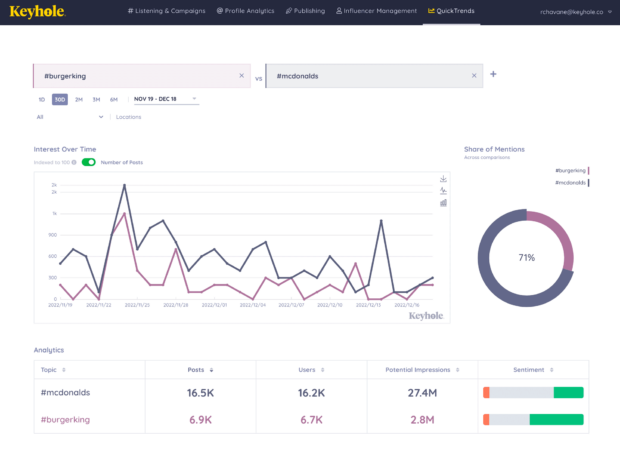
Keyhole is a social media competitive analysis tool that allows you to do some free competitor keyword and hashtag research. You can use the search bar to see which platforms a hashtag appears on, along with the top referring sites and accounts. This is especially useful for tracking branded or campaign hashtags.
If you sign up for a paid plan, you can access more detailed competitive analytics and competitor benchmarking.
Best for: Hashtag and keyword tracking
Platforms: X, Instagram, Facebook, YouTube, and web sources
Pricing: Free search tools; contact for paid plan pricing
Key limitation: Strongest on hashtags and campaigns rather than full account-level benchmarking.
8. Mentionlytics
Source: Mentionlytics
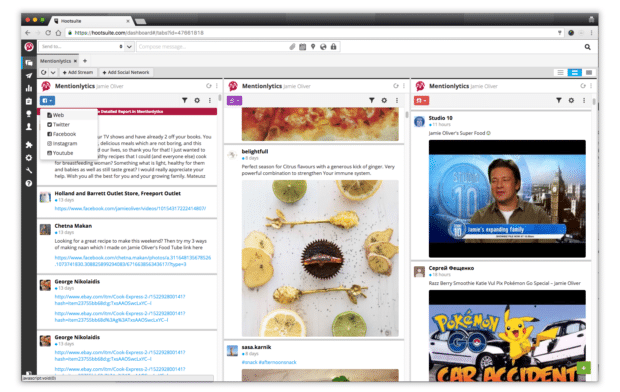
Mentionlytics is a social media monitoring tool for conducting a social media competitive analysis. It lets you track everything being said about your brand, your competitors, or any keyword across X, Instagram, Facebook, YouTube, Pinterest, and web sources like news sites and blogs.
Plus, it includes a handy sentiment analysis feature, so you can see not only what is being said, but how people feel about it.
P.S.: Mentionlytics integrates with Hootsuite so you can see everything it pulls in your Streams.
Best for: Brand monitoring and sentiment analysis
Platforms: X, Instagram, Facebook, YouTube, Pinterest, and web sources
Pricing: Plans listed publicly on Mentionlytics’ pricing page (custom Enterprise pricing available)
Key limitation: Monitoring-led rather than benchmarking-led, so competitor performance reporting is lighter than in dedicated analytics tools.
9. Phlanx
Source: Phlanx
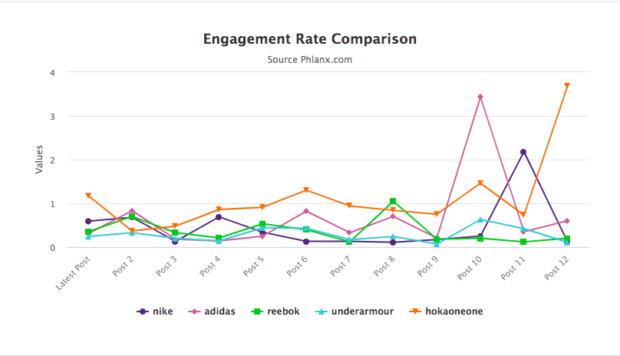
Phlanx is a social media competitor analysis tool for platforms like Instagram, YouTube, X, and Twitch. It offers a simple dashboard for tracking engagement and comparing performance.
However, its benchmarking is limited to engagement rate only, so keep this in mind if you want to analyze other social media metrics.
Best for: Quick engagement comparisons
Platforms: Instagram, YouTube, X, Twitch
Pricing: Free tools available
Key limitation: Engagement rate only, with no reporting or historical trend analysis.
10. Later
Source: Later
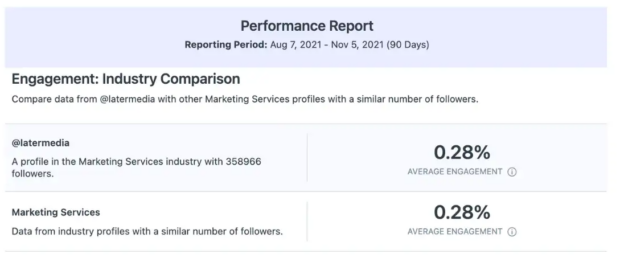
Later provides Instagram engagement rate benchmarking against industry averages for accounts with a similar following. It also offers weekly reports on top-performing industry hashtags.
Later has since expanded beyond Instagram, with social media management, scheduling, and competitive benchmarking features that cover additional networks. Its benchmarking is still strongest on Instagram, though, so check current platform support on Later’s site before you commit.
Find out more about how Later compares to Hootsuite.
Best for: Instagram-focused marketing
Platforms: Instagram, plus additional networks through Later’s social media management and competitive benchmarking features
Pricing: Plans are listed publicly on Later’s pricing page
Key limitation: Competitor benchmarking is strongest on Instagram and shallower than dedicated analytics platforms.
11. Social Blade
Source: Social Blade
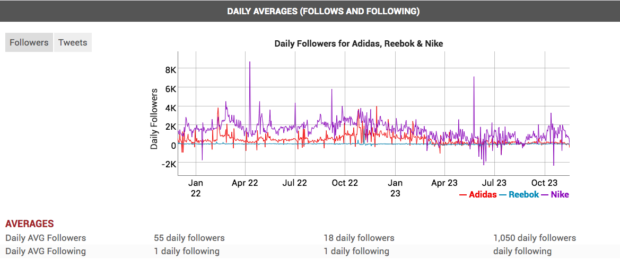
Social Blade is a free tool for comparing competitor performance on different social platforms. It tracks performance metrics like follower growth, post volume, and engagement, though the stats available vary by platform.
It also assigns competitor accounts a “grade” based on their Social Blade ranking, which looks at factors like followers and engagement rate.
Best for: Free, high-level performance tracking
Platforms: YouTube, Instagram, TikTok, Twitch, and Facebook
Pricing: Free, with paid tiers available
Key limitation: Surface-level metrics only, with no content or sentiment analysis.
12. Similarweb
Similarweb is a go-to tool for traffic analysis, but its social media capabilities shouldn’t be overlooked.
With Similarweb, you can track social media traffic trends for competitors across platforms like Facebook, Instagram, YouTube, and more.
It offers an overview of how your competitors are performing online, from social traffic sources to engagement metrics. It’s helpful if you’re aiming to understand the full customer journey and how social media fits into it.
Best for: Understanding social traffic within the full customer journey
Platforms: Facebook, Instagram, YouTube, and web sources
Pricing: Contact for pricing
Key limitation: Traffic-focused, so post-level social performance data is limited.
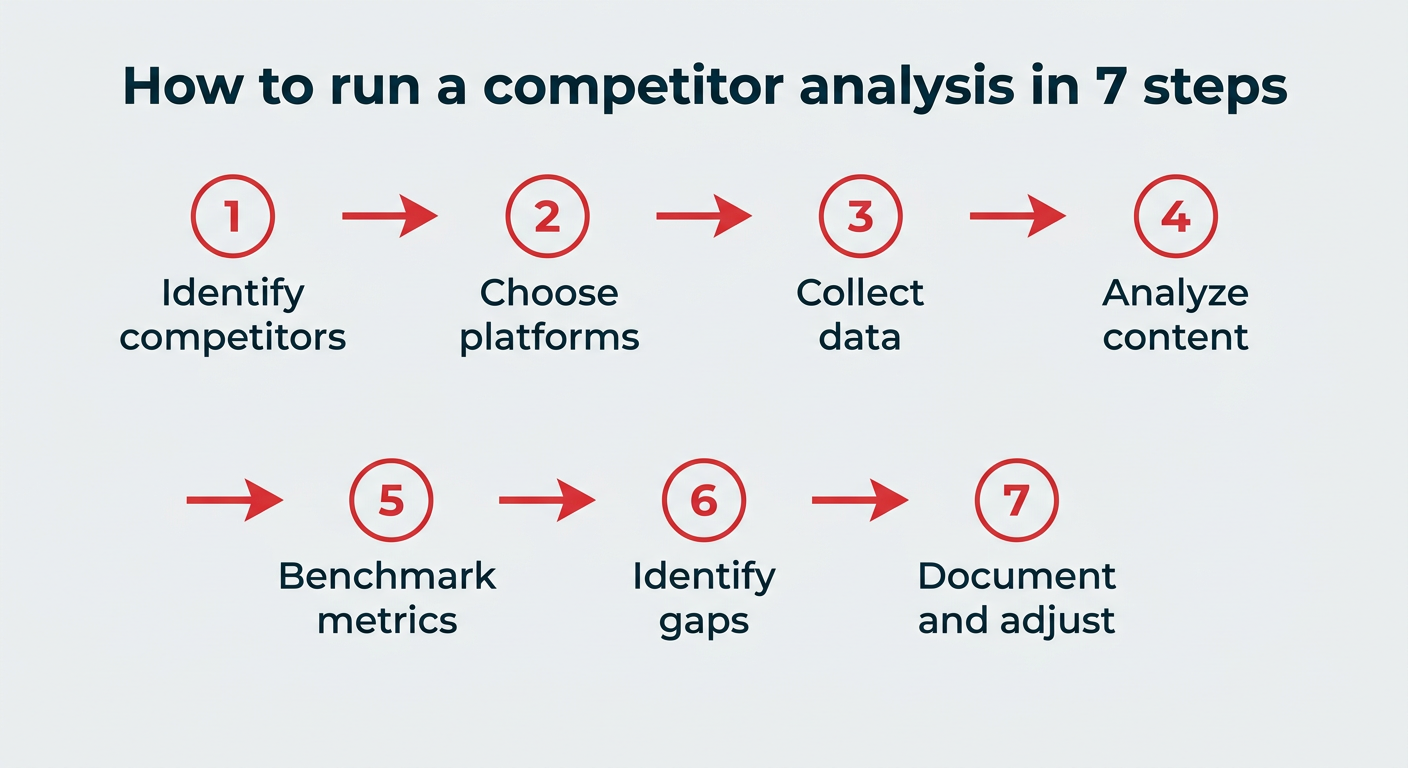
Once you’ve picked a tool, the process itself is fairly repeatable. Here’s the short version, followed by a breakdown of each step.
- Identify your competitors
- Choose which platforms to analyze
- Collect your data
- Analyze content strategy and performance
- Benchmark against your own metrics
- Identify gaps and opportunities
- Document findings and adjust your strategy
1. Identify your competitors
Start with three groups: direct competitors selling something similar, indirect competitors solving the same problem differently, and aspirational brands you’d like to compete with eventually. Five to ten accounts is usually enough to see patterns without drowning in data.
2. Choose which platforms to analyze
Focus on the networks where your audience actually spends time (84% of U.S. adults use YouTube and half use Instagram), not every platform your competitors happen to use. If you’re weighing up a new channel, social media market research can help you confirm whether the audience is there before you commit.
3. Collect your data
Set your date range, usually the last 30 to 90 days, and pull the same metrics for every account so comparisons hold up. If you’re working manually or want a place to consolidate tool exports, our free customizable competitive analysis template gives you a ready-made structure.
4. Analyze content strategy and performance
Look past the totals to the patterns. Which formats get the most engagement? How often does each brand post? What themes keep coming back, and which posts clearly outperformed the rest?
5. Benchmark against your own metrics
Put your numbers beside theirs using the same time frame and definitions. A unified analytics dashboard makes this comparison easier than juggling separate exports. The goal isn’t to win every metric. It’s to see where you’re ahead, where you’re behind, and by how much.
6. Identify gaps and opportunities
Gaps show up in a few predictable places: formats nobody in your category is using well, topics your audience asks about but no one covers, platforms competitors have ignored, or service complaints you could answer better.
7. Document findings and adjust your strategy
Write down what you found, what you’ll change, and what you’ll measure next time. Feed the highlights into your social media strategy so they inform real decisions. A short recurring summary is more useful than a one-off deep dive that nobody revisits.
What metrics should you track in a competitor analysis?
A useful analysis tracks a handful of metrics consistently rather than everything available. These are the ones that tend to drive decisions.
Metric | What it measures | Why it matters |
|---|---|---|
Engagement rate | Interactions relative to followers or reach | Compares content quality fairly across accounts of different sizes |
Follower growth rate | Percentage change in audience over a period | Shows who is gaining ground in your category |
Posting frequency | Number of posts published per week or month | Reveals whether results come from volume or from stronger content |
Share of voice | Your share of category conversation versus competitors | Tracks brand visibility beyond your own channels |
Content performance by format | How video, carousels, images, and text posts perform | Guides where to spend production time and budget |
Audience sentiment | Whether mentions are positive, neutral, or negative | Surfaces competitor pain points you can address |
Response time | How quickly competitors reply to comments and messages | Sets a service expectation for care-focused brands |
Hashtag performance | Which tags drive reach and engagement | Helps expand reach beyond existing followers |
For a closer look at that last one, here’s how to approach measuring hashtag results. Track the same set of metrics each cycle and the trend lines become far more useful than any single snapshot.
You can use competitor intelligence to set realistic goals, benchmark performance, discover new ideas, and pivot your strategy based on real market data.
Here are 7 ways to use competitor intelligence effectively:
- Set realistic goals
- Analyze your results vs. competitors
- Discover new ideas and inspiration
- Define what makes your brand different
- Understand your audience
- Expand your reach with keywords and hashtags
- Perform a SWOT analysis
1. Set realistic goals
Understanding how well your competitors’ social posts perform makes it much easier to set realistic performance goals for your own content.
This is especially helpful when you’re launching a new account or expanding to a new platform, since you don’t have a lot of historical data to work from yet.
But even when you have an established social presence, understanding what your competitors are up to (and what kinds of results they’re getting) can keep your expectations realistic.
A good social media competitive analysis tool will make it easy to identify your competitors’ top-performing posts based on the metrics that matter most to you.
In combination with analysis reports and benchmarking tools, this gives you a clear sense of the possibilities within your niche.
2. Analyze your results vs. your competitors’
Instead of analyzing your results in isolation, look at how competitors are performing.
If you notice an unexpected change, competitor data can help you understand why. Is it your content, or is something shifting across the industry?
That context makes it easier to decide what to do next. Whether it’s adjusting your content mix or reacting to an algorithm change, competitor insights give you a clearer picture of what’s actually going on.
3. Discover new ideas and inspiration
Social competitive intelligence tools bring your competitors’ top-performing content into one place, so you can quickly see what’s working in your industry. This is a lot more efficient than manually checking multiple accounts. (Bonus: You don’t have to give them a follow!)
Paying attention to high-performing content helps you stay on top of trends, memes, hashtags, and formats that resonate with an audience similar to your own.
You never want to copy your competitors’ content, of course. But you do want to learn from the strategies that work for them.
This is especially true for influencer marketing. You can get valuable insights into how influencers are performing and driving engagement with their audience.
4. Define what makes your brand different
Looking at your competitors helps you understand where you can stand out.
What makes you different? Where do you excel? What unique benefits do you offer that make you truly stand out from the competition?
That’s your unique selling proposition (USP), and it should shape how you show up on social. In fact, it’s the foundation of your entire brand identity.
Checking in on competitors also helps you protect that position. If another brand starts moving into your space, you’ll spot it early and can adjust.
5. Understand your audience
You can gain some powerful audience insights from competitor analysis tools. First, you’ll get a good sense of the potential audience size for a brand in your particular niche.
But diving deeper, you can also see what works best for connecting with your audience. Competitive analysis tools can help you answer questions like:
- What are the social platforms where your audience is most interested in engaging with brands like yours?
- Do they prefer videos or text posts? Stories or Reels?
- What tone of content seems to resonate? Should you make some tweaks to your brand voice?
- When are they most likely to engage with social content?
- What problems are they experiencing with your competitors? Are there pain points you can help resolve through existing services or new innovations?
- What do they love most about your competitors? Are there elements of your products and services you need to work on or highlight?
Understanding how your audience engages with competitor content provides a good starting point for your own content strategy. It’s also essential to take into account the demographics of your audience, which can vary significantly from one competitor to the next.
Hashtag analysis is useful here, too. Instead of jumping on a new hashtag you spot in a competitive analysis, put some thought into the intent behind it. What can it tell you about your audience, and the ways they think about their social personas? Does it offer clues on how you can better position your brand?
6. Expand your reach with keywords and hashtags
Looking at high-performing competitor content can reveal the keywords and hashtags that help expand reach beyond existing followers.
Hashtags are the easiest to identify, of course. But take a deeper look at your competitors’ content with the widest reach. Are there specific keywords and phrases that could be getting their content in front of new eyeballs?
Competitive analysis can be a key input for your social media marketing and social SEO strategy. You can also use market research and market trends to spot emerging keywords that will help you reach your audience more effectively.
7. Perform a SWOT analysis
Competitor data gives you the foundation for a strong SWOT analysis.
A SWOT analysis looks at strengths, weaknesses, opportunities, and threats. Strengths and weaknesses are internal, while opportunities and threats come from outside your brand.
- Strengths: What you’re doing well and where you’re keeping up or outperforming competitors
- Weaknesses: Where there’s room to improve, whether that’s performance, resources, or content gaps
- Opportunities: External factors you can take advantage of, like emerging platforms or trends
- Threats: External risks, like increased competition or changes in the landscape
Social media competitive analysis tools surface much of the data you need, making it easier to understand where you stand.
FAQ: Social media competitor analysis tools
What is social media competitor analysis?
What are the best social media competitor analysis tools for businesses?
How do competitor analysis tools help brands benchmark and improve performance?
What metrics should companies track in social media competitor analysis?
What features matter most in social media competitor analysis platforms?
Are there free social media competitor analysis tools?
How often should you run a social media competitor analysis?
Can competitor analysis tools track TikTok and LinkedIn?
What is share of voice in social media competitor analysis?
What is the difference between social listening and competitor analysis?
Save time managing your social media marketing strategy with Hootsuite. Publish and schedule posts, find relevant conversions, measure results, and more â all from one dashboard. Try it free today.