Customers aren’t waiting for a survey to tell you what they think. They’re posting in Reddit threads, TikTok comments, and niche communities all day long.
Social intelligence tools help you pull those signals together and see what they care about, how they feel, and where the conversation is probably headed.
Key takeaways
- Social intelligence turns raw conversation into insights you can act on.
- Top social intelligence tools include Lumen, Brandwatch, Meltwater, and Sprinklr.
- Hootsuite gets you from insight to action faster. Lumen surfaces the trends, risks, and audience signals that matter most, and Wisdom turns them into next steps.
A social intelligence tool helps brands turn online conversations into insights about their audience, market, and broader culture.
These tools mostly deal with unprompted data. People aren’t filling out a survey. They’re venting, joking, sharing recommendations in forums, and filming reviews for YouTube and TikTok.
That gives marketers access to millions of spontaneous mini focus groups happening all across social.
Social intelligence vs. social listening vs. social media analytics
All three run on social data, but they answer different questions:
- Social media analytics is about performance: How is our social content performing?
- Social listening is about conversation: What are people saying about our brand, competitors, or industry?
- Social intelligence pushes more into interpretation: What do those conversations actually tell us about our audience, our market, and what we should do next?
Here’s a quick breakdown of the biggest differences:
| Social media analytics | Social listening | Social intelligence | |
| What it does | Analyzes social data | Gathers, analyzes, and interprets social conversations | Turns social insights into strategy. |
| Focus | Performance metrics | Online conversations | Strategic insight |
| Types of data | Likes, shares, reach, impressions, clicks, and followers | Mentions, keywords, sentiment, topics, and share of voice | Listening data, analytics, trends, and audience and competitive context |
| Scope | Mostly your owned accounts and content | Your brand, competitors, and industry | Broader market, consumers, culture, competitors, and trends |
| Best for | Reporting and content optimization | Brand monitoring, crisis management, and campaign tracking | Consumer research, strategic planning, trend discovery, and market and competitive intelligence |
So, when should you take the leap to social intelligence?
Dylan Peterkin, a social intelligence expert, says teams tend to outgrow basic listening tools when their goals “move past performance and shift into understanding audiences and culture.”
A basic tool can help you measure what you spent on an idea and how it performed with your existing audience, but there’s no replacement for full-fledged intelligence: being where your target audience is, and finding ways to exist in those spaces naturally through product AND content.
In short, once your questions get bigger than campaign performance, basic listening starts to feel pretty limited.
Look for broad data coverage, real noise reduction, trend and theme detection, and AI-powered analysis, all wrapped in an interface your whole team can actually understand.
Let’s take a closer look at what to look out for:
Data coverage
Before you can monitor conversations, you need to make sure you’re in the right rooms.
Say an intelligence tool covers the big social platforms but misses the Reddit rabbit holes and niche forums where your audience hangs out. You’re only working with a partial picture.
That’s why Peterkin starts with data coverage. “I need to understand where the gaps are, both for my own goals as an org and for the reputation of the company at the forefront,” he says.
The right coverage can also extend beyond social media. For example, Peterkin points to online reviews as another valuable source.
“Review site tracking alongside social data is a powerful storytelling combination that not every tool offers,” he shares. “Every brand should be using both alongside customer support data to understand the customer journey and uncover real pain points and whitespace opportunities, both on and off social media.”

Noise reduction
Social media is never short on opinions. The problem is that not all opinions tell you something useful.
Search “Apple,” for example, and you have to distinguish the tech company from people talking about fruit. And that’s just one kind of noise.
Spam, bots, irrelevant mentions, reposts, and low-value chatter can all impact what you think is happening. A good social intelligence tool cuts through that: catching spam, flagging bots, and filtering out sources or terms you know are dead weight.
Trend and theme detection
The most useful insights hide in patterns, not individual posts.
A strong social intelligence platform does that pattern-spotting for you, highlighting the topics and themes that keep popping up across thousands of individual conversations.
A feature Peterkin thinks is underappreciated is conversation clustering. Its value, he says, is revealing “what else your audience cares about besides what you went hunting for.”

He gives the example of college students talking about the cost of textbooks. On the surface, it’s a conversation about textbooks. Zoom out, and it’s part of a much bigger conversation about students struggling to afford basic needs.
That broader pattern is usually the more interesting insight.
Analysis and actionability
Marketers don’t need more metrics. But they do need help understanding what all those metrics actually mean.
That’s the gap AI is helping to close. Newer tools can summarize huge volumes of conversation, explain unusual spikes, and surface possible drivers behind them.
Say conversation about your brand jumps from 10,000 mentions to 80,000. The obvious takeaway is: mentions increased 700%.
True. Also, not super helpful. What you really want to know is why.
Did Beyoncé mention you? Are 60,000 of those mentions spam? Did one controversial post go viral? Those are all very different situations, and they call for very different responses.
That’s the difference between reporting and intelligence. Look for tools that don’t just show you what changed, but help you understand the “why” behind it.
Pro tip 💡: Make sure you can trace any AI-generated conclusions back to the conversations behind them. For example, Wisdom, Hootsuite’s social-first AI, backs every answer with citations, so you can check the receipts yourself.

An interface people actually understand
Social intelligence tools can get sophisticated quickly, but that shouldn’t come at the expense of usability.
Peterkin uses a pretty simple test: “Can I put this platform in front of someone and they’ll understand what they’re looking at, regardless of whether they can operate or produce it themselves?”
He also considers whether a tool improves social media data literacy over time, or whether someone will always need to be there to fill in the gaps.
These are questions worth thinking about during a demo — and again, six months later, once the new-tool shine has worn off.
The best social intelligence tools in 2026 include Lumen, Brandwatch, Meltwater, Sprinklr, YouScan, Audiense, Pulsar, and Quid. Here’s how they compare, at a glance:
| Tool | Best for | Data coverage | AI layer |
| Lumen | Enterprise and global teams that need deep social listening | 150M websites and 30+ social channels | Wisdom: Answers questions from your actual data, surfaces trends and themes, and recommends next steps |
| Brandwatch | Brands that want a deep archive of consumer conversations | 100M online sources + 1.6T historical conversations | Iris AI: Spots trends, analyzes sentiment, and recognizes images and logos |
| Meltwater | PR-led teams tracking traditional media, social, and AI visibility | Social, news, broadcast, print, and LLMs | Mira AI: Answers questions with sources attached, grounded in Meltwater’s data |
| Sprinklr | Teams whose priority is customer experience, not just listening | Social and digital channels | Sprinklr AI: Catches emerging themes, shifting trends, and anomalies |
| YouScan | Visual-first brands | Social and digital channels, including images | Insights Copilot: Turns raw conversation into consumer insight |
| Audiense | Teams that need deep audience profiling | 3B+ global consumer profiles | Audiense Action: Chat with AI personas built from your real audience segments |
| Pulsar | Teams that want to understand different audience communities | Social and digital channels | Narratives AI: Detects and ranks emerging narratives across billions of news and social posts |
| Quid | Teams that need to predict shifts in shopper demand | Social, broadcast, news, and patents | Q Agents: Pre-built workflows that skip the manual analysis |
1. Lumen

Lumen is Hootsuite’s social intelligence platform. It offers the widest global coverage out there: 150 million websites and 30+ social channels, including Reddit, LinkedIn, and even Bluesky (not just the usual suspects).
Lumen pairs with Wisdom, Hootsuite’s social-first AI agent. Ask it plain-language questions about your social data, and get answers back with citations. It can even recommend your next move, helping you go from insight to action in less time.
A few specs worth knowing:
- Historical data: Over two years of searchable trends and mentions, enough to actually benchmark performance
- AI image and video detection: Catches mentions in photos and videos, not just text
- Real-time alerts: Instant notifications the moment sentiment shifts or a trend starts to take off
- MCP support: Connects directly to AI assistants like Claude, ChatGPT, and Gemini
Best for: Enterprise and global teams that need deep social listening. Grab your free trial here!
2. Brandwatch

Brandwatch is a social intelligence platform, and its biggest flex is scale. It’s indexed over 1.6 trillion conversations since 2010, with millions more added every day. If depth of historical data matters to you, this is hard to beat.
Its AI layer, Iris AI, handles the heavy lifting for you, like surfacing trends, scoring sentiment, and recognizing images and logos.
Best for: Brands that want the largest possible archive of consumer opinion to pull from.
3. Meltwater

Meltwater is a media intelligence platform with roots in PR. Its monitoring footprint stretches across news, broadcast, print, and social, and now LLMs.
That last part is where it gets interesting. Meltwater’s GenAI Lens tracks how your brand shows up across AI assistants like ChatGPT, Gemini, and Claude, then points you toward the specific publishers (like Adweek or Statista) that get cited the most.
Best for: PR-led teams who need one platform for covering traditional media, social, and AI visibility.
4. Sprinklr

Sprinklr is a customer experience platform, and social listening is one capability of many. It’s built so a single team can run customer service, social engagement, and marketing all in the same environment.
Sprinklr AI then does the work of surfacing emerging themes, shifting trends, and data anomalies across billions of indexed conversations.
Best for: Teams whose priority is customer experience or channel management.
5. YouScan

YouScan is a social intelligence platform built for visual-first brands. It picks up mentions the usual way (through keywords and text), but its real calling card is Visual Insights. It’s an add-on that scans over 500,000 online sources and detects logos, objects, and even demographic info in images.
You can also ask its AI assistant, Insights Copilot, questions about your social listening data and get up-to-the-minute answers back.
Best for: Brands that rely heavily on visual content.
6. Audiense

Audiense is an audience intelligence platform. It connects social, behavioral, and intent signals to build a complete picture of your audience. Impressively, it’s built on over 3 billion global consumer profiles and decades of behavioral data.
One of its more interesting features: you can chat with AI-powered personas built from your real audience segments, helping you test messaging, creative direction, or campaign concepts against them.
Best for: Teams that need deep audience profiling, not just conversation tracking.
7. Pulsar

Pulsar is a social intelligence platform built around audience segmentation. Instead of tracking one big pool of conversation, it breaks your audience into distinct communities and shows how each one talks about the same topic differently.
It pulls social and web data from 195 countries, picking up sentiment, topics, and emotion across every language it covers.
Best for: Teams that need to understand not just what’s being said, but who within their audience is saying it.
8. Quid

Quid is a consumer and market intelligence platform, which puts it a step beyond a typical social media listening tool. It pulls signals from social media, broadcast, news, and even patents.
Its edge is prediction. It forecasts shifts in shopper demand, so you can make decisions on inventory, pricing, and campaign planning. That makes Quid a great option for teams in pharma, retail, and consumer packaged goods.
Best for: Teams that need to predict shifts in shopper demand.
Lighter-weight listening tools cost a few hundred dollars a month, while more sophisticated social intelligence platforms tend to use custom pricing based on what you actually need. Brandwatch, Lumen, and Meltwater, for example, all work off custom quotes.
And there are a lot of dials vendors can turn: how much data you’re pulling, which sources you want access to, how many seats your team needs, and how deep you want to go on analytics and AI.
Hootsuite combines Lumen for deep listening and market intelligence with Wisdom for turning those insights into next steps.
Monitor and interpret conversations with Lumen

Social intelligence moves fast. A customer complaint starts gaining traction, a competitor suddenly owns more of the conversation, or a trend takes off before your team has time to plan around it.
Lumen helps you stay ahead of those moments with real-time social intelligence and alerts. It tracks conversations across the social web, flags important changes like spikes in mentions or sentiment dips, and helps your team understand what’s happening while there’s still time to act.
Ask questions in plain language with Wisdom
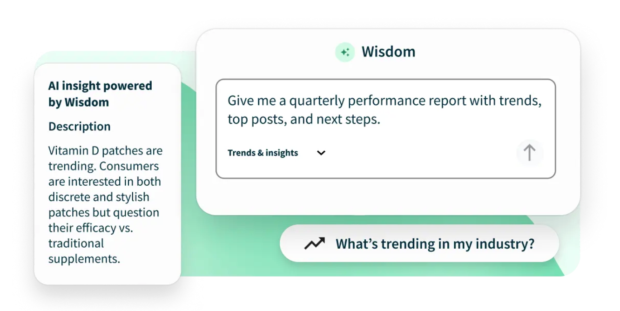
Wisdom helps teams turn social insights into content, strategy, and response decisions faster.
Ask questions in plain language — like “What’s shaping perception of us this week?” — and get a clear read of what’s happening, why it matters, and what to do next.
That means you’re not staring at charts or waiting for someone to translate the data for you. Wisdom summarizes the big shifts, flags the conversations that need your attention, and suggests next steps you can put to use right away.
FAQ: Social intelligence tools
What is a social intelligence tool?
Some newer tools go a step further, using generative AI to sort through all that data and surface what actually matters. A few even come with chatbots, like Wisdom, built on natural language processing (NLP).
What’s the difference between social listening and social intelligence?
Social intelligence takes those insights and puts them to work. It connects what you’re hearing to bigger business questions, helping inform everything from brand strategy to influencer marketing and product development.
What’s the difference between social media monitoring and intelligence?
What features should you look for when researching social media intelligence tools?
How does Hootsuite support social intelligence?
That makes it easier to do things like competitive benchmarking, catch shifts in brand perception, and turn social data into next steps.
Turn social intelligence into action with Hootsuite. Use Lumen to monitor conversations, spot sentiment shifts, and get real-time alerts when trends or risks start to take off. Then ask Wisdom, Hootsuite’s social-first AI agent, to explain what’s happening and what your team should do next. Try Hootsuite free today.