Table of Contents
Key takeaways
- Brand voice is the consistent personality your brand expresses through language, tone, and style across every channel.
- A documented brand voice guide keeps internal teams, freelancers, and agencies aligned and reduces off-brand content.
- Your voice should stay consistent at its core but adapt its tone for different platforms and contexts.
- Regular audits and testing help your brand voice evolve without losing its identity.
What is a brand voice?
Brand voice is the consistent, distinct way a brand portrays itself through words. It’s essentially your brand’s personality, expressed through tone, language, and style.
A clear brand voice helps keep messaging consistent, builds trust with your audience, and reduces the risk of off-brand moments on social media.
Creating a brand voice should start broad, and then get very detailed. The broad strokes define your overall tone — such as formal, friendly, jokey, or serious — while the details spell out specific words, phrases, and language choices to use (or avoid) in everyday communication.
We’ll walk you through all the steps of creating a brand voice later in this post. For now, start thinking about your brand and what you want it to represent. One point worth clarifying first is the difference between brand voice and brand tone, which are often confused.
Bonus: Get a free, customizable social media guidelines template to quickly and easily create recommendations for your company and employees.
What is the difference between brand voice and brand tone?
The difference is simple: brand voice is your consistent personality, while brand tone is how that personality adjusts based on the situation. Your voice stays the same no matter what, but your tone shifts depending on whether you’re celebrating a product launch or responding to an upset customer.
Think of it like a person. Your character doesn’t change from day to day, but the way you speak shifts depending on whether you’re at a party or comforting a friend. Here’s how that plays out for a brand:
Brand voice (consistent) | Brand tone (contextual) |
|---|---|
Stays the same across every channel and message | Flexes depending on the situation or audience |
Defined by your core personality and values | Shaped by context, like a celebration or a complaint |
Example: friendly, witty, and direct | Example: upbeat in a launch post, calm and reassuring in a support reply |
In short, you have one brand voice, but many tones that all sound like the same personality.
What makes a strong brand voice?
A strong brand voice is one that’s instantly recognizable, true to your brand, and easy for your team to apply consistently. It’s less about being clever and more about being distinct and dependable.
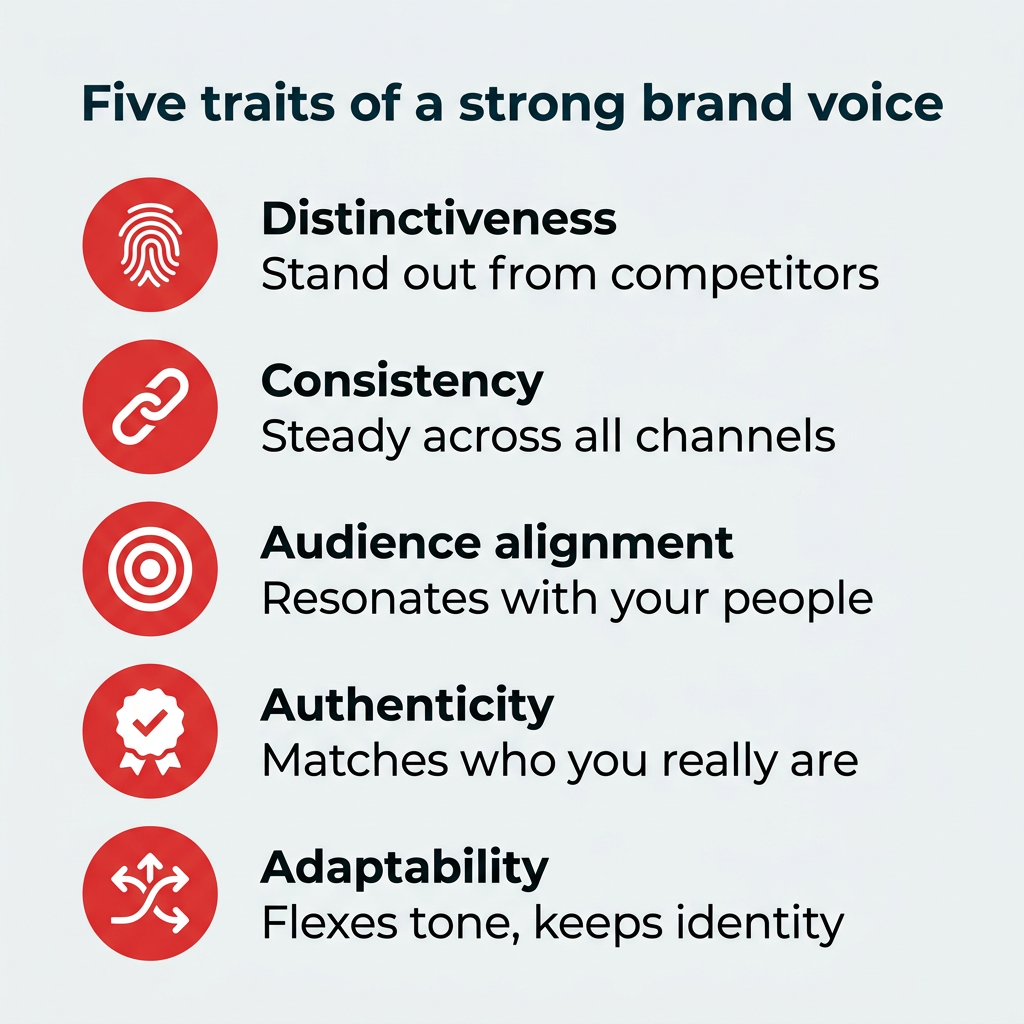
Here are the traits that define an effective brand voice:
- Distinctiveness: Your voice sounds different from competitors and stands out in a crowded feed.
- Consistency: The personality stays steady across channels, teams, and campaigns.
- Audience alignment: Your voice resonates with the people you most want to reach.
- Authenticity: The way you sound should feel authentic — matching who your brand actually is and what it values.
- Adaptability: Your voice can flex its tone for different platforms without losing its core identity.
When your brand voice hits all five, it becomes a genuine competitive advantage rather than just a style choice.
Why is having a consistent brand voice important?
Having a consistent brand voice is important because it ensures your brand sounds intentional, trustworthy, and cohesive, no matter where or how people encounter it. In fact, research shows that consistent brand presentation can increase revenue by up to 33%.
Here’s exactly why a strong brand voice matters:
Makes your brand more recognizable
Just like a great brand aesthetic (also known as visual identity), a solid social media brand voice makes your content more recognizable. When people scroll past your posts, they know it’s you before they even see the logo.
When your personality is clear and repeatable, you’re not just building brand recognition. You’re also protecting your brand from being impersonated by fake social media accounts.
When your social posts look and feel consistently like you, fake accounts and copycats tend to stick out fast.
Gives teams a communications blueprint
A well-defined brand voice keeps everyone aligned, even when content is coming from different teams.
Think about all the teams across your organization creating public-facing content — from product slides to email marketing campaigns. This usually includes:
- Sales
- Marketing
- Customer service
- Public relations
- Investor relations
- Tech support
- Product documentation
While tone may vary somewhat depending on the context, the overall language and voice should remain consistent at their core.
This is also important for new staff and external partners, like freelancers, agencies, and content creators. Clear social media guidelines help them get up to speed quickly, confidently communicate on your brand’s behalf, and avoid endless revisions.
Freelancers and agencies find it much easier to create content that sounds “right” for the brand in the first draft when they have a brand voice document to reference.
Avoids social media missteps
A clear brand voice reduces the risk of off-brand social media posts or comments that just miss the mark. This is especially crucial if multiple team members manage your social content.
This matters even more now that many teams use AI to help draft content. A Klaviyo and Datalily survey found consumers who spot AI-generated content are four times more likely to trust a brand less. Clear guidelines give you a benchmark to check AI-generated posts against, so anything off-brand gets caught before it goes live.
This matters most in high-pressure moments, like responding to negative feedback.
It’s why we recommend including guidelines for responding to negative comments and posts in your brand voice documentation.
Connects better with customers and prospects
A distinctive brand voice makes your company seem more human. And a more human brand is easier for customers, prospects, and social media followers to relate to.
Especially on social media, people don’t want to follow or engage with a random corporate entity. According to Edelman’s 2025 Trust Barometer, 73% of people trust brands more when they authentically reflect today’s culture. They want to follow and engage with brands that amuse, entertain, inform, and/or align with their values.
That’s true when it comes to purchasing, too. A well-defined social media voice ensures your social content resonates with your social media target audience.
How to build a strong brand voice
Building a brand voice means deciding how your brand should sound, documenting it clearly, and applying it consistently across channels.
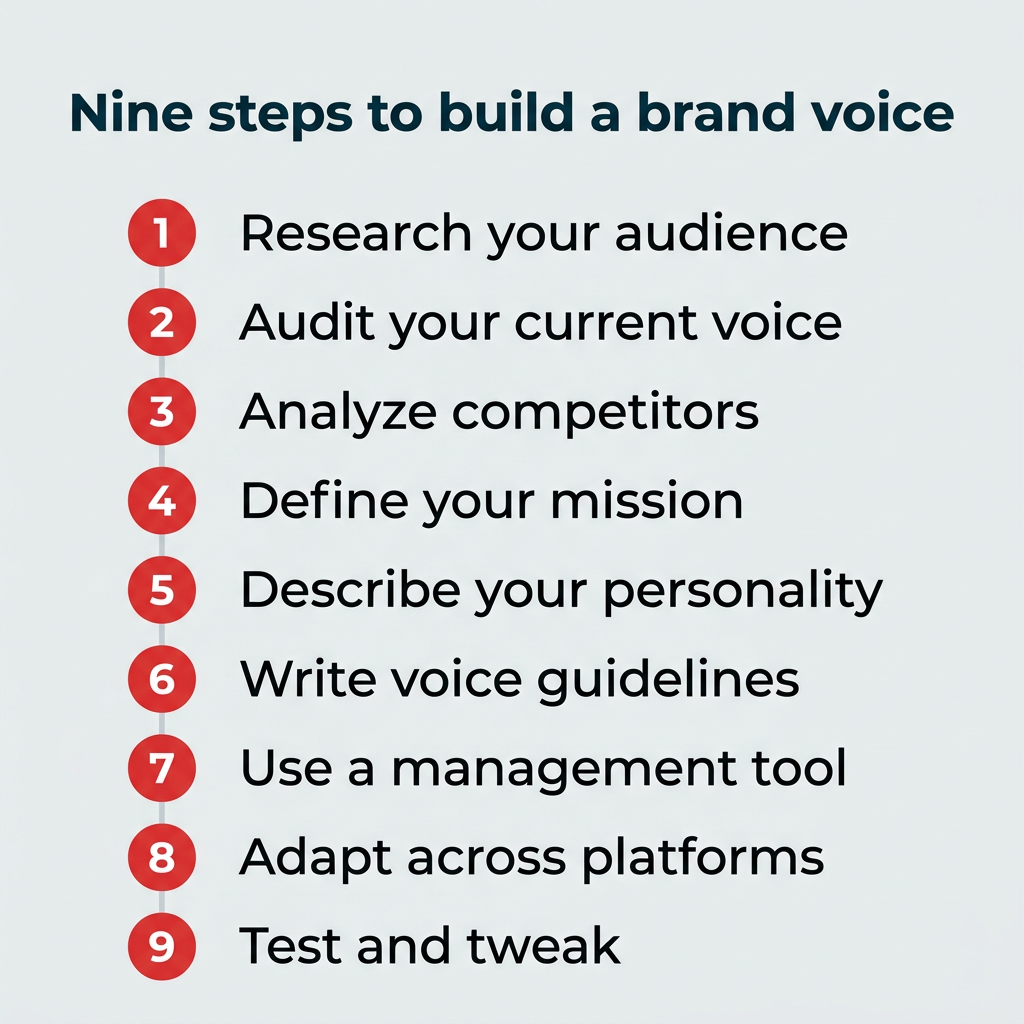
Here are nine steps to make it happen:
- Research your audience
- Audit your current brand voice
- Analyze your competitors’ brand voices
- Define your mission
- Describe your brand personality
- Put together brand voice guidelines
- Use a social media management tool
- Allow for differences between platforms
- Test and tweak
1. Research your audience
Before you can decide how you should speak to your audience, you need to know who your audience is.
Our guide on using social media for market research covers this in depth, but the short version is that you need to know what your target audience thinks about you, your products, and the competition.
You also need to understand where and how they communicate with each other so you can use the right messaging on the channels where they are most likely to be. A few audience research tactics can help you get there:
- Social listening: Track mentions and conversations to learn the words and phrases your audience actually uses.
- Platform analytics: Review your audience demographics and which posts they engage with most.
- Customer surveys: Ask directly how people describe your brand and what they value about it.
2. Audit your current brand voice
If your brand is already active on social, a brand voice audit shows you where you stand before you start refining. Review your existing content across every channel and look for inconsistencies in tone, language, and style.
Pull your top-performing posts and look for patterns. What did the captions that resonated have in common? Noticing what already works gives you a foundation to build on.
At the same time, flag anything that feels off-brand or inconsistent. This is the content your new guidelines will help you avoid going forward.
3. Analyze your competitors’ brand voices
Once you understand your own voice, take a look at how your competitors sound. Reviewing their social content shows you what’s already common in your space and where there’s room to stand out.
Pay attention to their tone, vocabulary, and how they respond to comments. If most competitors sound formal and corporate, a warmer, more human voice could set you apart.
The goal isn’t to copy anyone. It’s to find a distinct voice that fills a gap your audience isn’t getting elsewhere.
4. Define your mission
Now you need to define what you want to do for them. When it comes to social media brand voice, this one’s a two-parter.
- First, you need to define the mission statement of your brand. What does your brand stand for? What are its core values? What do you most want to achieve?
- Next, think about how that relates to your social audience. How does your mission improve the lives of your social followers? How do you make their lives better, easier, or more entertaining?
Working through this discussion will help you clarify your brand messaging and communication style, which, in turn, helps you understand the language to use when you talk to them.
5. Describe your brand personality
Buyer personas help you picture your audience as real people, making it easier to craft social content that speaks directly to them.
A brand persona does the same thing for your brand. Once you have a clear brand identity, you can create social content that feels natural and intentional.
Start by imagining your brand as a person. Would they be friendly or aloof? Funny or formal (or both)? Young and hip or established and reserved? Dig into the adjectives to fully round out your brand’s unique personality.
If you’re not sure where to start, the Brand Personality Framework, developed by professor Jennifer L. Aaker, is a popular place to start. It breaks brand personality down into five traits: sincerity, excitement, competence, sophistication, and ruggedness.
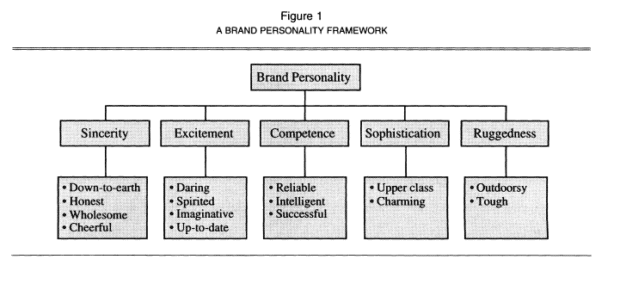
Source: Aaker, J. L. (1997). Dimensions of Brand Personality. Journal of Marketing Research, 34(3), 347-356.
The goal isn’t to mirror your audience exactly. It’s to build a brand persona your audience relates to, respects, and trusts.
6. Put together brand voice guidelines
Every good brand should have a style guide. Your style guide includes your brand colors, logos, and — most importantly for this post — your brand voice guidelines.
You can get really detailed here, even nailing down specific words to use and others to avoid. Be especially detailed about specific terms and word choices to use when referring to your products, your services, your company, and your employees.
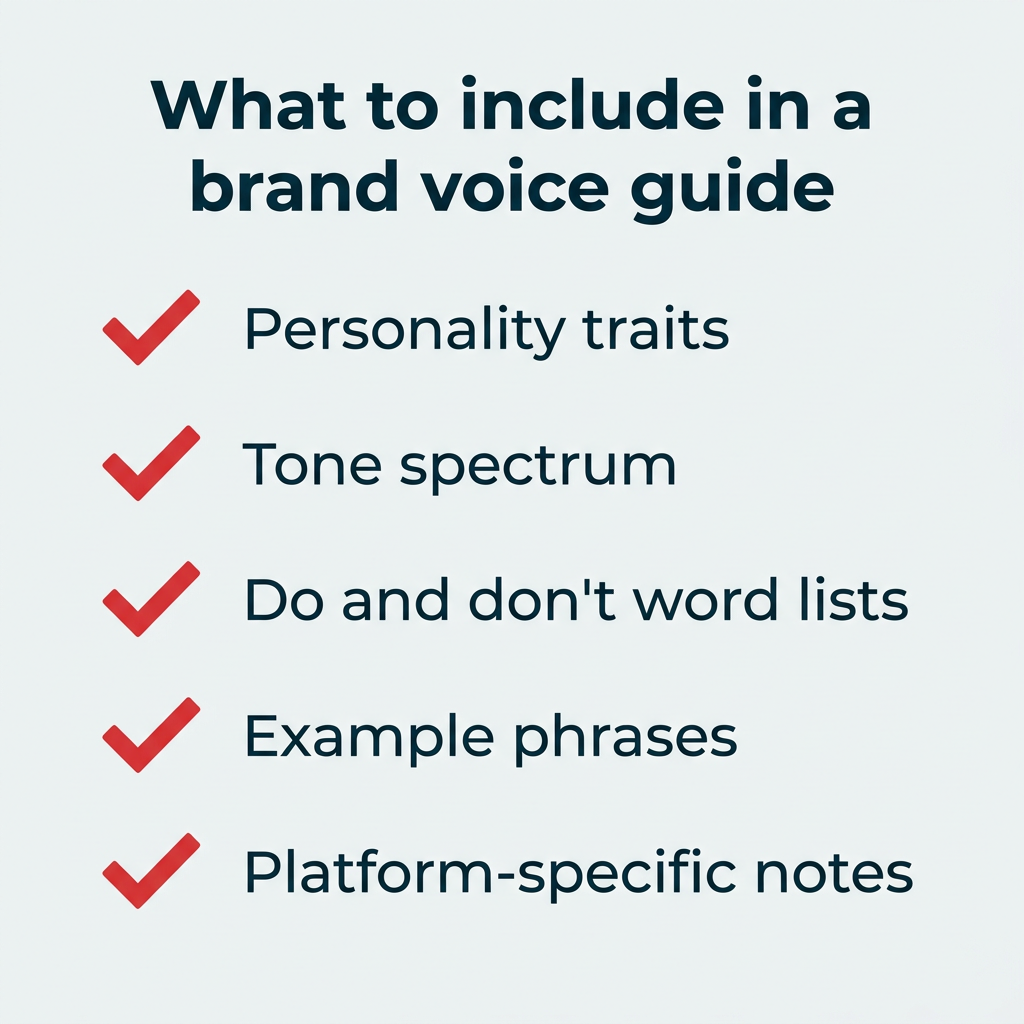
At a minimum, your brand voice guidelines should include:
- Personality traits: The handful of adjectives that define how your brand sounds.
- A tone spectrum: How your tone shifts for different situations, from celebratory to serious.
- Do and don’t word lists: Specific words and phrases to use, and ones to avoid.
- Example phrases: Sample copy for common scenarios, like launches or customer complaints.
- Platform-specific notes: How your voice adapts across channels like LinkedIn, TikTok, and Instagram.
The most important factor is tone. Make sure the tone you describe aligns with the brand personality you defined in the last step.
Include a list of branded hashtags and guidelines for creating new hashtags for future campaigns.
7. Use a social media management tool
If your marketing team manages multiple social media accounts, use a social media management tool to make sure your brand voice stays consistent across channels.
With Hootsuite, you can set up approvals and easily collaborate on post drafts to always publish approved content and keep the quality of your conversations with followers on brand.
Here are a few ways that Hootsuite can help you streamline your workflows:
- Manage all incoming messages and comments from one centralized inbox
- Assign messages to team members as tasks
- Collaborate on post drafts in Hootsuite Planner
- Set posting permissions for individual team members
- Set up easy approvals so the right people have final say
You can also use OwlyWriter AI to generate on-brand captions and post ideas in seconds. And because your approval workflows sit on top of everything, anything that doesn’t sound quite right, including AI-generated drafts, gets caught before it publishes.

OwlyWriter AI instantly generates captions and content ideas for every social media network. It’s seriously easy.
Start your free trial8. Allow for differences between platforms
While your brand voice should feel consistent everywhere, you can (and should!) make adjustments for each social channel.
After all, different channels have different vibes, formats, and expectations, and your voice needs to flex accordingly. What works in a blog post won’t land the same way in a TikTok video, a LinkedIn post, or a Threads reply (and that’s a good thing).
The key is making sure each post still sounds like you, even when the wording, length, or delivery changes.
When your brand guidelines are clear, this gets a lot easier. They give you a steady foundation so you can adapt your brand’s content to platform demographics and trends.
9. Test and tweak
Just like a human personality, your brand voice can evolve over time and shift with new information and learning.
As you roll it out, keep a close eye on your social analytics. Notice which posts land, which ones fall flat, and whether certain tones or formats consistently perform better.
At the same time, watch for any unexpected flops. Maybe your audience finds the content too stiff, too jokey, or too casual. That’s useful data, not a failure.
Brand voice can also evolve as social channels evolve. For instance, when brands started to join TikTok, they had to figure out a new way of speaking to younger audiences that still aligned with their brand guidelines.
Be willing to test, learn, and tweak, then test again. Brand voice is never truly finished, and that’s exactly how it stays relevant.
What does a brand voice chart look like?
A brand voice chart is a simple table that documents your voice traits alongside concrete dos and don’ts. It turns abstract personality descriptions into clear guidance anyone on your team can follow.
Here’s a sample brand voice chart you can adapt for your own brand:
Voice trait | Description | Do | Don’t |
|---|---|---|---|
Confident | We state things directly and clearly. | “Here’s how to fix it.” | “You might want to consider possibly trying…” |
Friendly | We sound warm and approachable. | “Great question, let’s dig in.” | “Per our previous correspondence.” |
Witty | We use light humor where it fits. | “Mondays. We’ve got you covered.” | Forced jokes that distract from the message. |
Helpful | We lead with value and clarity. | “Three quick steps to get started.” | Jargon that leaves readers guessing. |
Keep your chart short and usable. Three to five traits are usually enough to keep your team aligned without overwhelming them.
Brand voice examples to learn from
Let’s take a look at how a few well-known brands bring their brand voice to life on social media — and how committing to a personality can become a key differentiator.
Liquid Death
Andy Pearson, Liquid Death’s Vice President of Creative, once described the brand as “a character we’re writing for.”
That mindset shows up everywhere, especially on social. Treating the brand like a fully formed persona or character makes it much easier to stay true to its voice across platforms.

Source: Liquid Death
Remember that this is a company selling water. Their branding, especially their brand voice, is the differentiator. It’s why Liquid Death feels worlds apart from brands like Smartwater or Evian.
La Croix
If Liquid Death is all heavy metal energy, La Croix is the complete opposite. Think bubblegum colors and literal puppies. Terms like “BFF” and “Bestie” appear often in their captions, along with lots of emojis, exclamation points, and puns.


Source: La Croix
Using Aaker’s brand personality framework, Liquid Death is bold and rugged, while La Croix is cheerful and charming. Different tones, but same strategy: each brand commits fully to a distinct character.
Calm
Calm’s branding is cohesive from top to bottom. Visually, their social feeds lean into soothing blue tones, nature imagery, and clean layouts that instantly feel, well… calm.
That same energy shows up in their brand voice. Calm’s captions are grounded, supportive, and gentle. And they often use infographics and bullet points to share helpful information in a way that feels approachable, not overwhelming.

Source: Calm
Headspace
There’s a striking visual difference between Calm’s posts and those shared by Headspace.
While Calm uses muted blues, Headspace shows up in bold colors and playful illustrations. You’d never mistake one for the other, even though the apps operate in the same general market.

That contrast carries straight into the voice, too. Both are encouraging and inspirational, but Headspace comes across more casual and lighthearted in tone.

Source: Headspace
Slack
Brand voice isn’t just for consumer brands. Slack proves that even enterprise brands leading with social can sound genuinely human.
Slack’s voice is friendly, clear, and slightly witty. They explain complex features in plain language and keep their captions conversational, which makes a workplace tool feel approachable rather than corporate.
Whole Foods vs. Trader Joe’s
These two grocery brands show how the same friendly energy can play out in very different ways.
Whole Foods keeps their captions short, letting the visuals do most of the heavy lifting. Many posts are just a few words and a couple of emojis, but it’s enough to convey Whole Foods’ brand voice. The tone of voice comes through as light and friendly but still polished.

Source: Whole Foods
Trader Joe’s, by contrast, uses much longer captions. Posts are broken into sections with line breaks, and they follow a conversational rhythm that feels like a friendly crew member explaining what’s new. Instead of sharing short product descriptions, Trader Joe’s zooms way in. Each post tells the story of a single product — what it tastes like, how to use it, and why it’s special.

Source: Trader Joe’s
FAQ: Brand voice
What is brand voice and how do you define it?
How do brands create a consistent brand voice across social media?
What are examples of strong brand voice on social media?
How does brand voice differ from brand tone?
Why does brand voice matter for brand trust and engagement?
What is a brand voice example?
Is brand voice a skill?
What’s another word for brand voice?
What should a brand voice guide include?
How often should you update your brand voice?
Save time managing your social media marketing strategy with Hootsuite. Publish and schedule posts, find relevant conversions, measure results, and more — all from one dashboard. Try it free today.