Table of Contents
Key takeaways
- Social media risk management is the process of identifying, assessing, and mitigating risks.
- The biggest social media risks for businesses include reputational damage, security breaches, compliance violations, operational disruption, and financial fallout.
- A strong risk management strategy combines a clear social media policy, employee training, real-time monitoring, defined roles, and regular audits.
- Centralized tools like Hootsuite Social OS help teams detect threats early, route issues to the right people, and respond before problems escalate.
Social media risk management is the process of identifying, assessing, and mitigating risks that stem from social media. It covers threats that can hit your brand channels, your employees, and your wider audience, from reputational crises to security breaches and compliance violations.
A complete approach relies on clear social media policies, real-time monitoring, and the right tools. It also depends on cross-functional coordination, since marketing, legal, compliance, IT, and customer service all have a role to play.
Your brand, customers, and employees are all active on social media, making your channels common ground for conversations — both good and bad — and potential crises.
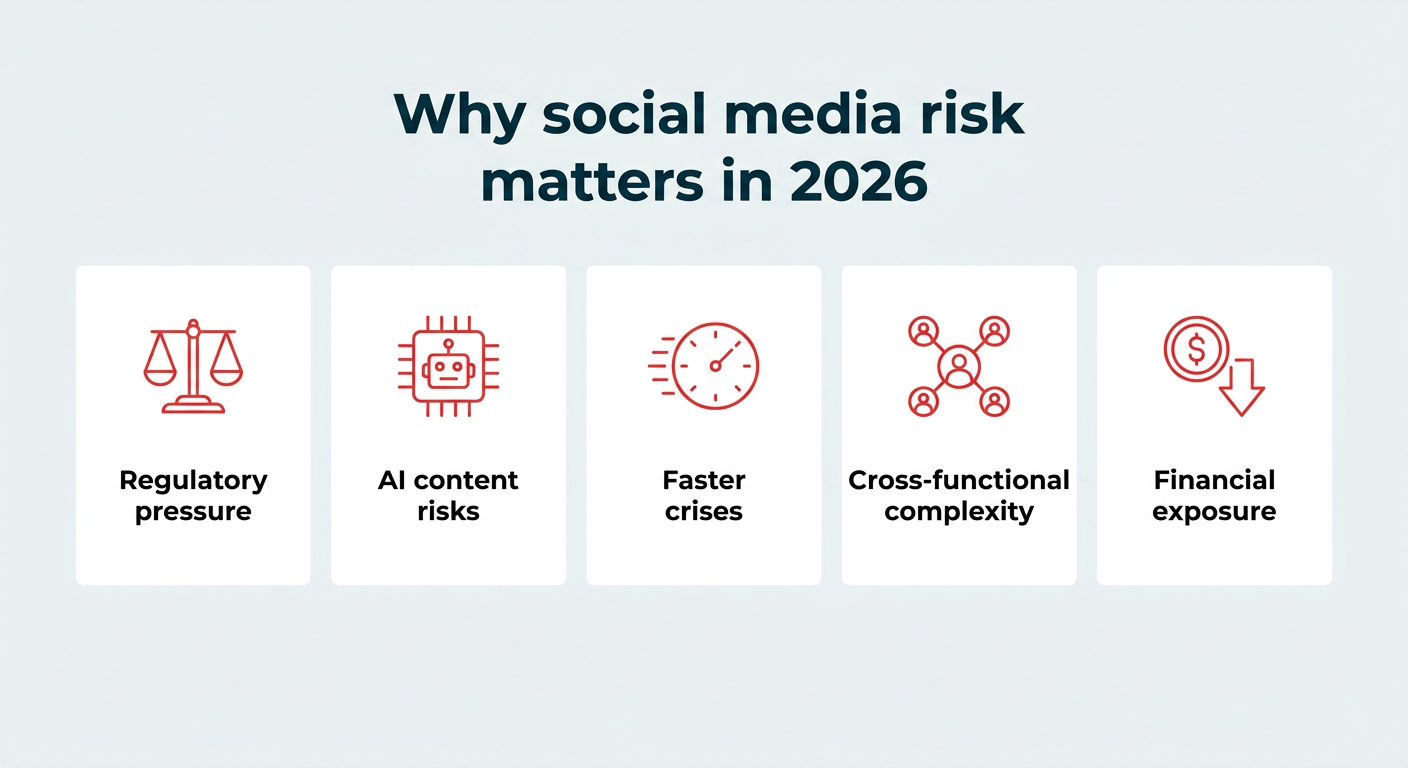
Social media risk management matters more than ever in 2026 because a single post can reach a global audience in seconds, and a single misstep can trigger a crisis just as fast. The stakes are higher, the pace is faster, and the rules keep changing.
Here are the main reasons risk management deserves your attention right now:
- Regulatory pressure is tightening. Data privacy laws and advertising rules continue to expand, and violations can carry real legal and financial penalties.
- AI content introduces new risk vectors. AI-generated posts, deepfakes, and impersonation accounts create fresh threats to brand safety and trust.
- Crises escalate at record speed. A negative comment or fake account can go viral before your team even sees it, especially when 38% of U.S. adults regularly get news on Facebook alone.
- Cross-functional complexity is growing. Distributed teams, multiple regions, and dozens of accounts make coordination harder and gaps easier to miss.
- Financial exposure is significant. Reputational and security incidents can hit revenue, stock price, and customer loyalty.
In short, the speed and scale of social media mean that a proactive risk management strategy is no longer optional for enterprise brands.
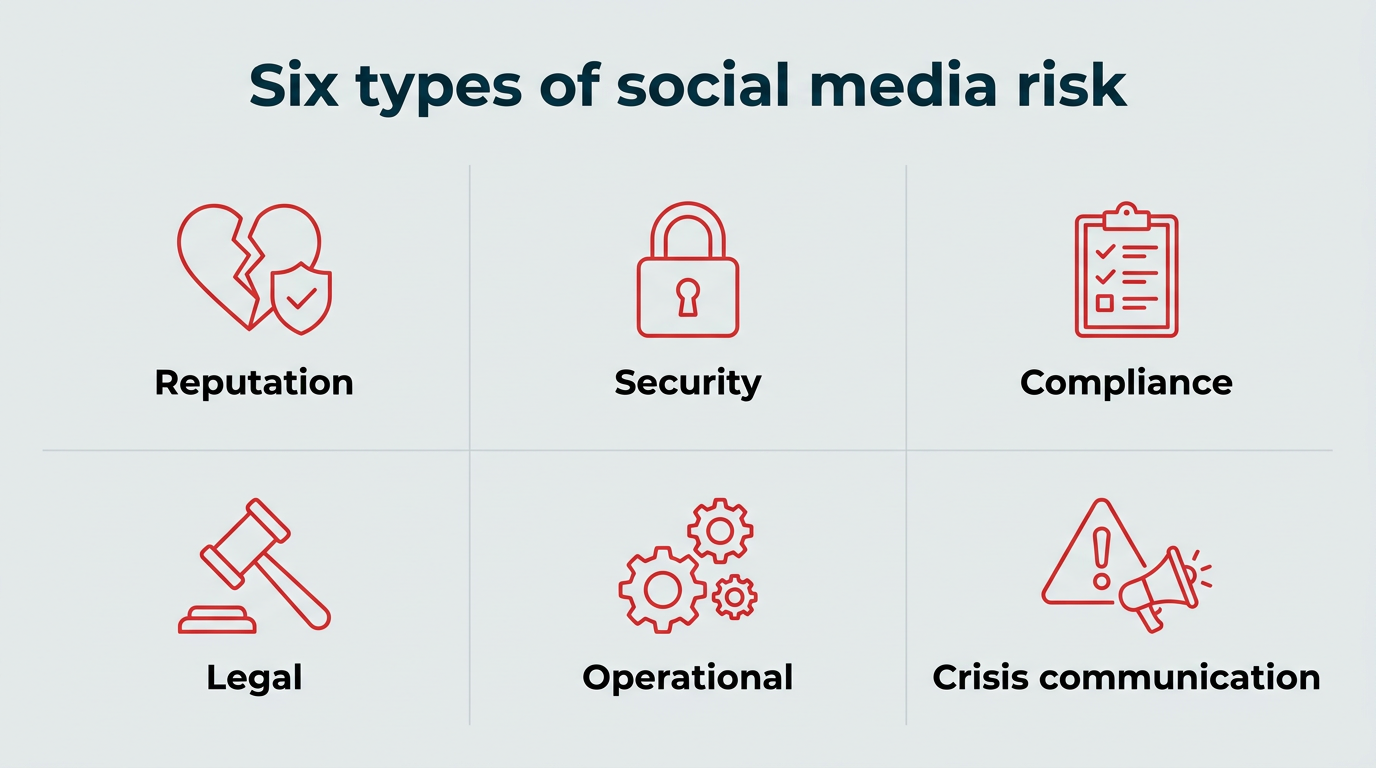
The main types of social media risks for businesses include reputational damage, security breaches, compliance violations, legal issues, operational disruption, and crisis communication failures. Each one can affect your brand in different ways, so it helps to understand them individually.
Let’s dive into each risk below:
Reputation risks
Negative comments, inappropriate posts, or bad reviews can all chip away at trust, especially among young adults who trust social media as much as traditional news. And because social media is so public, crises can spiral out of control quickly.
Trust is hard to earn and easy to lose. According to the 2025 Edelman Trust Barometer, 68% of people worry that business leaders purposely mislead them, which shows how fragile brand trust has become. A single viral misstep can reinforce that skepticism in minutes.
Maintaining trust in your brand is crucial, and brand reputation monitoring is a key part of that proactive approach. To limit brand reputation risk, your team should have a social media crisis management response plan in place.
Security risks
If your social media passwords get into the wrong hands, it creates a serious security vulnerability.
A breach can lead to spammy posts, lost account access, or exposed customer data, putting data privacy (and other sensitive data) at risk.
Security risks also increase during employee transitions. When someone on your marketing or social team leaves, it’s important to remove account access and permissions right away. This keeps your social media accounts secure.
Enterprise teams can reduce these risks with stronger controls. Single sign-on (SSO), multi-factor authentication (MFA), and role-based permissions all limit who can access accounts and what they can do.
AI-generated threats are also on the rise. Deepfakes and fake accounts that impersonate your brand or executives are becoming more convincing, so monitoring for impersonation is now part of good social media security.
Compliance risks
Social media compliance means following the rules set by regulatory bodies, social platforms, and your own organization.
Depending on your industry, that can require extra care when publishing content. Regulations like GDPR govern how you handle personal data, HIPAA protects patient information for healthcare brands, and FTC guidelines require clear disclosure of sponsored content. In healthcare, sharing patient information without proper consent is not just risky, it can be illegal.
If you work with brand partners or influencers – or run sponsored content or giveaways – make sure you’re following advertising regulations.
AI-generated content adds a new layer of complexity. When you publish AI-created copy or images, questions around accuracy, disclosure, and rights are still being worked out, so review these posts carefully.
You can avoid compliance risks by having your legal team review all contracts. They should give the green light on any social content that all parties plan to share.

Source: Laneige
Legal risks
Legal risks on social media go beyond regulatory compliance. They include intellectual property infringement, defamation, and liability tied to employee personal accounts.
Employees should feel comfortable sharing work updates online, but without social media guidelines, even well-intentioned social media posts can create legal issues in the real world. This is especially important for businesses in regulated industries.
A social media policy helps set expectations around what employees can and cannot post, protecting both your brand and your team.
Operational risks
Operational risks come from the day-to-day mechanics of running social media at scale. When processes break down, coverage gaps and mistakes follow.
For enterprise brands, these risks often show up as inconsistent posting across regions or sub-brands, unclear ownership of accounts, and tool fragmentation that leaves conversations unmonitored. Approval bottlenecks can also slow your team down when a fast response matters most.
Strong social media governance keeps these moving parts aligned so nothing slips through the cracks.
Crisis communication risks
Crisis communication risk is the danger that a poor or slow response amplifies the damage of an incident. This is different from reputation risk, which concerns the underlying issue itself. Here, the failure is in how you communicate.
When brands stay silent, respond defensively, or post tone-deaf messages during a crisis, they often make things worse. A single mishandled reply can turn a small complaint into a trending story.
Having a plan — with your PR and comms team aligned in advance — is the best way to keep a difficult moment from spiraling.
| Risk type | Potential impact | Primary mitigation |
|---|---|---|
| Reputation | Loss of customer trust, viral backlash | Crisis response plan, real-time monitoring |
| Security | Account takeover, data exposure | SSO, MFA, role-based permissions |
| Compliance | Legal penalties, regulatory action | Content review, governance workflows |
| Legal | Lawsuits, IP disputes, defamation claims | Social media policy, legal review |
| Operational | Coverage gaps, inconsistent messaging | Clear roles, centralized tools |
| Crisis communication | Amplified damage from poor response | Pre-approved templates, escalation matrix |
When you don’t manage social media risk, small incidents can snowball into major financial, legal, and reputational damage. In some cases, that impact shows up directly on the bottom line.
Just ask pharmaceutical company Eli Lilly. Its stock fell 4.37% in the fall of 2022 when a fake account tweeted that insulin was free. A single impersonation post, left unaddressed, wiped billions from the company’s market value.
Security incidents carry a steep price too. According to IBM’s 2025 Cost of a Data Breach Report, the global average cost of a data breach reached $4.4 million, a reminder of how expensive a lapse can become.
That kind of fallout is exactly why a proactive social media risk management plan matters for any brand that’s active on social media.
Meet the Suite
Understand what matters, decide what to do next, and take action across every social workflow — all from one connected suite.

Building a social media risk management strategy starts with assessing your risks and putting the right policies, people, and tools in place. We asked Trish Riswick, Former Social Engagement Specialist at Hootsuite, for her top tips. Here are the seven key steps:
- Create a social media policy
- Train employees on social media risk
- Establish clear roles and responsibilities
- Monitor social media channels in real time
- Build a crisis management plan
- Audit your social media channels regularly
- Review and update your policy on a regular basis
1. Create a social media policy
The first step in managing risk on social media is to have a clearly defined social media policy.
A social media policy should outline a plan of action for different scenarios, including emergencies, PR crises, or security breaches.
A strong policy — which you can build from a customizable template — should include:
- Approved channels: Which platforms your brand uses and who can post to them.
- Escalation paths: Who to notify, and when, during a crisis.
- Content approval workflows: How posts get reviewed and signed off before publishing.
- AI usage guidelines: Rules for creating and reviewing AI-generated content.
- Employee personal account expectations: What staff can and can’t share about work.
Just as importantly, your policy should cover team transitions. Define your handover process and outline the steps you need to take to secure your accounts. This makes sure that everything will continue to run smoothly in their absence.
2. Train employees on social media risk
Your employees can be some of your strongest brand advocates — but without regular training, they can unintentionally put your business at risk. An off-message or non-compliant post can quickly impact your brand reputation.
“Many employees want to be more active on social and showcase what they’re doing at their company,” says Riswick. “However, they need to understand what they can and cannot post.”
This is where clear guidelines for employees come into play. Your risk management plan should include direction on what employees can share from their personal accounts, from confidentiality rules to industry regulations. Aim to refresh employee training at least quarterly — using an updated guidelines template — and any time your policies change.
To make this easier (and safer), consider a tool like Hootsuite Parliament. Parliament, the employee advocacy app in Hootsuite Social OS, lets you generate on-brand, pre-approved social media content that employees can conveniently share on their personal channels, including LinkedIn, Facebook, and Instagram.
3. Establish clear roles and responsibilities
Clear roles and responsibilities keep everyone aligned when a risk emerges, so no one assumes someone else is handling it. Cross-functional coordination is one of the biggest challenges for enterprise teams.
Define who owns what across the social team, legal, compliance, IT, PR, and customer service. A RACI-style approach, where each role is marked as responsible, accountable, consulted, or informed, works well for crisis scenarios.
When roles are documented in advance, your team can move fast instead of scrambling to figure out who does what.
4. Monitor social media channels in real time
Monitoring your social channels helps you spot potential issues early and step in before they escalate. But it’s not just the social team’s responsibility.
Depending on the situation, teams like customer service or PR may also need visibility into what’s happening. That’s why it’s important to have a clear process for routing messages to the right teams and stakeholders.
“A lot of information can get lost when moving from team to team,” says Riswick. To avoid that, she recommends using an internal system to flag and relay critical messages.
“Categorizing and tagging messages helps more people in the company have eyes on what is happening. They can use that information as business intelligence to improve their area of the organization.”
Tools like Lumen, the listening and insights app in Hootsuite Social OS, make real-time monitoring easier. You can track brand mentions, watch sentiment shifts, and set keyword alerts so your team gets notified the moment a potential crisis surfaces.
5. Build a crisis management plan
A crisis management plan prepares your team to act fast and consistently when something goes wrong. Preparation — including crisis detection and response tools — is what separates a contained incident from a full-blown crisis.
Your crisis response plan should include pre-approved response templates, an escalation matrix, a designated spokesperson, and channel-specific response protocols. For more detail, see our guide to handling a crisis on social.
With these pieces ready in advance, your team won’t have to improvise under pressure.
6. Audit your social media channels regularly
A regular social media audit helps you catch risks before they turn into problems. It’s a health check for your accounts, access, and content.
A thorough audit includes a review of account access, a content review for anything off-brand or non-compliant, a check against current platform policies, and a performance benchmark. Aim to run one quarterly so nothing drifts out of line.
Regular audits keep your channels clean, secure, and consistent across every team and region.
7. Review and update your policy on a regular basis
As platforms, trends, and regulations change, your social media policy needs to evolve with them.
“In order to stay compliant within your industry, you need to revise your policy on a regular basis,” says Riswick. “This not only protects the brand but, more importantly, protects employees.”
Keep an eye on emerging platforms, shifting social trends, and updates to industry and local regulations. In 2026, updating your AI usage guidelines should be a top priority as tools and rules continue to change.
When updates happen, communicate them clearly so employees are always aware of what is and isn’t okay to post.
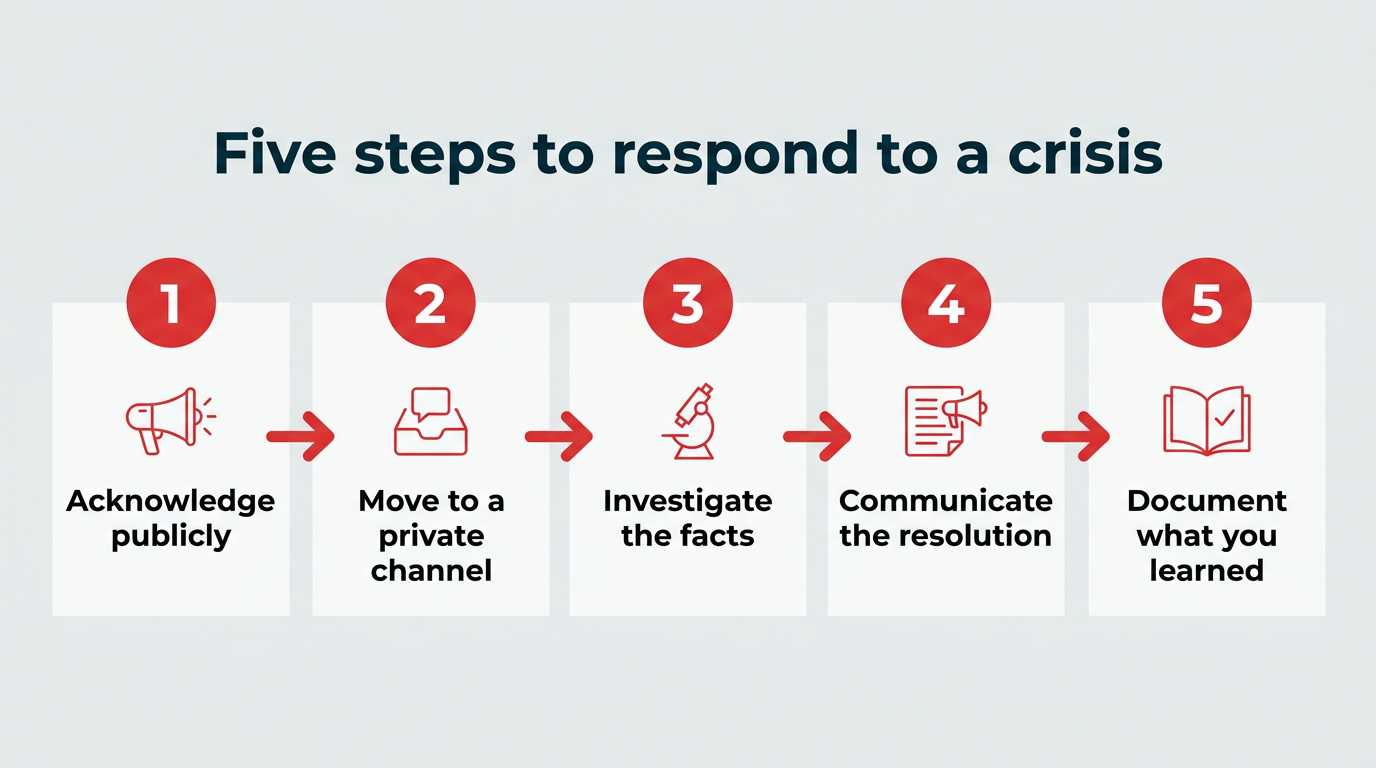
When a crisis hits, respond quickly and follow a clear process so your team can act with confidence. Here are five steps to guide your response:
- Acknowledge the issue publicly so customers know you’re aware.
- Move the conversation to a private channel to resolve it.
- Investigate what happened and gather the facts.
- Communicate the resolution clearly.
- Document what you learned to improve your response next time.
“My best practice is to always move that conversation from public to private as quickly as possible,” suggests Riswick.
Effective crisis communication starts by acknowledging the issue publicly. This tells customers you’re aware of it. Then, move the conversation to a private channel to resolve the problem.

Source: Glossier
Acting quickly helps prevent negative comments from gaining momentum and turning into a larger PR issue.
A centralized social media management tool reduces risk by giving every team a single source of truth for conversations, permissions, and approvals. Instead of juggling scattered logins and disconnected apps, your organization gains one governed system.
Here’s how a centralized platform lowers your risk:
- Single source of truth: All accounts, messages, and content live in one place.
- Unified permissions: Role-based access controls who can post and publish.
- Cross-team visibility: Marketing, legal, PR, and support see the same information.
- Audit trails: Every action is logged for accountability and compliance and governance.
- Governed workflows: Approvals and escalations happen inside a controlled system.
How Hootsuite Social OS helps manage social media risk
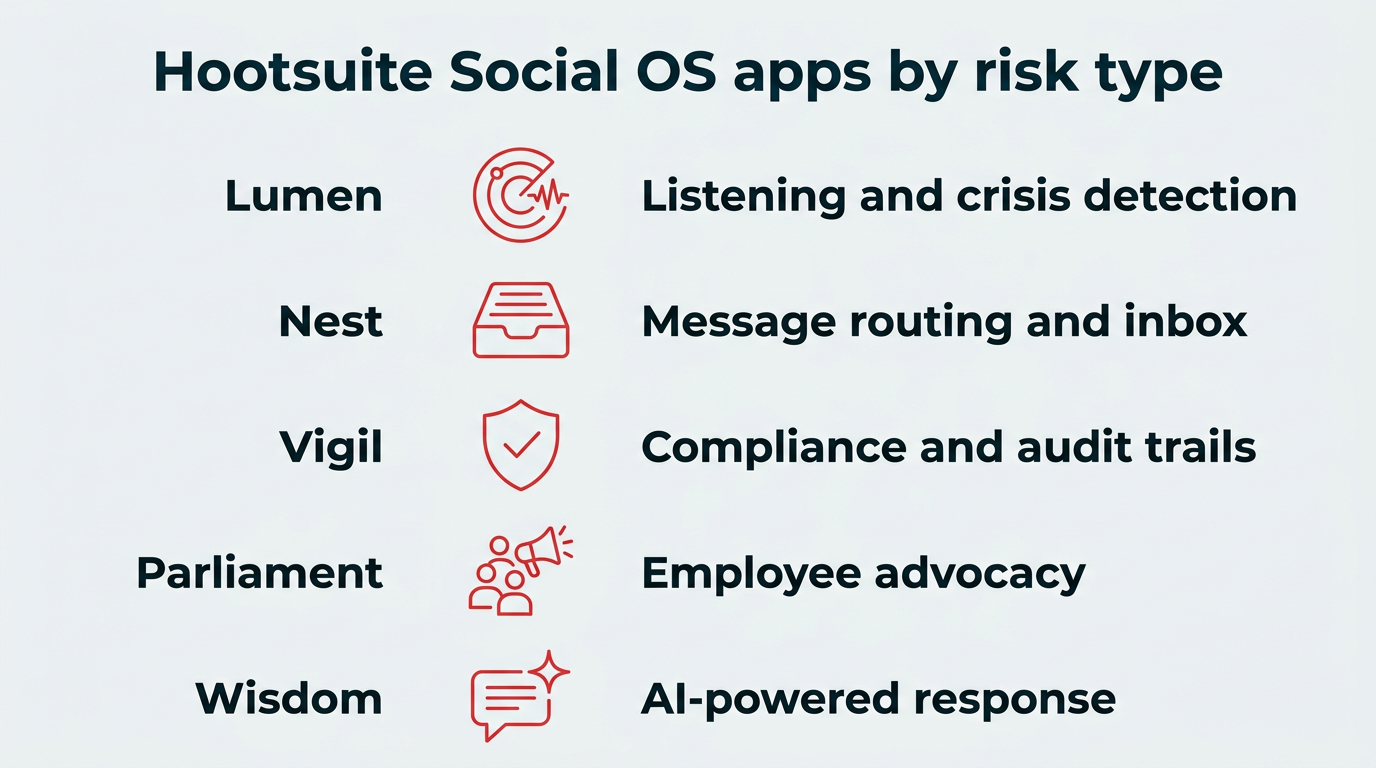
Hootsuite Social OS brings listening, engagement, compliance, and advocacy into one connected system, so you can spot risks early and respond before they escalate. Each app maps to a different type of social media risk.
Here’s how the key apps support social media risk management:
- Lumen: Real-time listening, sentiment monitoring, and crisis detection across a huge range of online sources.
- Nest: A unified inbox that routes issues to the right team and prioritizes messages by sentiment.
- Vigil: A compliance and governance layer with approval workflows and audit trails.
- Parliament: Employee advocacy with pre-approved, on-brand content.
- Wisdom: AI orchestration for faster response, with cited answers grounded in live data.
With Lumen’s listening tools, you can track brand mentions, watch sentiment, and catch potential issues early.
To level up your social media customer care, Nest helps you manage all of your messages in one place. This includes private DMs, public comments, emoji reactions, and more, with routing so the right team handles each issue.
FAQ: Social media risk management
What is social media risk management and why is it important for enterprises?
What are the best practices for building a social media risk management strategy?
How do companies manage social media risks like data breaches, brand safety, and compliance?
What tools help enterprises monitor and mitigate social media risk in real time?
How can regulated industries manage social media risk and compliance?
What is the 5 5 5 rule for social media?
What are the four steps in social media risk management?
What are the biggest social media risks for businesses in 2026?
How often should you update your social media risk management policy?
What is the difference between social media risk management and crisis management?
Save time managing your social media marketing strategy with Hootsuite. Publish and schedule posts, find relevant conversions, measure results, and more â all from one dashboard. Try it free today.