Table of Contents
Key takeaways
- User-generated content (UGC) is original content created by real customers, including reviews, photos, videos, and social posts, that brands can amplify across marketing channels.
- UGC builds trust faster and cheaper than traditional advertising because shoppers trust real customer experiences over branded content.
- A strong UGC strategy includes clear collection methods, defined content types, documented permissions, and alignment with measurable marketing goals.
- Hootsuite Social OS helps you manage UGC at scale: Use to track mentions and monitor hashtags and to publish and measure approved content.
What is user-generated content (UGC)?
User-generated content (UGC) is original, brand-specific content created by real customers and fans rather than by the brand itself. It can come in many forms, including videos, images, product reviews, testimonials, and even podcasts.
UGC can live everywhere: your own social channels, third-party review sites (e.g., Google and G2), community forums, blogs, or on your customers’ own social profiles.
When a happy customer posts about your product and you reshare it — like in the example below from drink brand Wildwonder — that’s UGC in action.

Source: @drinkwildwonder
In short: If a real person made it, it mentions your brand, and you didn’t produce it in-house, it counts as UGC.
What are the different types of user-generated content?
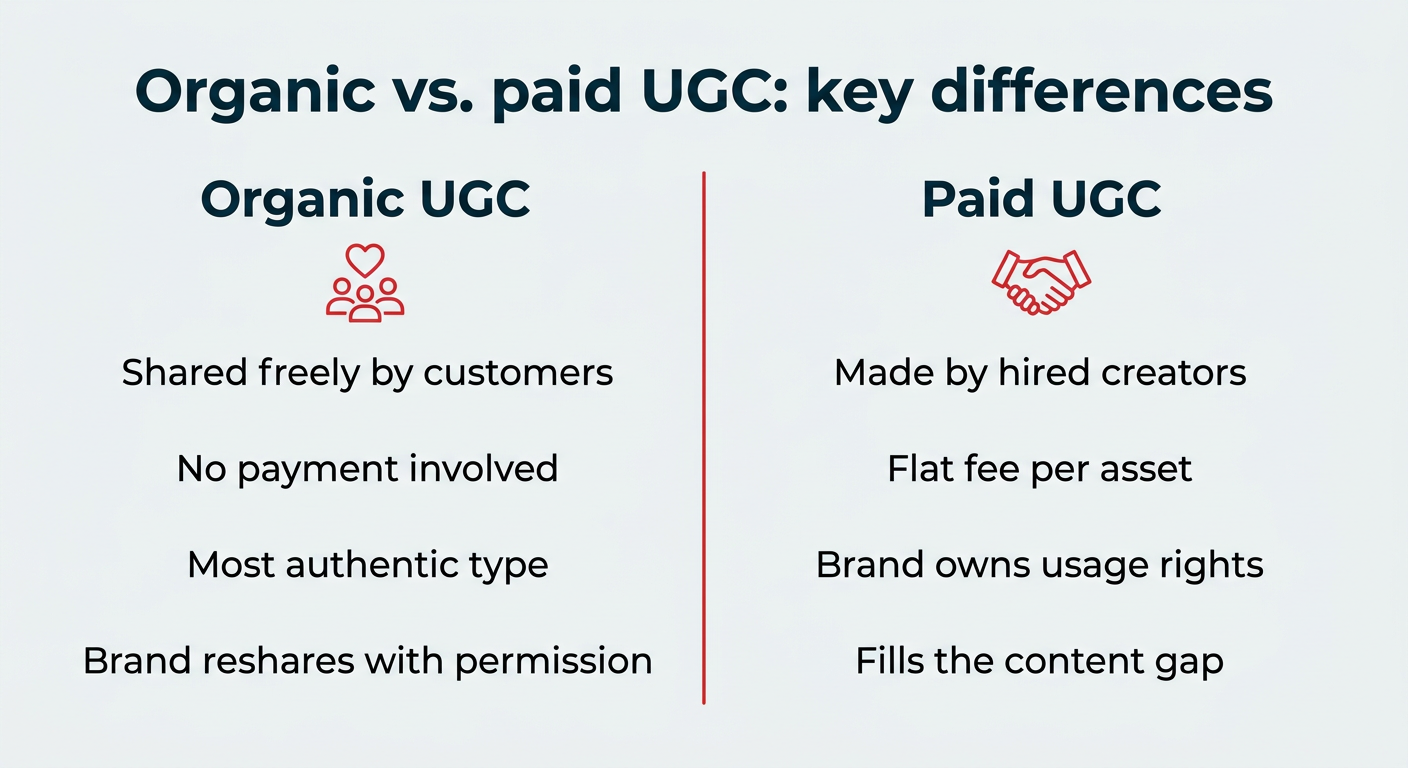
UGC comes in two main flavors: organic and paid. Both can show up as customer reviews, photos, videos, social media posts, or blog posts — the difference is whether money changed hands.
What is organic UGC?
Organic UGC is content your real customers share freely, without being paid or asked. It’s the most authentic type of UGC, and the kind every brand hopes to see more of.
Here are a few examples of organic UGC:
Reviews and testimonials
Online reviews are a classic form of UGC, and they work hard as social proof across your website and social channels.
Some brands even turn glowing testimonials into branded graphics to share on social. It’s an easy way to squeeze more value out of a single review.

Source: Living Proof
Photos
Photos are one of the most common types of UGC. Think: A customer showing off your product in the wild, or sharing their results after using it.
Use a niche or branded hashtag to make these posts easier to find (and reshare) later.
For example, footwear brand Asics uses the hashtag #soundmindsoundbody to collect photos from fans around the world. One quick search pulls up thousands of posts they can tap into for both content and community-building.

Source: Asics
Videos
Social videos and YouTube content are UGC gold. YouTubers regularly post “product hauls” or unboxing videos featuring multiple brands in one video. If yours gets a mention, grab that clip (with permission) and feature it on your own channels.
Social media posts
Even a quick, positive mention of your brand is worth resharing. Repost it directly on X or TikTok, or take a screenshot and turn it into a graphic for Instagram and LinkedIn. Hootsuite’s engagement tools make it easy to spot these moments as they happen.
Blog posts
Bloggers may also shout your brand out, whether it’s a full review or a passing mention in a bigger roundup. Pull a quote and share it on social or your website to extend its reach.
For example, travel blogger Nikki on Her Way casually recommends Tevas as the best brand for water shoes in her long-term packing guide. It’s a quick, unprompted endorsement that Teva could easily pull into their own content marketing.

Source: Nikki on Her Way
What is paid UGC?
Paid UGC is content made by creators you hire to talk about your product. It’s a popular option for newer brands that don’t have a big customer base sharing content organically (yet).
Paid UGC creators typically deliver a short vertical video, a set of product photos, or a voiceover testimonial that you own the rights to use. Common deliverables include unboxing clips, before-and-after demos, “get ready with me” style videos, and lifestyle photography for product pages. Rates vary widely by format and usage rights, so agree on both before work starts.
Keep in mind that UGC creators aren’t the same as influencers. They’re not promoting to their own audience; they’re creating content for you to post on your own channels. More on that difference in the next section.
You can reach out to UGC creators on your own (using a platform like Fiverr or Upwork), but if your brand already has fans, creators may come straight to you. Either way, once you sort out a deal, you can take the content they create and share it on your website or social media channels.
Pro tip 💡: Always disclose paid UGC. Some social media platforms, like Instagram, require you to clearly label any content that’s commercial in nature.
Bottom line: paid UGC helps you fill the content gap while your organic UGC engine gets going.
How is UGC different from influencer marketing?
The short answer: UGC creators make content for your channels, while influencers post content on theirs. Both involve creators, and both can be paid, but the distribution model and what you’re actually buying are completely different.
With UGC, you’re buying content and the rights to use it. With influencer marketing, you’re buying access to someone else’s audience. That distinction changes how you brief creators, how you measure results, and how much you should expect to pay.
Dimension | User-generated content | Influencer marketing |
|---|---|---|
Who creates it | Customers, fans, employees, or hired UGC creators | Creators with an established following |
Where it’s posted | Your brand’s owned channels, website, and ads | The influencer’s own channels |
Compensation model | Free (organic) or a flat fee per asset (paid) | Flat fee, affiliate commission, or gifted product |
Content ownership | Brand typically licenses or owns usage rights | Creator usually retains ownership |
Audience reach | Your existing audience | The influencer’s audience |
Why it works | Feels like a real customer experience | Borrows the trust the creator has built |
Many brands run both. UGC keeps your owned channels stocked with authentic-looking content, while influencer partnerships push that content in front of new audiences.
Meet the Suite
Understand what matters, decide what to do next, and take action across every social workflow — all from one connected suite.

Why is user-generated content important?
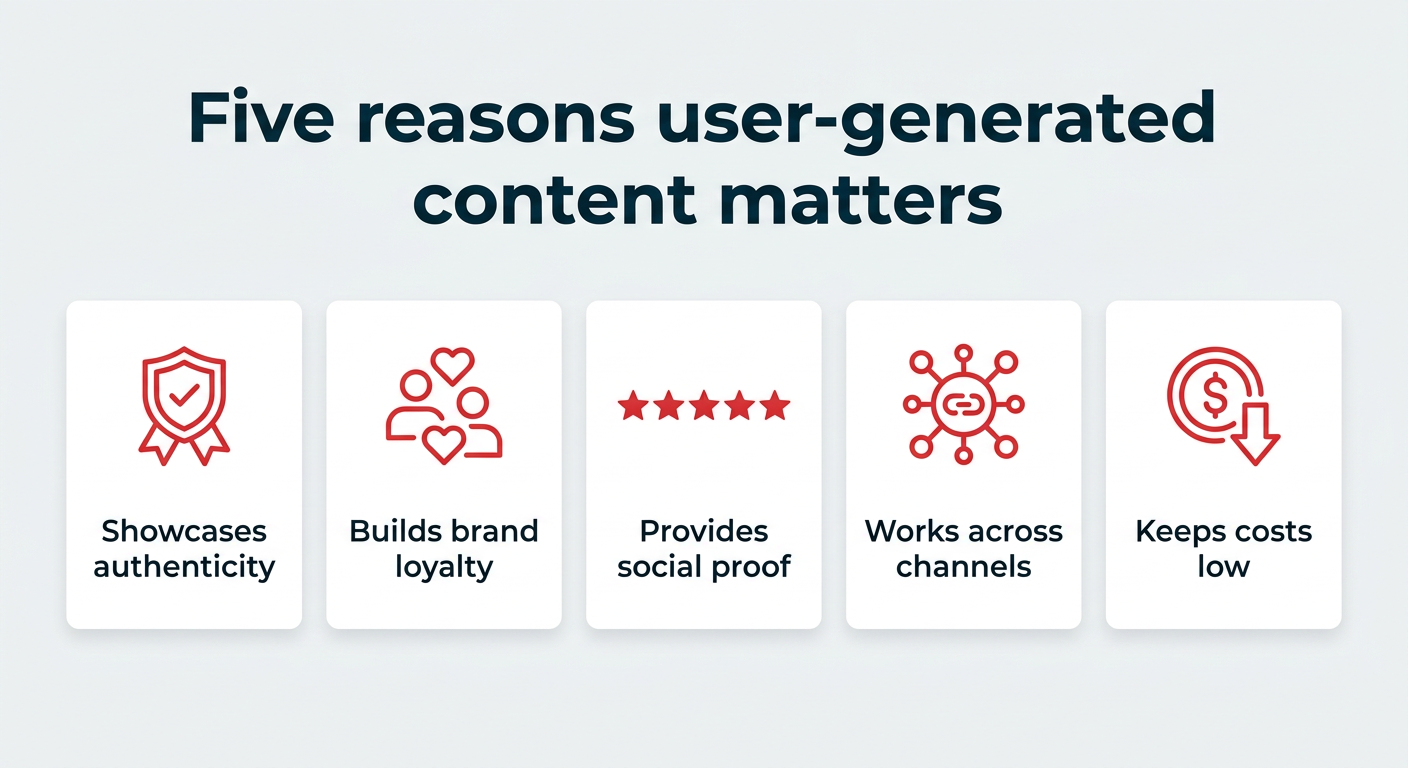
User-generated content is one of the most powerful marketing tools out there because it builds trust faster and cheaper than traditional advertising. In other words, real customers talking about your brand carries more weight than polished campaigns.
UGC helps brands:
- Showcase authenticity
- Foster brand loyalty
- Provide social proof
- Curate content across channels
- Keep costs low
Let’s break down why each of these matters.
Five reasons user-generated content matters
It showcases authenticity
UGC is the most authentic type of marketing content you can share, full stop. Shoppers are savvier than ever, and they can smell a polished ad from a mile away.
The proof is in the numbers: Nearly half of shoppers find user reviews on retailer websites the most influential content when researching products online.
Just don’t resort to faking your user-generated posts. Audiences will catch on fast, and the damage to your brand authenticity isn’t worth the shortcut. Stick to UGC from the people who actually know your brand, like customers, loyal fans, or even employee advocates.
In short, think of UGC as modern-day word of mouth. When it comes to purchasing decisions, most consumers trust a recommendation from a real person over any ad you could run.
It builds brand loyalty
UGC builds brand loyalty because it makes customers feel like they’re part of something bigger than a transaction. When someone creates content about your brand, they’re joining your community.
It also opens up a two-way conversation between your brand and your customers, which deepens relationships and drives repeat business.
Lego does this brilliantly with its Lego Ideas community, where millions of fans submit and vote on ideas for future products. It’s a genius move: Lego gets free product research, and fans get to feel like co-creators of the brand they love.

Source: Lego
It provides social proof
With so much competition online, earning consumer trust is harder than ever. That’s why social proof can make or break your brand for new customers.
Case in point: Products with just five reviews are 270% more likely to be purchased than products with zero reviews. In a noisy online world, that kind of validation can be the difference between a sale and a scroll.
It works across every marketing channel
UGC isn’t just for your social feeds. It works across almost every marketing channel you have.
For example:
- Add UGC images to cart abandonment emails
- Feature customer photos on product pages
- Build a dedicated UGC landing page, like Calvin Klein’s #MyCalvins hub

Source: Calvin Klein
Instead of relying only on glossy editorial shots, they show real people styling their Calvin’s, giving shoppers a more honest sense of how things actually look on real humans.
It keeps costs low
UGC is one of the most cost-effective marketing tactics you can run.
A full studio shoot or an influencer campaign can eat a meaningful chunk of your quarterly budget. Asking your customers to share content about your product? Next to nothing.
That makes UGC especially valuable for smaller brands or teams without big ad budgets. You get authentic content, expanded reach, and a closer connection to your audience, all without hiring an agency or shooting a full campaign.
Put together, those five benefits explain why UGC tends to outperform branded content on both trust and cost per asset.
How do you build a user-generated content strategy?
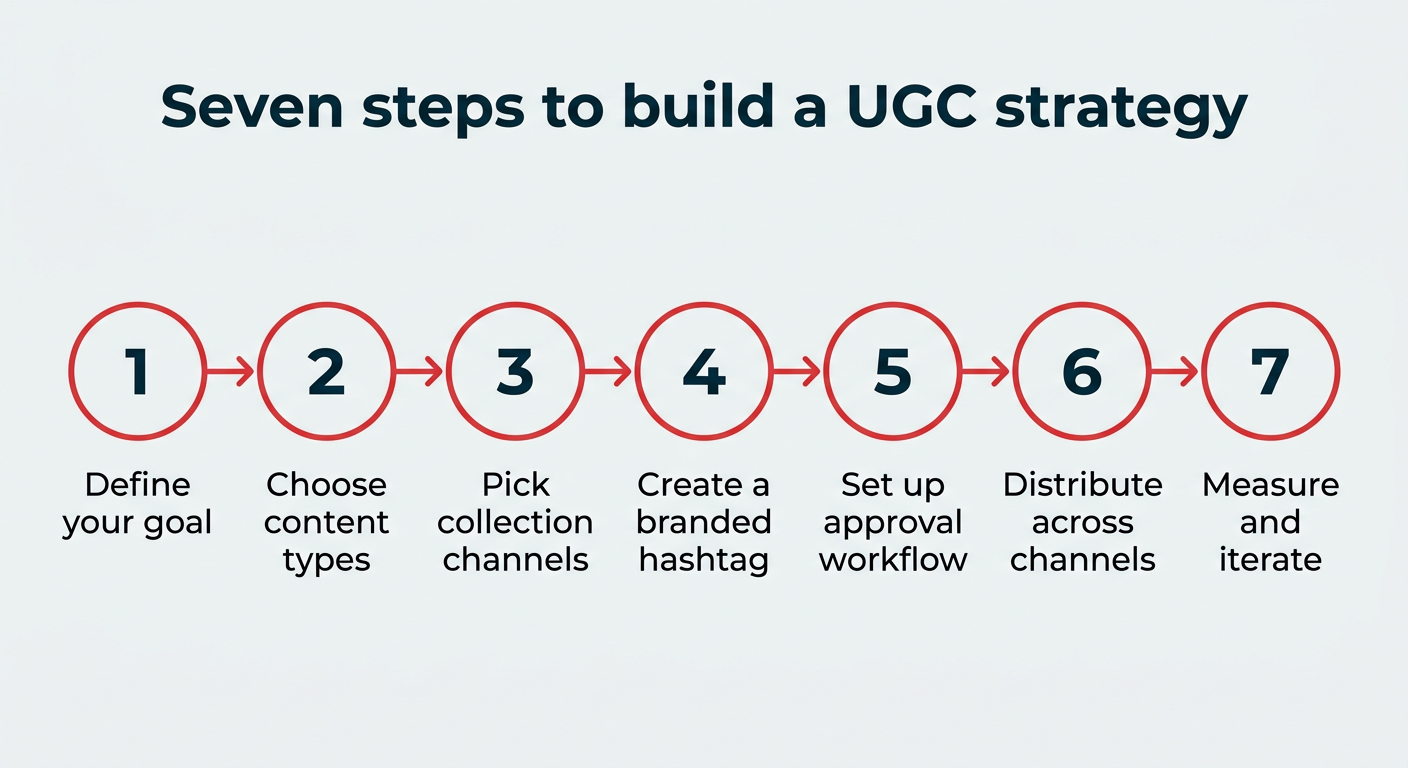
Building a UGC strategy means deciding what content you want, how you’ll collect it, who approves it, and how you’ll measure whether it worked. Most brands skip straight to “post a hashtag and hope,” which is why their UGC programs stall out after a few weeks.
Here’s the seven-step framework:
- Define your goal
- Choose the content types you want
- Pick your collection channels
- Create a branded hashtag or campaign hook
- Set up a curation and approval workflow
- Distribute UGC across channels
- Measure and iterate
1. Define your goal
Start with what you’re actually trying to move: awareness, engagement, conversion rate on product pages, or retention. Pull up your social media strategy document and pick one primary goal per campaign. A UGC program aimed at everything usually delivers nothing.
2. Choose the content types you want
Different goals need different assets. Conversion-focused campaigns need product-in-use photos and short demo videos for product pages. Awareness campaigns need shareable, personality-driven video. Write down the formats, orientations, and rough specs you need before you ask for anything.
3. Pick your collection channels
Decide where UGC will come from: tagged social posts, a branded hashtag, post-purchase review requests, a submission form on your site, a contest, or paid creators. Most brands do best with two or three sources rather than trying to run all of them at once.
4. Create a branded hashtag or campaign hook
Give people a single, memorable place to send their content. Keep the hashtag short, easy to spell, and unlikely to be confused with anything else. Then put it everywhere: social bios, packaging, order confirmation emails, and in-store signage.
5. Set up a curation and approval workflow
This is where most programs break down. You need a repeatable approval workflow that covers who reviews submissions, who requests permission, where approved assets are stored, and who signs off on anything sensitive. In Perch, you can tag content, route it through approval steps, and keep legal or brand review in the same place as publishing.
6. Distribute UGC across channels
One approved asset should work in more than one place. Plan the reuse up front: a customer video can run across organic and paid channels, on product pages, and as an email hero image. Just make sure your usage rights cover every one of those placements.
7. Measure and iterate
Track UGC posts separately from branded posts so you can compare engagement rate, click-through, and conversion. Use Lumen to monitor hashtag volume and sentiment over time, then double down on the content types and sources that perform.
Get these seven steps documented once, and your UGC program becomes a repeatable system instead of a scramble.
5 great examples of user-generated content campaigns
Now that you have the framework, here’s what it looks like in practice. Let’s look at a few case studies from GoPro, lululemon, LaCroix, Well Traveled, and Edloe Finch.
GoPro
Action cam company GoPro uses UGC to sustain its YouTube channel, with its top three most popular videos all originally filmed by customers. Combined, those three videos have racked up hundreds of millions of views.
Not bad for content that costs GoPro nothing to produce.
Today, GoPro runs its own awards show and daily photo challenges to inspire consumers to get creative. That’s step four of the framework in action: a permanent, always-on hook for submissions.

Source: GoPro
Lululemon
Canadian athleisure brand Lululemon is primarily known for its expensive leggings and yoga clothing. To increase company reach across social media, it asked followers and brand loyalists to share photos of themselves in Lululemon garments using the hashtag #thesweatlife.

Source: @brittanyleighball
Not only did this result in a treasure-trove of UGC for Lululemon to repurpose, it also organically expanded the company’s brand awareness and reach across social media via its brand ambassadors.
LaCroix
Sparkling water brand LaCroix takes a different approach to UGC: instead of relying on branded hashtags or a roster of ambassadors, they regularly repost content from everyday creators, no matter their follower count.

Source: @lacroixwater
That makes their UGC feel refreshingly accessible. Audiences see real people enjoying the product, which makes the brand feel more relatable.
Well Traveled
Well Traveled is a community-driven travel brand that leans on member-generated content to showcase its platform, property partners, and exclusive perks.
“As a service in such a visual industry, the ‘proof’ provided by member content is immeasurable,” said Laura DeGomez, Director of Partnerships & Brand Marketing at Well Traveled. “The beautiful trips discovered, planned, and booked on Well Traveled are a phenomenal marketing and retention tool.”
DeGomez uses UGC to visually engage existing and prospective members, and increase brand awareness, expand reach, and strengthen community.
“No one tells our story better than our members,” she added. “The Well Traveled community is the key here. Whenever we can let their experiences shine, we do.”

Source: Well Traveled
Edloe Finch
Boutique furniture brand Edloe Finch pulls UGC in two clever ways: through its #EdloeFinch hashtag, and by letting customers submit photos directly on its website. Those customer photos then live right on the product pages, next to the pro shots.
Buying furniture online can feel risky. You’re spending real money on something you haven’t seen in person, and you’re hoping it looks as good in your living room as it does on screen.
Seeing how the piece looks in real customers’ homes gives shoppers the social proof they need to click “add to cart” with confidence.

Source: Edloe Finch
What are the best practices for user-generated content?
User-generated content is free and powerful, but it still comes with rules. To keep your brand ethical (and your relationships with creators strong), follow these four best practices.
- Always request permission
- Credit the original creator
- Specify the type of UGC you want
- Align your UGC with social strategy and marketing goals
1. Always request permission
Always ask permission before republishing or reusing a customer’s content. Consent isn’t optional, it’s the foundation of doing UGC right.
People may use your branded hashtags without realizing they’re part of a UGC campaign. Resharing their content without explicit permission is a fast way to burn goodwill with some of your best brand advocates.
When you do ask, you show the original poster that you appreciate their content and get them genuinely excited about being featured.
Bonus: it also keeps you clear of any copyright headaches down the line.
2. Credit the original creator
Always give clear credit to the person who made the content. That means tagging them directly in the post and noting whether you’re using their visuals, words, or both.

Source: Reformation
If you’re sharing content across multiple platforms, check with the creator about how they want to be credited on each one. For example, if you want to repost an Instagram photo on Facebook, ask if they have a Facebook page you can tag there, too.
Giving proper credit does two things: it shows content creators you value their work (which keeps them posting about your brand), and it helps your audience instantly spot the post as social proof from a real person, not your marketing team.
3. Specify the type of UGC you want
Tell people exactly what kind of content you want to see. UGC creators want their posts to be featured, and they can’t deliver what you’re looking for if you don’t spell it out.
Don’t be afraid to get specific. A clear ask makes it easier for people to create content that fits your brand and your marketing campaigns.
For example, soap brand Dove’s “Project #ShowUs” campaign asked for images from women and non-binary individuals “as they are, not as others believe they should be.”

Source: Getty
Despite not explicitly featuring any of its products, this UGC campaign earned the brand numerous awards and garnered tons of goodwill with its audiences.
4. Align UGC with your marketing goals
Before asking for UGC, make sure it actually supports your bigger marketing goals. Sure, it’s nice when people tag you in pretty pictures, but how can you use that content to move the needle on something that matters?
Start by looking for places in your existing plan where UGC can support what you’re already working toward. Then, create a simple statement based on that information that tells users specifically what kind of content you’re most likely to feature.
Once you’ve nailed down your UGC ask, put it everywhere your audience might see it:
- Your social media bios
- Replies and comments on other user-generated posts
- Your website
- Your physical store or location
- Your product packaging
The bottom line: UGC works best when it’s specific and tied to a clear goal. Get those two things right, and your creators (and your marketing reports) will thank you.
What are the legal considerations for user-generated content?
The main legal consideration is simple: the person who created the content owns the copyright, not the brand that inspired it. Tagging your account or using your hashtag does not transfer any rights to you. Reposting without permission can expose your brand to copyright infringement claims, and in some cases, right-of-publicity claims for using someone’s image commercially.
This is not a formality to skip when a deadline is tight. Here are the key checkpoints to build into your rights management process:
- Copyright and usage rights: Get written permission that names the specific channels, formats, and time period you intend to use the content for. Verbal or implied consent is not enough for paid media.
- FTC disclosure: If you paid for the content, gifted product, or offered anything of value, the material connection has to be disclosed clearly and conspicuously. Review the current FTC endorsement guides before running a paid UGC campaign.
- Platform terms of service: Each network sets its own rules for resharing content, embedding posts, and using organic content in ads. Check the official documentation for every platform you plan to publish on.
- Model releases and likeness rights: If a recognizable person appears in the content, including someone other than the creator, you may need a release before using it commercially. Content featuring minors requires extra care and parental consent.
- Music and third-party assets: A trending audio track that’s licensed for organic posting is often not licensed for paid ads. Strip or replace audio before boosting UGC.
- Data protection and international rules: If you’re collecting submissions from EU or UK audiences, GDPR applies to the personal data you gather, including names, images, and contact details. Document your lawful basis and give people a way to withdraw consent.
The safest approach is a single documented permission step in your workflow that captures consent, scope, and duration for every asset before it goes live. When the stakes are high, such as a national ad campaign, involve your legal team.
What user-generated content trends should you watch in 2026?
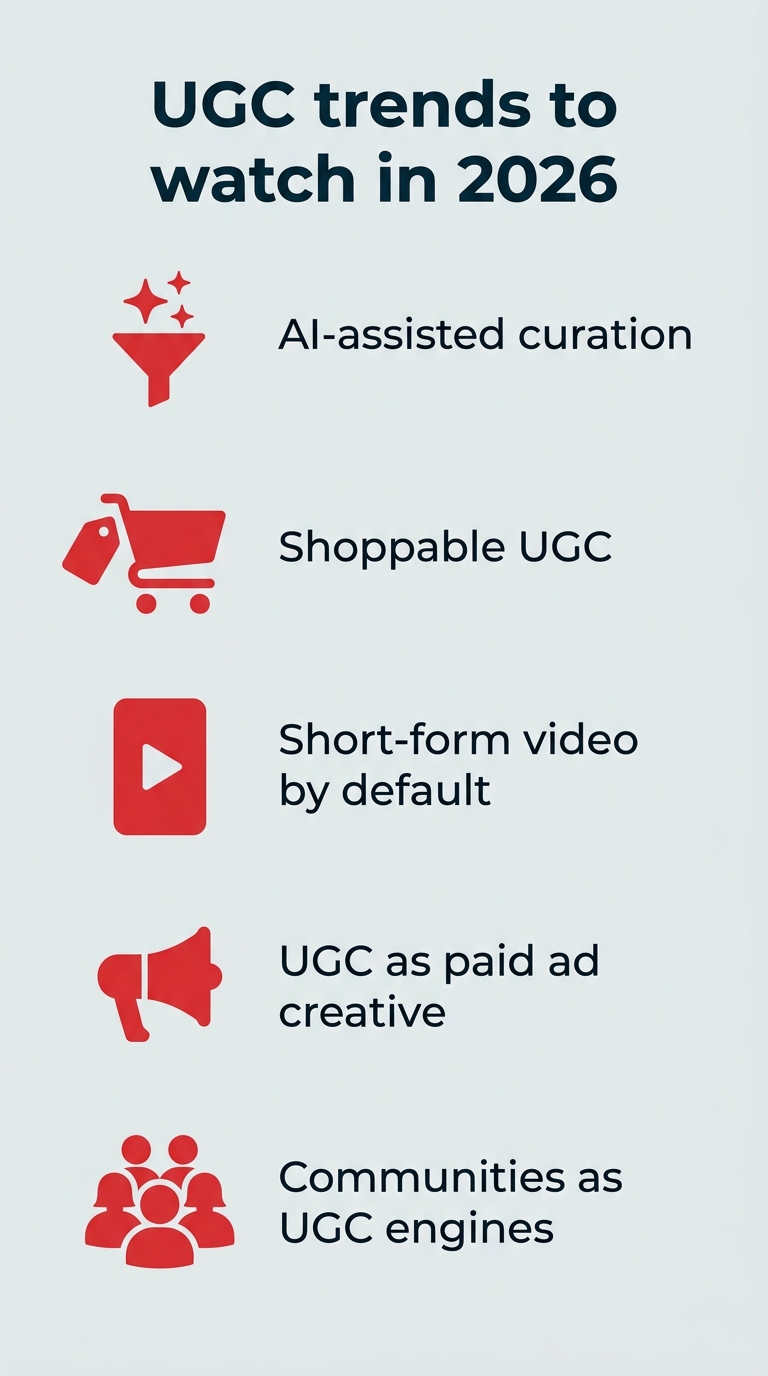
UGC isn’t standing still. The way brands source, approve, and deploy customer content is shifting fast, and a few changes are worth planning around this year.
- AI-assisted curation, not AI-generated “UGC”: Teams are using AI to surface, tag, and sort thousands of mentions into usable assets far faster than manual review allows. Using AI to fabricate fake customer testimonials, on the other hand, is a reputational and regulatory risk that isn’t worth taking.
- Shoppable UGC: Customer photos and videos are moving directly into product pages and social storefronts with tagged products attached. It shortens the path from social proof to checkout — in a market where global social commerce has reached an estimated $585.9 billion in revenue — which is why more ecommerce teams are treating UGC as a conversion asset rather than a social one.
- Short-form video as the default format: TikTok, Reels, and Shorts have made vertical video the format most customers reach for first. Brief your creators for vertical, sound-on, and hook-in-three-seconds by default.
- UGC as paid ad creative: Over 25% of US marketers are already running customer-style content as their primary ad creative because it blends into the feed. Just make sure your usage rights explicitly cover paid placement before you spend behind it.
- Communities as UGC engines: Owned communities, from Discord servers to member programs like Well Traveled’s, produce a steadier stream of content than one-off hashtag campaigns. They also give you a warm audience to request permission from.
The common thread across all five: UGC is moving from a nice-to-have social tactic to a core input for performance marketing.
What tools help you manage user-generated content at scale?
Managing UGC at scale takes four capabilities: discovery, curation and approval, engagement, and measurement. Once you’re handling more than a handful of submissions a week, spreadsheets and screenshots stop working.
Here’s how the workflow maps to Hootsuite Social OS:
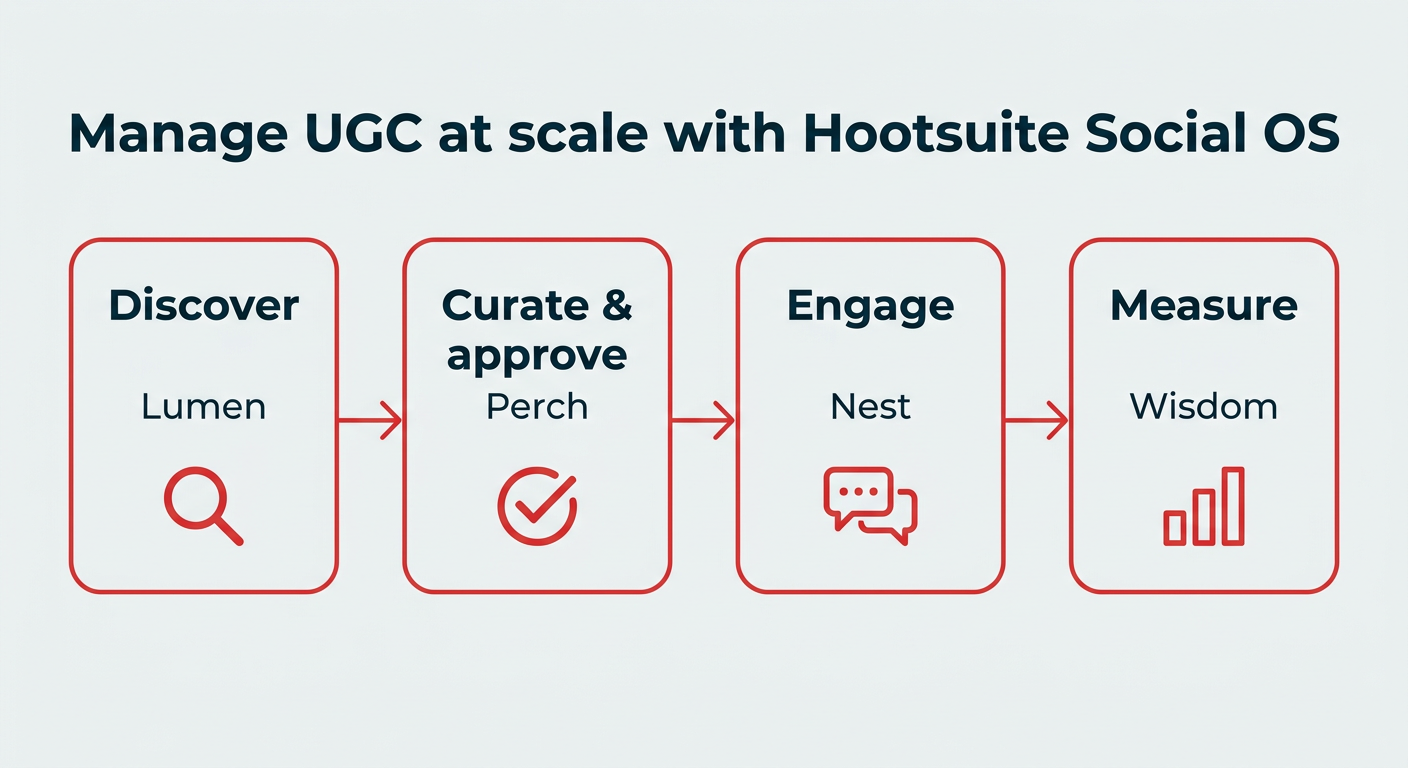
- Discover and monitor: Lumen tracks branded hashtags, mentions, and conversations across networks so you can spot UGC as it appears instead of stumbling on it weeks later.
- Curate, approve, and publish: Perch handles tagging, approval steps, and scheduling in one place, so brand and legal review happen before anything goes live.
- Engage: Nest brings comments and DMs into a single inbox, which makes it easy to thank creators and request permission without hopping between apps.
- Measure: Perch analytics lets you compare UGC posts against branded posts on engagement, clicks, and conversions, and Wisdom lets you ask questions of that data in plain language.
FAQ: User-generated content
What is user-generated content and why is it important for brands?
What is an example of user-generated content?
What are the benefits of user-generated content for engagement and trust?
What is the difference between UGC and influencer marketing?
How do companies collect and use user-generated content in marketing?
Do you need permission to use user-generated content?
How do I become a UGC creator?
Can you actually make money doing UGC?
How do brands manage and moderate user-generated content at scale?
How do businesses measure the impact of user-generated content?
Save time managing your social media marketing strategy with Hootsuite. Publish and schedule posts, find relevant conversions, measure results, and more â all from one dashboard. Try it free today.
With files from Chloe West.