Table of Contents
Key takeaways
- Social mentions include any tagged or untagged reference to your brand on social media, and tracking both types is essential for protecting brand reputation.
- Monitoring sentiment across mentions helps enterprise teams prevent crises early and identify brand advocates for influencer partnerships.
- AI-powered social listening tools can analyze millions of mentions to surface trends, competitive insights, and product feedback that manual monitoring would miss.
- Responding strategically to mentions (not just reactively) turns social conversations into business outcomes like UGC, case studies, and customer loyalty.
Social mentions are posts on social media that reference your organization. They can be posts your brand name is tagged in (i.e. @hootsuite) or instances where your organization’s name is written in a text caption without a direct tag.
Here’s an example of Hootsuite being mentioned, or tagged, with the ‘@’ symbol:

This Instagram comment shows a user tagging @hootsuite directly in their response.
And here’s an untagged social mention of Hootsuite:

This comment mentions Hootsuite by name without using the @ tag.
Most social media platforms notify you when you’re tagged (@hootsuite). It usually means someone is trying to flag something, or wants a response from you.
Both tagged and untagged social mentions are an indication of brand awareness and can have positive, negative, or neutral effects on your brand. Tracking social mentions is one part of using social listening to improve your social media performance and fine-tune your online presence.
Tagged vs. untagged mentions
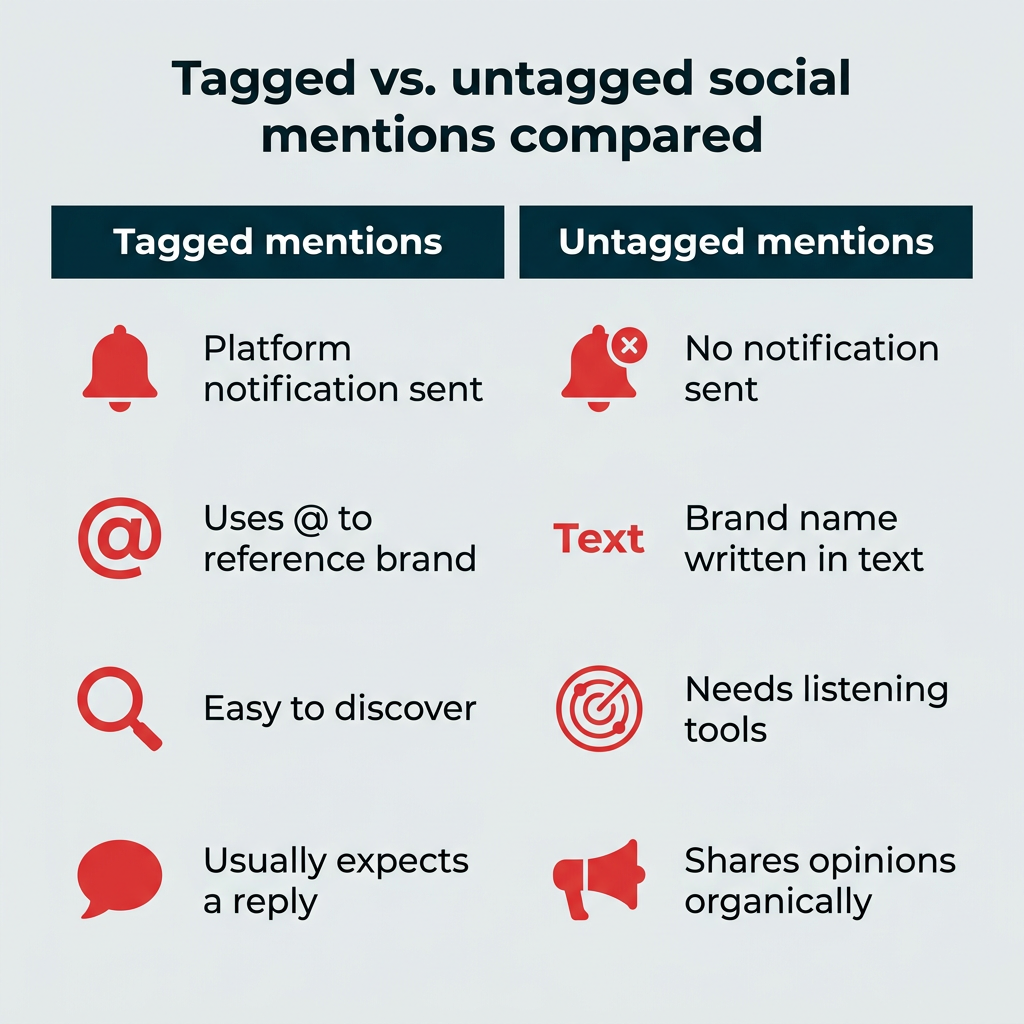
Understanding the difference between tagged and untagged mentions matters because each requires a different approach to discover and respond to.
Tagged mentions | Untagged mentions | |
|---|---|---|
How it works | Uses the @ symbol (e.g., @hootsuite) to directly reference your account | Writes your brand name in text without tagging |
Notification | You receive a platform notification | No notification is sent |
Discovery method | Check your notifications or inbox | Requires social listening or monitoring tools |
Intent | Usually wants a response or is flagging something for you | May be sharing an opinion, recommendation, or complaint with their own audience |
Example | “Love the new scheduling feature @hootsuite!” | “Just switched to Hootsuite and it’s been a game changer” |
Both types are valuable signals. Tagged mentions are easier to catch, but untagged mentions often contain the most candid feedback and organic advocacy. To capture the full picture, you need monitoring tools that surface both.
Social mentions matter because they’re a real-time window into how people perceive your brand. Every mention, whether it’s a glowing recommendation or a frustrated complaint, shapes your social listening strategy and overall brand reputation.
For enterprise teams, tracking mentions isn’t just about staying informed. It’s about acting on what you find. Mentions can reveal emerging crises before they escalate, surface product feedback your support team hasn’t heard yet, and uncover competitive positioning opportunities hiding in plain sight.
They also serve as a direct measure of brand awareness. A rising volume of mentions (especially positive ones) signals that your content, campaigns, or customer experience is resonating. A sudden spike in negative mentions is an early warning system that something needs attention.
In short: if you’re not tracking social mentions, you’re making decisions with incomplete data.
Every social platform handles mentions a little differently. Here’s how to find them natively on the platforms that matter most, along with the limitations you’ll run into without a dedicated monitoring tool.
How do you see mentions on Instagram?
Instagram notifies you when someone tags your account with @ in a post, comment, or Story. You can find these in your Activity tab under “Mentions” or “Tags.”
The limitation: if someone writes your brand name in a caption or comment without using @, you won’t see it. Instagram’s native search is also limited for tracking untagged mentions at scale. A social listening tool is the only reliable way to catch those.
How do you monitor mentions on X (Twitter)?
X notifies you of @mentions in your Notifications tab. You can also use X’s search bar to look for your brand name in posts, which will surface some untagged mentions.
That said, X’s native search has limits. It doesn’t offer sentiment analysis, historical data beyond a short window, or the ability to set up ongoing alerts. For consistent monitoring, especially across high-volume conversations, a third-party tool is more practical.
How do you track mentions on Facebook?
Facebook notifies you when someone tags your Page in a post or comment. You can also see reviews and recommendations on your Page, which function as a form of brand mention.
Untagged mentions on Facebook are harder to find natively. The platform’s search functionality is limited for brand monitoring, and public posts mentioning your brand without a tag won’t appear in your notifications.
How do you find mentions on TikTok?
TikTok notifies you when someone @mentions your account in a video caption or comment. Duets and Stitches that reference your content also appear in your notifications.
However, TikTok’s native search is not built for brand monitoring. If someone talks about your brand in a video without tagging you, there’s no built-in way to find it. This is a significant gap, especially as TikTok continues to grow as a discovery platform with 24% of U.S. adults using it daily.
How do you monitor mentions on LinkedIn?
LinkedIn notifies you when someone @mentions your company page in a post or comment. You can find these in your Page notifications.
For B2B and enterprise brands, LinkedIn mentions are especially valuable because they often come from industry professionals, potential partners, or decision-makers. Like other platforms, untagged mentions require a media monitoring tool to surface.
The bottom line across all platforms: Native tools catch tagged mentions, but untagged mentions (often the most candid and valuable) require a dedicated social monitoring solution.
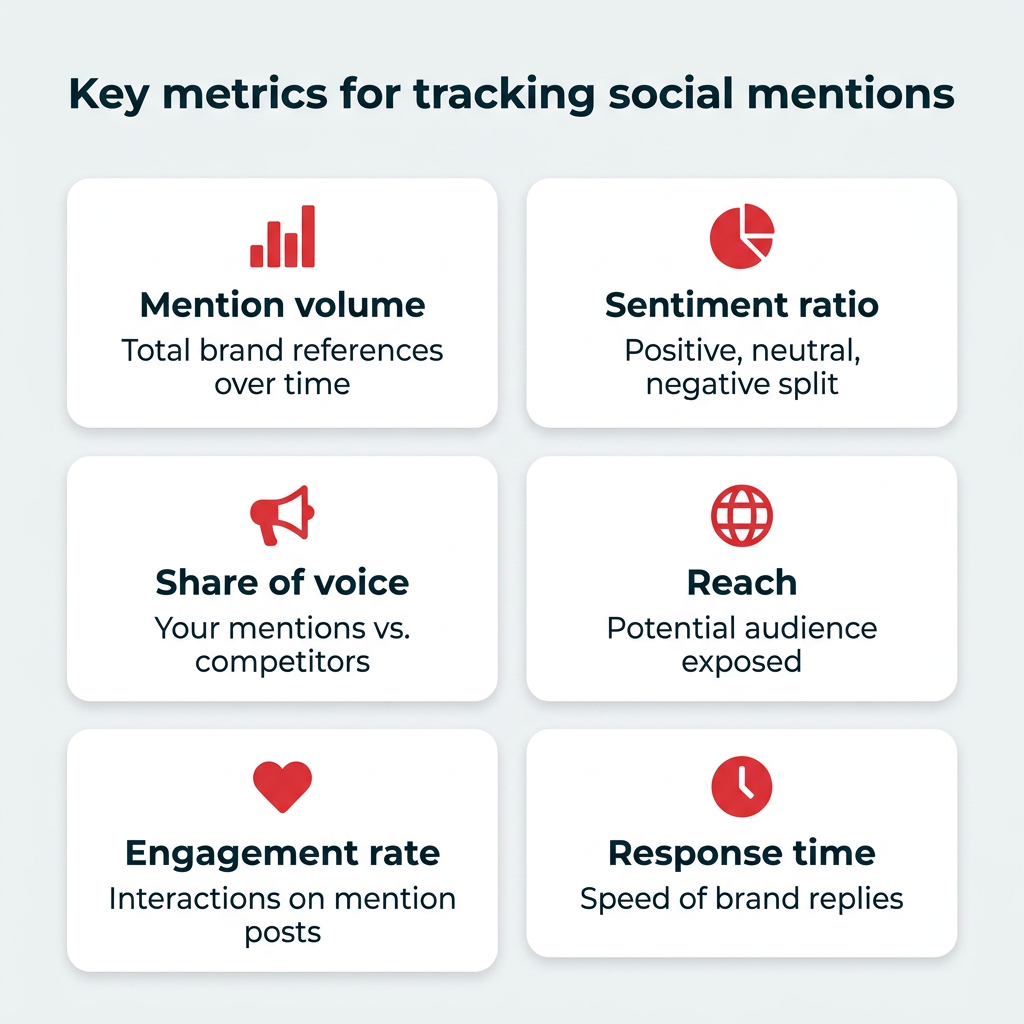
The key metrics to track for social mentions include mention volume, sentiment ratio, share of voice, reach, engagement rate, and response time. Knowing that people are mentioning your brand is a start, but knowing what those mentions mean for your business is where the real value lies.

Metric | What it measures | Why it matters |
|---|---|---|
Mention volume | Total number of times your brand is mentioned in a given period | Tracks brand awareness over time and flags unusual spikes |
Sentiment ratio | Proportion of positive, negative, and neutral mentions | Reveals overall brand perception and early warning signs |
Share of voice | Your mention volume compared to competitors | Shows your competitive standing in the conversation |
Reach | Potential audience size exposed to your mentions | Indicates how far your brand conversations are spreading |
Engagement rate on mentions | Likes, comments, and shares on posts that mention you | Measures how much your audience cares about those conversations |
Response time | Average time between a mention and your reply | Directly impacts customer satisfaction and brand perception |
Tracking these key metrics consistently gives you a clear picture of brand health and makes it easier to tie social media activity to business outcomes when reporting to leadership.
The best tools for tracking social mentions in 2026 include Perch by Hootsuite (with Lumen), Brandwatch, Mention, and Brand24. Several tools can help you monitor social mentions, but they vary significantly in depth, data sources, and enterprise readiness. Here’s how the leading options compare.
Tool | Key capabilities | Best for | Pricing |
|---|---|---|---|
Perch by Hootsuite (with Lumen) | Social listening across 150M+ sources including websites, blogs, forums, and social networks, AI-powered sentiment analysis, competitive benchmarking, real-time alerts, boolean search | Enterprise teams needing unified publishing, listening, and analytics | Starting at $99/user/month billed annually (Standard); advanced listening available on Enterprise plans |
Brandwatch | Deep social listening, audience segmentation, image recognition, historical data | Large enterprises focused primarily on consumer intelligence | Custom pricing |
Mention | Real-time monitoring, basic sentiment analysis, alert system | Small-to-mid teams needing straightforward mention alerts | Starting around $41/month |
Brand24 | AI-powered mention tracking, sentiment analysis, influence scoring | Mid-market teams wanting accessible analytics | Starting around $199/month |
Hootsuite stands out because it connects basic mention tracking in Perch with publishing, engagement, and analytics workflows. For deeper listening, Lumen by Talkwalker adds enterprise-grade sentiment analysis, share of voice, competitive intelligence, and real-time alerts.
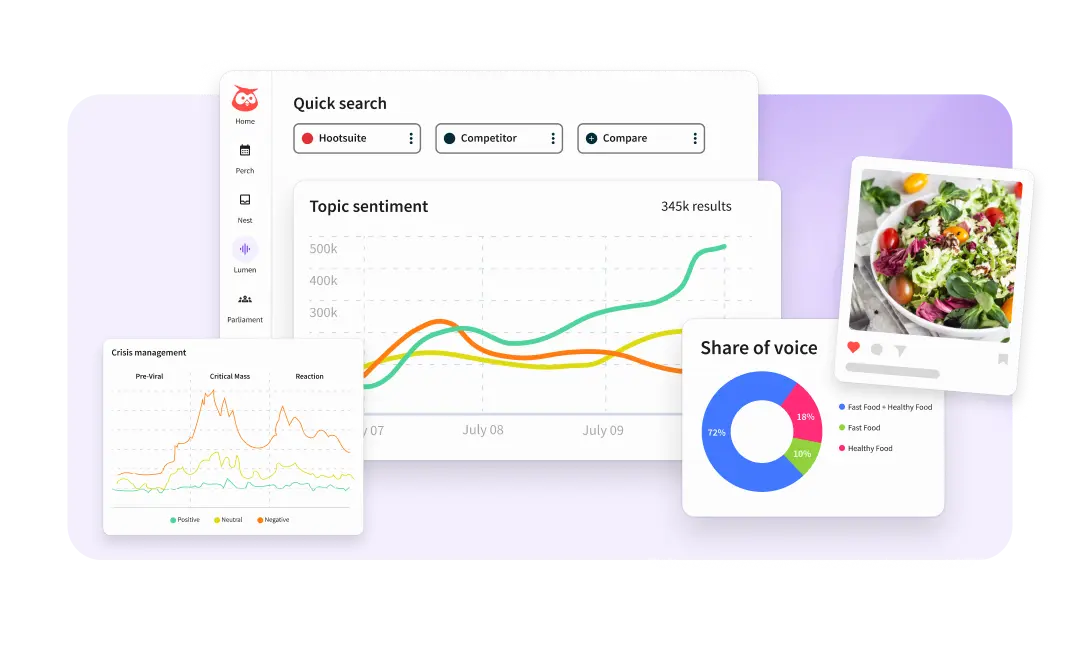
See the top-rated social listening tool in action
See for yourself how Lumen can revolutionize the way your team markets, researches, and reports. Schedule a zero-risk demo now.
Here’s how to track social mentions using Perch by Hootsuite:
- Discover trends with Quick Search
- Check your key metrics
- Identify related themes
- Get specific with filters
- Use boolean operators for targeted results
- Use AI to identify patterns in your mentions
- Share insights with your team
- Go deeper with Talkwalker by Hootsuite
1. Discover trends with Quick Search
Always know the latest trends people are talking about on social media. Get the big picture globally or dive deep into a region.
In Perch, type in your specific keyword, handle, or hashtag to search across millions of social posts. You can also view trending brands and events.

The Quick Search interface displays real-time trend data for any keyword you enter.
2. Check your key metrics
Are more people talking about your organization this week? Search and ye shall see, along with the sentiment around these conversations. Know where you stand at a glance, as well as how people feel about you.
For example, here’s how Netflix and Disney+ stack up in terms of engagement, sentiment, and potential reach:

3. Identify related themes
What are people talking about when they talk about you? Identify all the other topics people mention most alongside your brand name. Or, search for a topic to see other related topics.

Related themes reveal what topics and concepts people associate with your brand.
4. Get specific with filters
In the Results tab, you’ll see selected posts for your search, filterable by sentiment, social network, and more. These are perfect for outbound engagement.
Hootsuite tracks mentions across social platforms, forums (like Reddit and Quora), and more.

Filter results by sentiment, platform, and other criteria to find the mentions most relevant to your goals.
5. Use boolean operators for targeted results
For more targeted results, try adding a boolean operator, the words “AND,” “OR,” or “NOT,” to filter through the noise.

Boolean operators help refine your search to capture exactly the conversations you need to see.
6. Use AI to identify patterns in your mentions
Once you’ve reviewed your mentions, use Wisdom, Hootsuite’s social-first AI, to help make sense of what people are saying. Wisdom can summarize patterns in your social mentions, surface common themes, and help you understand what’s driving a spike in conversation.

Just ask Wisdom plain-language questions like:
- “Why are mentions increasing this week?”
- “What are people saying about our latest launch?”
- “What themes are showing up in negative mentions?”
- “Which conversations should our team pay attention to?”
From there, use the insights to decide what to do next — whether that’s responding to a customer concern, adjusting your messaging, briefing stakeholders, or creating timely content based on what your audience is already talking about.
7. Share insights with your team
Social mentions and listening don’t exist in a vacuum. Make the most of your discoveries by sharing them with your team.
Export the data and metrics you need for presentations to gather buy-in for new social media strategies, and for reporting on results afterwards. Hootsuite’s makes it easy to package insights for leadership reviews and cross-functional stakeholders.

8. Go deeper with Lumen by Talkwalker
Quick Search in Perch is a great way to track recent mentions and spot what people are saying about your brand right now. But when your team needs deeper social intelligence, Lumen by Talkwalker helps you go further.
Use Lumen to analyze sentiment over time, track share of voice, monitor competitors, identify emotional drivers, and understand the audiences behind your social mentions. You can also set up spike alerts to catch emerging risks — like sudden changes in conversation volume or sentiment —before they snowball.

For enterprise teams, Lumen adds the depth needed to connect social mentions to brand health, market positioning, crisis prevention, and competitive strategy — not just day-to-day monitoring.
Use Lumen to:
- Analyze audiences and market-level trends
- Track sentiment shifts over days, weeks, or months
- Monitor share of voice against competitors
- Set alerts for spikes in mentions or negative sentiment
- Understand the emotions and themes driving conversations
- Identify influencers, advocates, and partnership opportunities

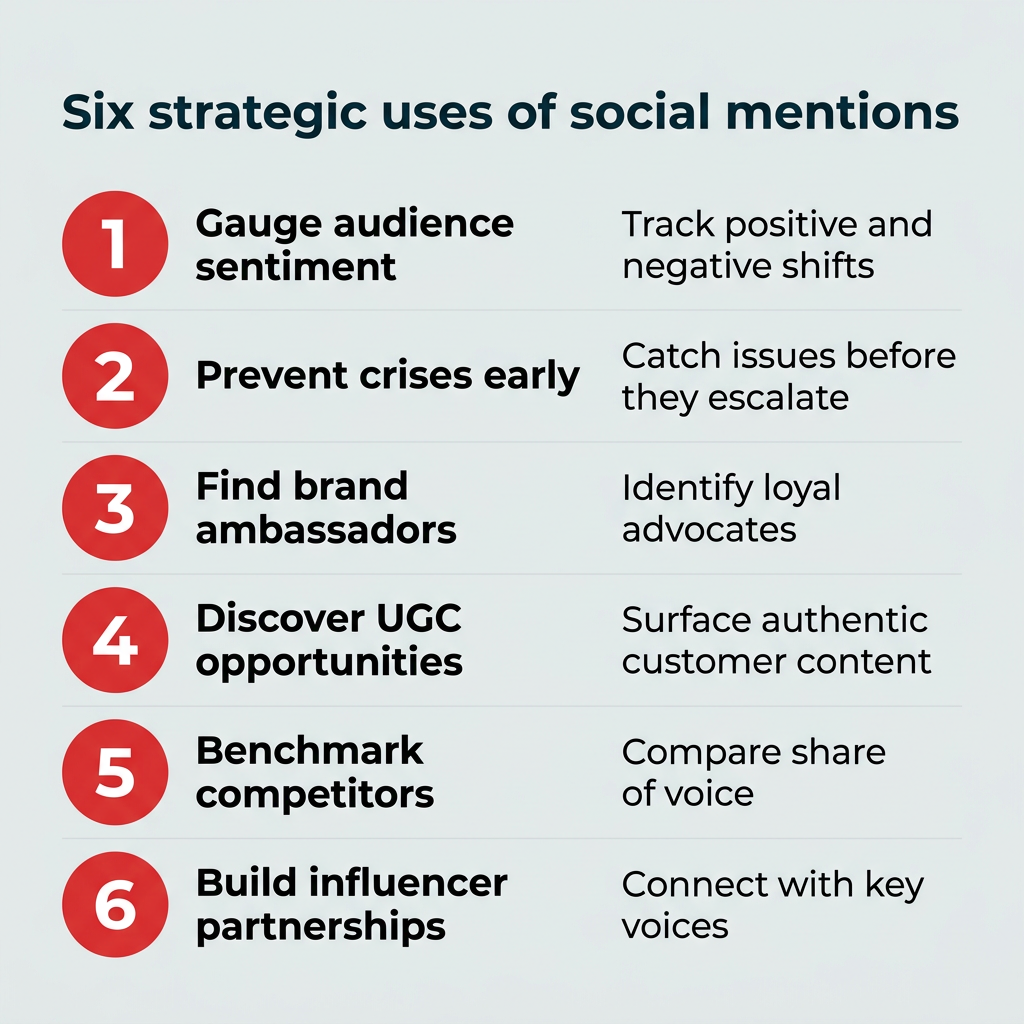
Strategic marketers use social mentions to understand audience sentiment, prevent crises, find brand ambassadors, and identify user-generated content opportunities. As marketing pioneer Bill Bernbach once said, “Word of mouth is the best medium of all.” What Bernbach knew decades ago is what’s still true today: relationships drive sales. And social media is all about building relationships.
Here are six ways to use social mentions in your strategy.
How do you understand audience sentiment?
Social media listening tools find what people are saying, and the best ones can also uncover the emotions behind their words.
Monitoring your ratios of overall positive, neutral, and negative brand sentiment keeps a bird’s eye view on your brand reputation.
A spike toward positive sentiment? Find out what it is and capitalize on the moment. A spike toward negative mentions? Find out what it is and address it head-on as early as possible.

Track sentiment ratios over time to spot shifts in brand perception before they become problems.
How do you prevent crises before they escalate?
Monitoring social media mentions is powerful because you can often avoid a small negative sentiment spike from snowballing into a PR nightmare.
Pay attention when your organization is tagged in social mentions, especially if it’s negative. Try and reframe it from ‘negative’ to ‘constructive’ in your mind. Social mentions are an invitation for dialogue, that customer wants to talk to you to solve the problem, and an opportunity to turn a negative situation into a positive one.
While a few negative social mentions aren’t a crisis, it’s still a good idea to have a PR emergency plan so you can react quickly, if needed.
How do you find brand ambassadors and influencer partners?
Social mentions also help you turn happy customers into bonafide brand heroes, people who shout their love for your brand from the rooftops. Identifying brand ambassadors opens up partnership possibilities for influencer marketing campaigns.
With spending on influencer marketing strategies continuing to grow rapidly, projected to reach $12.17 billion in the U.S. in 2026 and outpacing traditional social media and digital ad spend, social mentions could be the key to unlocking a major competitive advantage for you.

How do you identify and repurpose user-generated content?
User-generated content (UGC) is anything your customers share publicly, for free, about you or your products. It’s real, authentic content that works because it’s content by your customers.
UGC is powerful because trust is the biggest factor to winning (and keeping) customer loyalty: 87% of shoppers would pay more for a product from a brand they trust.
Besides building trust on social media, UGC content is an asset you can use in many ways, such as:
- Testimonials and reviews: Use on your website
- Photos and videos: Repurpose for campaigns
- Social sharing: Repost UGC on your own social media channels, like @moment does
FAQ: Social mentions
What’s the difference between social mentions and social listening?
How often should enterprise teams monitor social mentions?
Can social mentions help with competitor analysis?
Most enterprise listening tools allow you to set up competitor tracking streams and compare sentiment and volume metrics side by side.
Should you respond to every social mention?
Use automation to triage mentions by sentiment and urgency, then focus your team’s efforts where response will have the greatest business impact.
How do you measure ROI from tracking social mentions?
Report these outcomes to leadership with clear before-and-after comparisons showing how listening informed strategy.
Save time managing your social media marketing strategy with Hootsuite. Use Perch to track mentions, spot trending topics, publish posts, and measure results; Nest to manage comments, DMs, and customer conversations; and Lumen to go deeper on sentiment, share of voice, and brand health. Try it free today.