Social media advertising is paid promotion on platforms like Facebook, Instagram, TikTok, and LinkedIn to reach targeted audiences beyond your organic reach.
Most platforms use an auction-based system where you set objectives, define audiences, choose ad formats, and bid for placements.
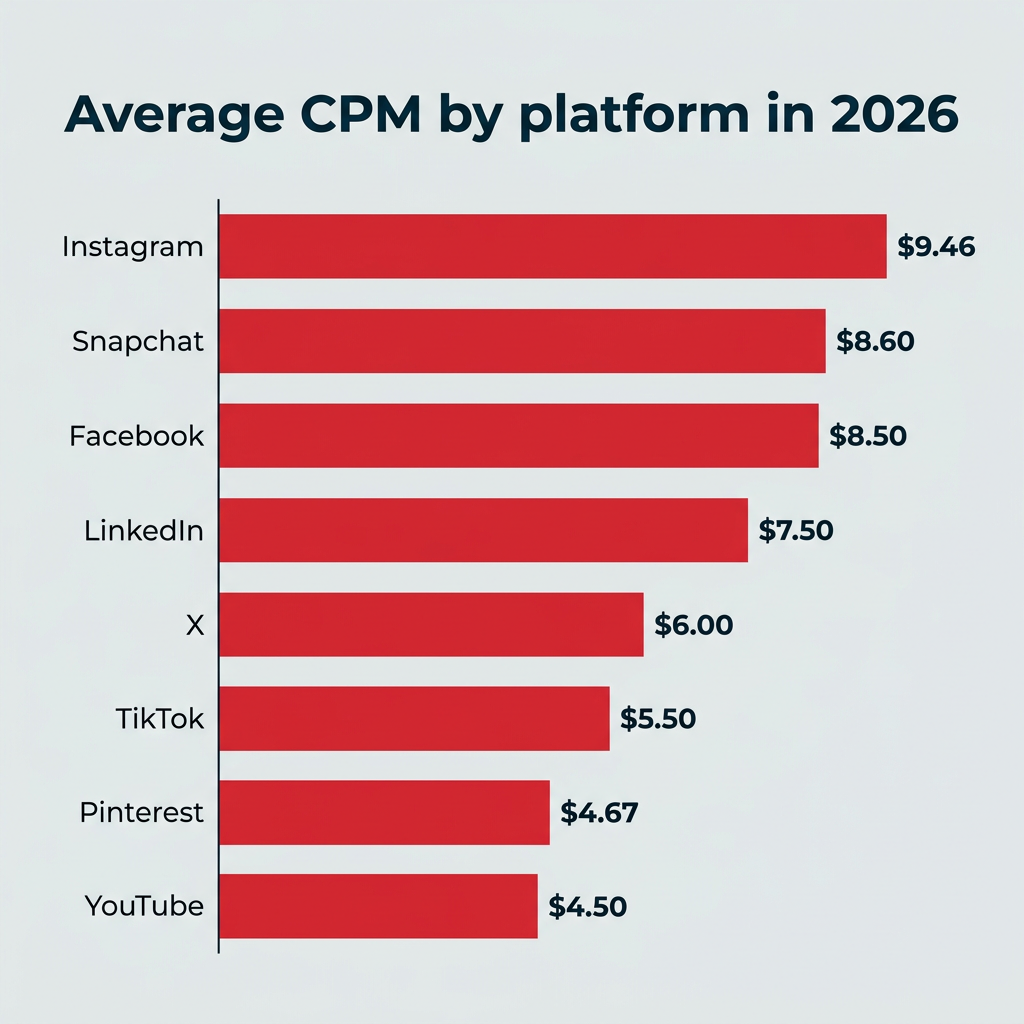
Average CPMs in 2026 range from roughly $4 to $10 depending on platform, audience, and competition, but actual costs vary by industry and targeting.
The best-performing ad campaigns start with clear goals, use organic performance data to inform creative, and track results through metrics like CTR, conversions, and ROI.
What is social media advertising?
Social media advertising is a form of digital advertising where brands pay to reach their target audiences on a social platform like Facebook, Instagram, TikTok, LinkedIn, or X.
The number of people who see your social media ads is referred to as your “paid reach.” This is different from your “organic reach,” which refers to people who see your content when it’s distributed by a platform’s algorithm.
Social advertising is constantly evolving, with global ad spend projected to reach $338.75 billion in 2026.
Standard Meta (then Facebook) ads are no longer the only way to reach users. Advertisers can now take advantage of the rise of new platforms such as TikTok, Snapchat, Reddit, and others that are constantly updating their advertising capabilities to stay competitive.
Cedric Bruce-Kotey, Senior Manager, Paid Social at Hootsuite
Bonus!!!
Download a free guide to social advertising and learn the 5 steps to building effective campaigns. No tricks or boring tips—just simple, easy-to-follow instructions that really work.
Social media advertising vs. social media marketing
Social media marketing is the broad practice of using social platforms to build your brand, which includes organic posting, community management, and content strategy.
Social media advertising is one part of that bigger picture: the paid side, where you spend money to put your content in front of a targeted audience.
Here’s an easy way to think about it. When you post a Reel and reply to comments, that’s marketing. When you pay to put that same Reel in front of 50,000 people who fit your ideal customer profile, that’s advertising.
The two work best together. Your organic efforts tell you what resonates with your audience, and your paid social budgetlets you scale the winners to reach people you wouldn’t otherwise touch. You don’t have to choose one or the other, and most successful brands run both side by side.
What are the benefits of social media advertising?
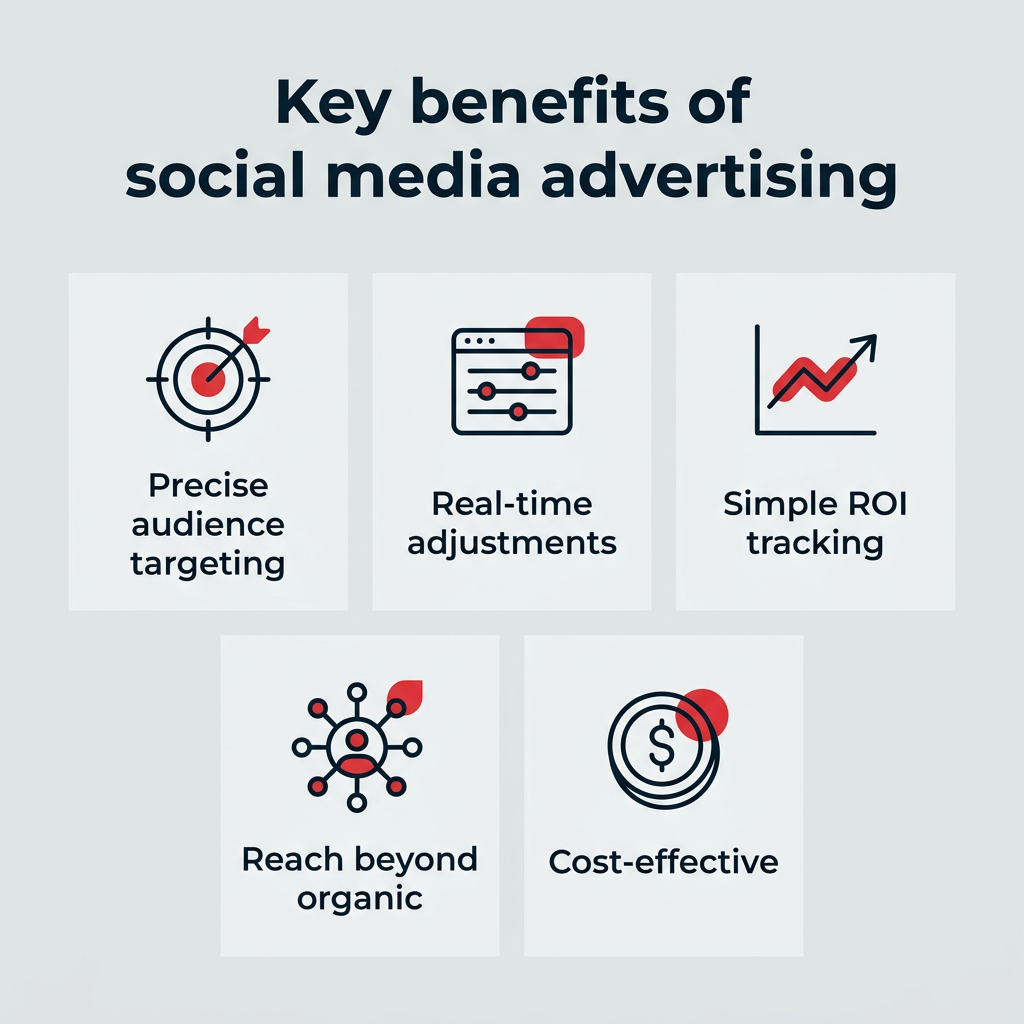
Social media advertising helps businesses reach the right people, control their ad spend, and measure results more clearly than most other marketing channels.
Let’s take a closer look at its benefits below:
Specific audience targeting. Social platforms offer very detailed ad targeting. When you micro-target users with ad campaigns, you reach only the audience most interested in your products, which maximizes your ad spend.
Real-time adjustments. Social ads provide instant feedback. You can easily gauge the effectiveness of an ongoing campaign and make changes based on performance, including reallocating budget to your best-converting ads with just a few clicks.
Simple ROI tracking. Calculating the return on investment (ROI) of your overall social strategy can be challenging, but social ad metrics and reporting show you the real value of your work in dollars and cents.
Wider reach beyond organic limits.Organic reach has declined across most platforms, so even great content often reaches only a small slice of your followers. Paid ads let you get in front of people who don’t follow you yet, which is how you grow past your existing audience.
Cost-effective compared to traditional advertising. A TV spot or billboard can cost thousands before a single person acts on it. With social ads, you can start with a few dollars a day, target precisely, and pay based on the results you actually want.
How social media ads work
Before you spend a dollar, it helps to understand how social media ads actually operate. While each platform has its own quirks, nearly all of them run on the same four building blocks: you pick a goal, choose who sees your ad, build the creative, and set how much you’re willing to pay. Here’s how each piece fits together.
Campaign goals and objectives
Every ad campaign starts with an objective, such as awareness, traffic, engagement, leads, or conversions. This choice matters more than it looks. Once you select an objective, the platform’s algorithm optimizes delivery to get you the most of that specific outcome for your budget. Pick “conversions” and it will hunt for people likely to buy. Pick “awareness” and it will chase cheap impressions instead.
Audience targeting
Audience targeting is where social advertising earns its reputation. Instead of buying a general placement, you tell the platform exactly who you want to reach based on demographics (age, location, gender), interests, and online behaviors. You can also build:
Custom audiences from your own data, like email lists or website visitors.
Lookalike audiences that mirror the traits of your best existing customers.
Retargeting audiences made up of people who already interacted with your brand.
Your creative is the actual ad people see. Most platforms offer image, video, carousel, Stories, and shopping ad formats, and the right choice depends on your goal and where the ad runs. The platform-by-platform breakdown further down goes deep on the specific formats available on each network, so you can match your creative to the placement.
Bidding and budgeting
Social ad space is sold through an auction. You set a daily or lifetime budget, and the platform bids on your behalf against other advertisers competing for the same audience. You’re not just bidding the most money, though. Platforms weigh your bid against how relevant and engaging your ad is likely to be, so a strong creative can win placements at a lower cost. From there, the system spends your budget where it thinks it will best hit your chosen objective.
Social media advertising statistics for 2026
If you’re building a case for paid social, the numbers are on your side. Here are a few current data points on where social media advertising stands heading into 2026:
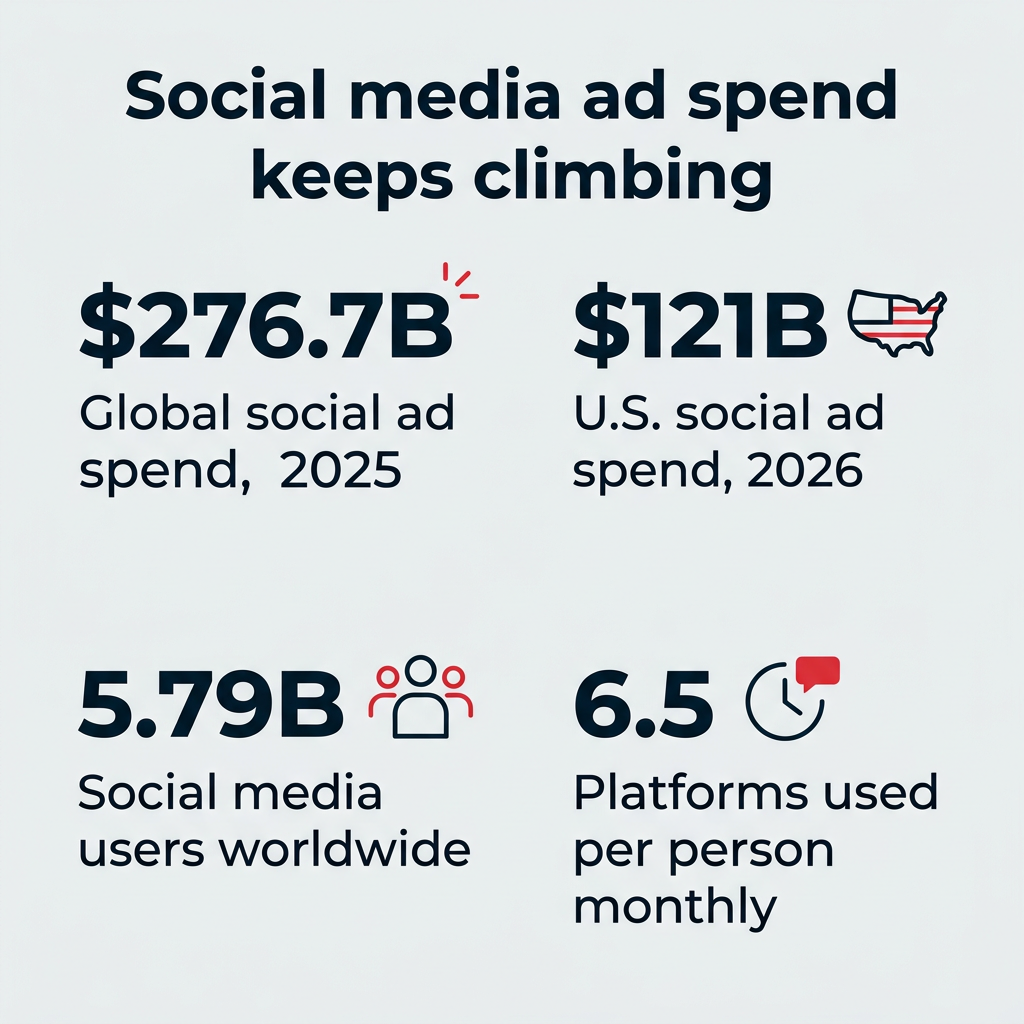
Worldwide social media ad spend is projected to reach $276.7 billion in 2025, according to Statista.
Social media advertising spend in the United States is forecast to grow to roughly $99 billion in 2025 (Statista).
Ad spend per internet user in the social media advertising market is expected to reach about $52 globally in 2025 (Statista).
The number of social media users continues to climb, with DataReportal counting more than 5.79 billion users worldwide, giving advertisers an enormous addressable audience.
The average person uses around 6.5 different social platforms each month, according to DataReportal, which is why a multi-platform ad strategy often outperforms betting on a single network.
The takeaway: Budgets keep rising (with U.S. social ad spend expected to exceed $121 billion in 2026) because the audience keeps growing and the targeting keeps improving. Competition is getting tougher (driven by shifting social media trends), which makes a smart strategy more important than a big budget.
How much does social media advertising cost in 2026?
Social media ad costs vary by platform and format, but most brands can expect to pay between $4 and $10 per thousand impressions (CPM) in 2026.
Overall, CPMs have been increasing across major social platforms, a sign that competition for attention is getting tougher.
Here’s a look at average CPMs and, where reliable data exists, cost per click (CPC) for each social media channel:
The tips below show how to use paid ads to strengthen your existing social strategy rather than replace it. Together, they form a repeatable paid social strategy you can apply to any platform.
Use what you’ve learned from your organic posts, user-generated content, or influencer partnerships as a starting point for your social media advertising strategy. Make sure to treat each platform as its own experiment, since results will vary depending on the audience.
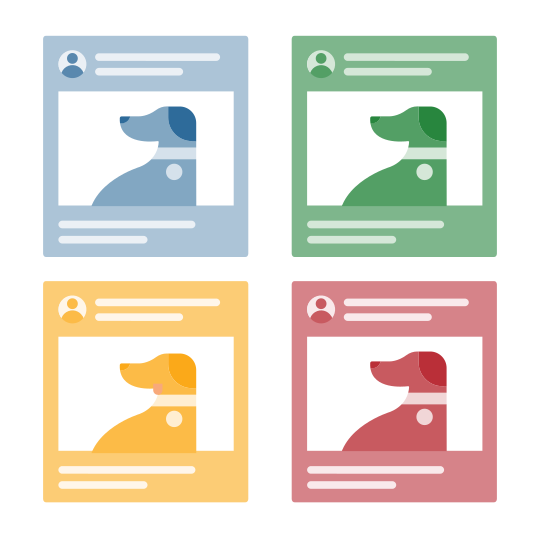
Run A/B tests
Testing one ad against another to determine what works best and refine your strategy is known as A/B testing.
Optimizing ads is all about testing hypotheses. That means test, test, and test some more. You need to determine which creative resonates best, explore new platforms your audience might be on, and take advantage of new features and placements that may help give you an edge.
Cedric Bruce-Kotey, Senior Manager, Paid Social at Hootsuite
It’s a best practice to test several ads with small audiences to determine what works best. Then, use the winning ad for your main social marketing campaign.
It’s awfully hard to achieve your goals if you don’t know what your goals are in the first place.
“Campaign ‘success’ can mean many things,” says Bruce-Kotey. “To determine success, you have to start with a clear goal or OKR.”
Understanding your ultimate goal is critical. It ensures you choose the right social network to advertise on and find the right advertising solution within that platform. Your goal will even guide your creative strategy.
Define your target audience
Know exactly who you’re trying to reach to take maximum advantage of the targeting options and maximize your ROI.
Pro tip 💡: If you have a brick-and-mortar business, try using “geofencing” to target mobile users so they only see ads when they are close enough to walk in your front door.
Measure results and optimize
Having concrete data on ad performance, and how they contribute to business goals (purchases, leads, and so on) is a key part of proving (and improving) ROI.
Focus on the metrics that map to your objective: conversion rate and return on ad spend (ROAS) for sales campaigns, click-through rate (CTR) and cost per acquisition (CPA) for traffic and lead goals, and reach or impressions for awareness. Knowing which ads are most cost-effective will ensure you get the budget you need to continue your work.
The major social networks offer analytics to help you measure the results of ads. You can also use tools like Google Analytics and Hootsuite Perch to measure results across networks from a single dashboard, and pair them with a social media report that ties your ad results back to your overall social content strategy.
Strategies for increasing ad conversions
Getting the click is only half the battle. Once your ads are running, these tactics help turn more of that attention into social media ad conversions:
Use remarketing.Remarketing shows ads to people who already visited your site or engaged with your content. They know you, so they convert at higher rates than cold audiences.
Lean on user-generated content. Real customer photos, reviews, and videos tend to feel more trustworthy than polished brand creative, which lifts click-through and conversion rates.
Add social proof. Ratings, testimonials, follower counts, and “bestseller” tags reassure hesitant buyers and reduce the friction of a first purchase.
Optimize your landing page. Send clicks to a fast, mobile-friendly page that matches the ad’s message and makes the next step obvious. A mismatched landing page wastes even the best ad spend.
Create urgency and exclusivity. Limited-time offers, low-stock notices, and members-only deals give people a reason to act now instead of later.
#1 Easy Social Advertising
Build and post ads for Facebook, Instagram, LinkedIn, and X. Our targeting and reporting are seriously easy.
Now that you have the strategy down, here are four real social media advertising examples that show these ideas in action.
1. Good Protein combines brand ads with creator content
The protein shake brand Good Protein ran a social media advertising campaign on TikTok in which they used Spark Ads to promote creator content alongside brand ads. Creators shared everything from recipes to reviews, while the brand answered questions through video responses.
Why this works: Social media users often trust creators more than brands themselves. Showcasing a variety of voices improved average watch time by 25%.
2. PureGym embraces “real Reels”
PureGym ran lo-fi, handheld Reels ads designed to blend into the Reels feed. By mirroring the look and feel of organic content, the ads felt more native, helping drive stronger watch time and engagement.
Why this works: Brands can sometimes be tempted to make their ads look a little too slick. But it can be more effective to match the style of the typical organic content found on the surface you’re using.
Going more casual gave PureGym a 5.6x increase in Thruplays over previous Reels ads. Bonus: The ads were cheaper and faster to create than their usual, more formal ads.
3. NARS Cosmetics boosts ROI with Instagram Shop ads
NARS Cosmetics tested shopping ads that allowed customers to checkout via their Instagram Shop versus ads that directed customers to the NARS website to complete their purchase.
They found that adding the Instagram Shops checkout option increased ROI by 6% and decreased cost per purchase by 24%.
Why this works: This is a prime example of why testing is so important. The ad pointing customers to the NARS website was working just fine. Why mess with a good thing? Would customers be as willing to check out within the Instagram Shops interface? In fact, they were more willing to do so, something NARS would never have known without testing.
4. Cetaphil gets trendy on Pinterest
Cetaphil leaned into trending topics paired with the Pinterest Trend Badge to show Pinners that they were aligning their content (and new products) with statistically significant trends on the platform.
Why this works: Cetaphil put in the research before launching their campaign. They used keyword research to learn that people were searching for “simple skincare routine” and “skin types.” They used that information to inform their ad creative strategy, leading to a 4.5% increase in brand awareness.
FAQ: Social media advertising
What is social media advertising and how does it work?
Social media advertising is when brands pay to show ads to specific people on social platforms. It works by letting you set a goal, choose who sees your ads based on things like age, interests, and behavior, and set a budget. The platform then shows your ads to the people most likely to take action.
How much do social media ads cost?
Social media ads typically cost between $4 and $10 per thousand impressions (CPM) in 2026, though actual costs vary by platform, audience, and industry. Cost per click ranges from a few cents on YouTube to several dollars on LinkedIn, which reaches a professional B2B audience.
What is the difference between social media marketing and social media advertising?
Social media marketing is the broader practice of using social platforms to build brand presence organically, while social media advertising specifically refers to paying for ad placements to reach targeted audiences. Advertising is one component of a full social media marketing strategy, and the two work best together.
Which social media advertising platforms deliver the best ROI?
The social media platforms that deliver the best ROI are the ones your audience already uses. For many brands, Instagram, Facebook, TikTok, LinkedIn, and YouTube perform well, but results depend on your industry and goals. The best way to find strong ROI is to test a few platforms, track your results, and double down on the ones that drive returns.
What are the most common types of social media ads?
The most common types of social media ads are image ads, video ads, carousel ads, Stories ads, and shopping ads, though each platform offers its own variations. Video and short-form formats like Reels and Shorts ads have become especially popular for reaching younger audiences.
How do social media ads target specific audiences?
Social media ads target specific audiences by using data like demographics, interests, behaviors, location, and custom audience lists to show ads only to people who match your criteria. You can also build lookalike audiences that resemble your best customers and retargeting audiences of people who already engaged with your brand.
What is a good budget to start with for social media advertising?
A good starting budget for social media advertising is $5 to $20 per day on a single platform, which gives you enough data to test what works before scaling up. Start small, identify your best-performing ads, then move more of your budget behind the winners.
How does social media advertising compare to Google Ads?
Social media advertising targets users based on who they are and what they’re interested in, while Google Ads targets users based on what they’re actively searching for. Social ads are strong for building demand and awareness, while search ads are strong for capturing existing intent. Many brands use both.
Are social media ads worth it for small businesses?
Yes, social media ads are worth it for small businesses because they allow you to reach targeted audiences with budgets as low as a few dollars per day. Precise targeting means even a small spend can reach exactly the right people, which is hard to match with traditional advertising.
What metrics should I track for social media ads?
The most important metrics to track for social media ads are click-through rate (CTR), cost per click (CPC), conversion rate, return on ad spend (ROAS), and reach. The right metric depends on your goal: awareness campaigns focus on reach and impressions, while sales campaigns focus on conversions and ROAS.
Save time managing your social media marketing strategy with Hootsuite. Publish and schedule posts, find relevant conversions, measure results, and more â all from one dashboard. Try it free today.
Christina Newberry has been writing about digital marketing since the prehistoric days of 2002, when email opt-ins were every marketer's biggest goal. With a deep understanding of how to connect to online audiences, she shifted her focus to social media and has been contributing to the Hootsuite blog since 2016.
Analytical, curious, and always learning. Results-driven, with a passion for digital advertising. Over 7+ years of agency-side experience in performance marketing for Fortune 500 brands across an array of industries/verticals and media platforms. Experience in aspects of marketing primarily focused on paid media strategy, media buying, measurement, influencer marketing, Google Ads (PPC), Paid Social, Display Advertising, Youtube Advertising, Bing Ads, and Remarketing. Earned a Master's Degree in Digital Marketing & Analytics at Aurora University.
Expertise in: Facebook Ads, TikTok Ads, Google Ads (Search & Display), Programmatic Ads, Tag Manager, Mobile App Campaigns.