Key takeaways
- Social media KPIs are the specific metrics tied to business goals that tell you whether your strategy is working, not just any number you can measure.
- The most important KPIs fall into five categories: engagement, awareness, conversions, customer care, and content performance.
- Setting effective KPIs starts with your business objectives and uses the SMART framework to create measurable, time-bound targets.
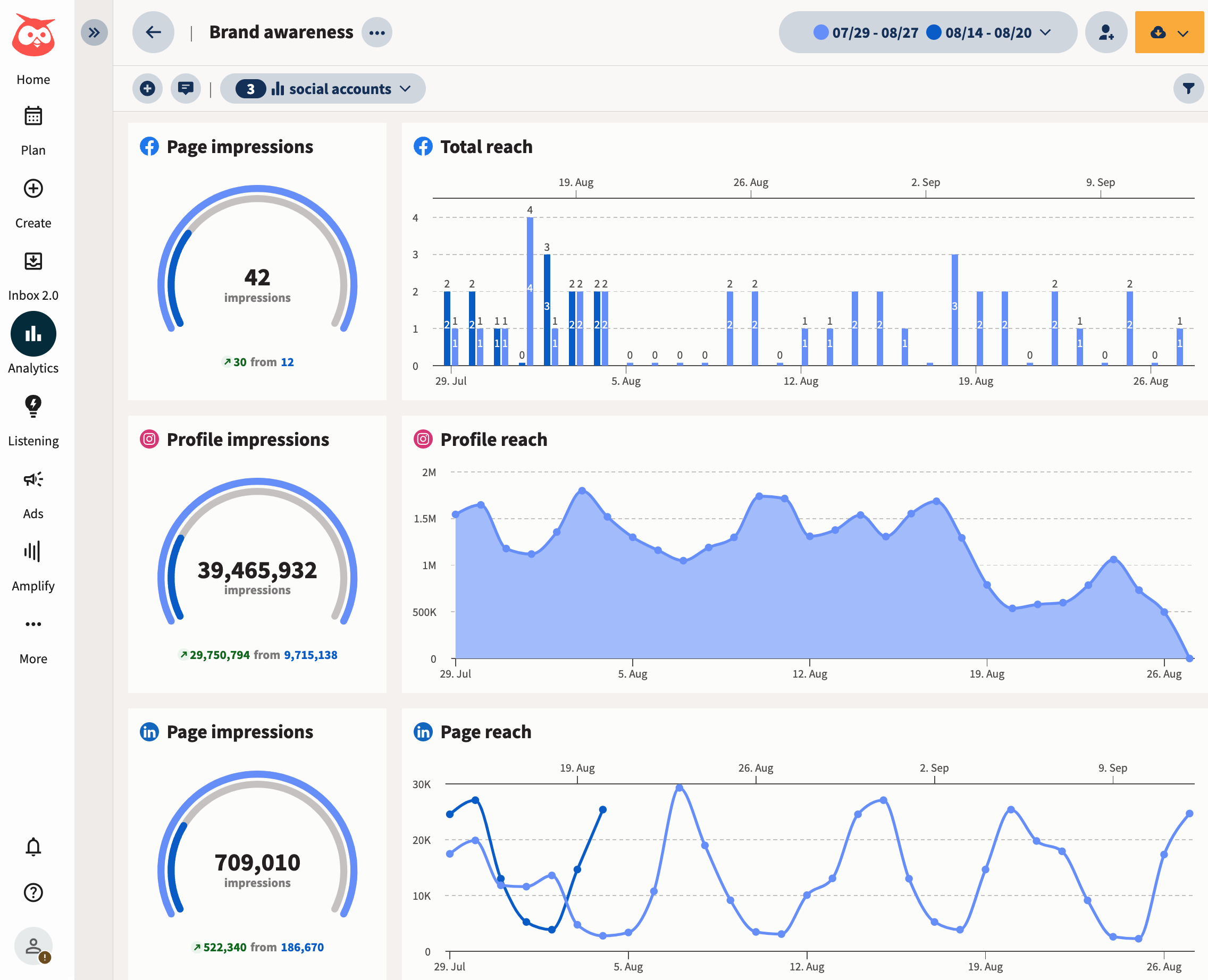
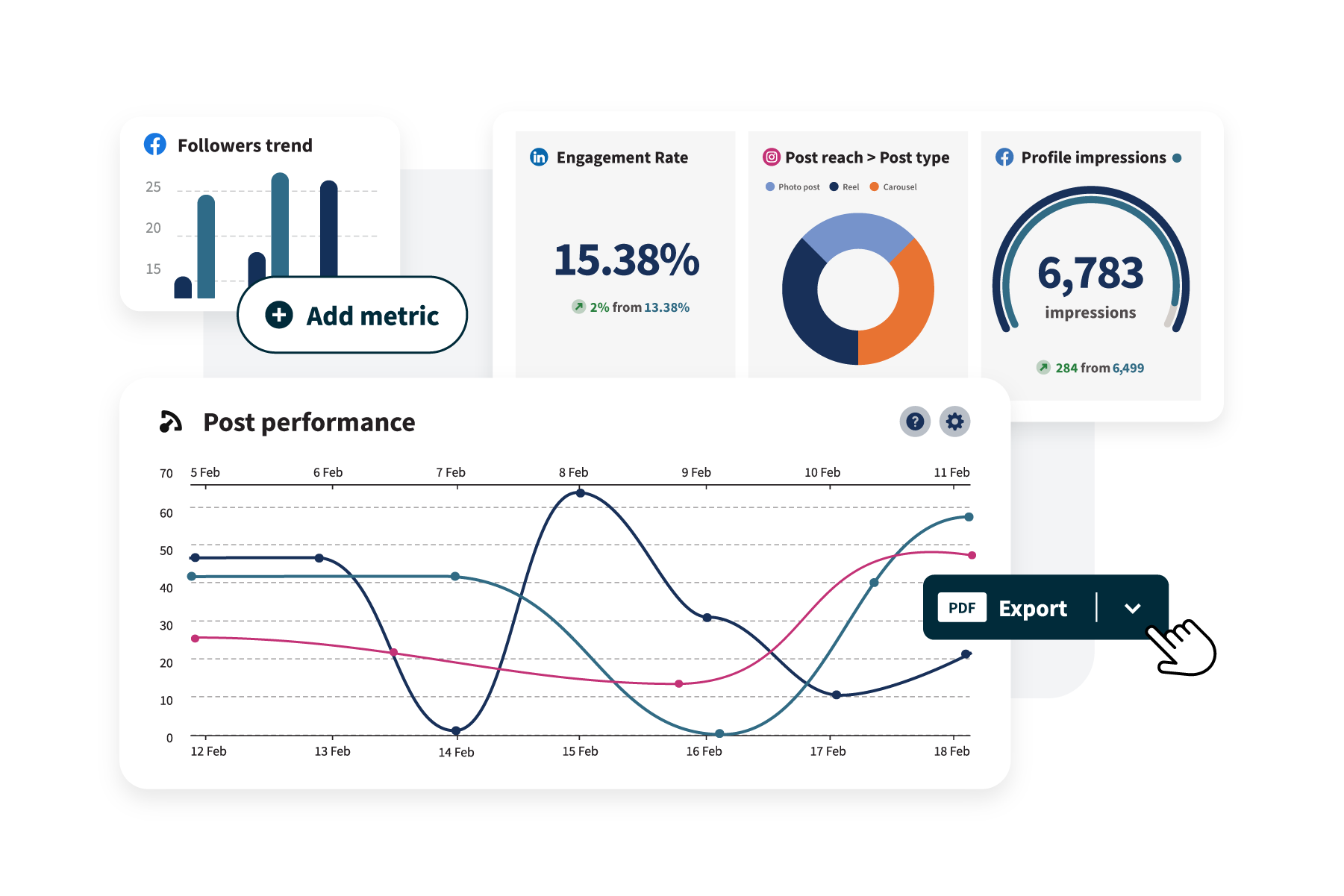
- Tracking KPIs for social media across platforms from a single dashboard (like Hootsuite Analytics) eliminates manual reporting and surfaces trends faster.
Social media KPIs (key performance indicators) are numbers that help you measure how well your social media strategy is working.
Unlike general metrics (like impressions or likes), KPIs are tied to specific business goals.
For example, if your goal is to grow brand awareness, your KPIs might include follower growth rate and post reach. If you’re focused on customer care, you might track average response time or resolution rate.
The key word here is key. A KPI isn’t just any number you can measure. It’s not a vanity metric. It’s the number that tells you whether your work is moving the needle in the right direction.
KPIs help answer questions like:
- Is our content strategy working?
- Are we reaching the right people?
- Are we getting results that help the business?
In short, social media key performance indicators are the metrics that connect your daily social media work to measurable business outcomes.
Social media KPIs vs metrics: What’s the difference?
People often use KPIs and metrics interchangeably. But in practice, they serve different purposes.
- Metrics are any measurable data points you track, such as likes, comments, shares, and clicks.
- KPIs are the key metrics that are directly tied to a specific business goal. They’re the numbers you actually use to measure success.
Think of it this way: All KPIs are metrics. But not all metrics are KPIs.
Let’s say your goal is to grow your audience. You might track a range of metrics: impressions, engagement rate, shares. But your KPI might be weekly follower growth. That’s the one tied to your outcome.
Here’s a quick breakdown:
| If your goal is to... | A KPI might be... | Supporting metrics could include... |
|---|---|---|
| Build awareness | Reach or impressions | Shares, profile views, hashtag performance |
| Drive traffic to your website | Link clicks | Tap-throughs, bio clicks |
| Increase engagement | Comments per post | Likes, shares, saves |
| Improve customer service | Average response time | Reply volume, resolution rate |
In short, all KPIs are metrics, but only the metrics tied to specific business goals qualify as KPIs.
With social networks projected to claim close to 32% of US digital ad spending in 2026, clear KPIs are essential to know whether your social strategy is actually working. Here’s why tracking them matters:
- KPIs keep your team aligned. Social media KPIs give everyone, from creators to executive stakeholders, a shared understanding of what success looks like. Whether it’s reach, clicks, or conversions, your whole team works toward the same goals.
- Measure progress against business objectives. KPIs for social media help connect your daily posts to bigger outcomes, like sales, leads, or brand awareness, and ultimately help you prove your social media ROI.
- Justify budget and headcount. Need more resources? Solid social media KPIs help make your case, especially when 59% of CMOs report insufficient budget to execute their strategy in 2025. If you can show how your work contributes to growth, it’s easier to unlock or justify budget to hire more help.
- Spot what’s working, and fix what’s not. KPIs highlight the tactics that deliver real results. You can double down on high-performing content and adjust quickly when something underperforms.
- Make reporting easier. KPIs give structure to your social media reports. They make it easy to show clients, stakeholders, or leadership exactly how your content is performing and why it matters.
To set social media KPIs, start by identifying what success looks like within your broader social media strategy, then reverse-engineer the path to get there. It’s not just about picking numbers to track.
Here are a few tips on how to set social media KPIs that are tied to your business goals, grounded in data, and flexible enough to grow with your strategy.
Understand your business objectives
Your social media KPIs should always be tied to an overall strategic goal. Ask yourself: what’s the end game?
For example, is the goal of your social media campaigns to increase brand exposure (the top benefit of social media marketing, with 81% of marketers worldwide citing increased exposure as the leading outcome)? Drive website traffic? Or to get more conversions and sales?
Once you decide on a strategic direction, it’s time to break that down into individual goals and associated KPIs for social media.
If your end game is to drive website traffic, for instance, one of your KPIs might be tied to the number of clicks from social media to your site. You might also explore strategies like zero-click content to keep users engaged on the platform while still building brand awareness.
Track competitors and industry benchmarks
What does success look like for social accounts similar to yours?
With Hootsuite’s social media benchmarking, you can find out how others in your industry are doing on social and compare your results for social media metrics like:
- Profile impressions
- Profile visits
- Followers
- Audience growth rate
- Engagement rate
- Video plays
- Posting frequency
- Clicks
- Shares
You can also get even more granular and compare your performance to specific competitors rather than your industry as a whole.

Hootsuite’s benchmarking tool lets you compare your social media KPIs against industry standards.
If measuring KPIs on social media is new to your team, make sure you collect your own benchmark data too, so you know where you’re starting from.
Set SMART goals
Comparing your current performance to that of your industry helps you set more realistic KPI targets. Like your overall business goals, your social media KPIs should be SMART:
- Specific: Include a clear target. For example, do you aim to increase the brand’s Instagram follower count by 500 next month? Do you want to increase your click-through rates by 20% by the end of the year?
- Measurable: KPIs incorporate metrics to track and quantify your progress. You should always be able to determine how close you are to meeting the goal.
- Attainable: Keep it real. Set KPIs that are within an achievable scope based on the overall industry and your own resources.
- Relevant: Make sure each social media KPI connects to the business’s larger goals.
- Timely: What’s the timeframe for achieving this goal and determining whether success has been met? One month, six months, one year?

Use the SMART framework to set social media KPIs that are specific, measurable, achievable, relevant, and timely.
Choose the relevant metrics and structure your KPIs
Once you’ve set your direction, choose the specific social media metrics that will show if you’re making progress.
Say your goal is to grow your brand. You might track metrics like Instagram Reels views, reach, or follower growth.
Now, turn those into structured KPIs using the SMART framework. For example:
- Grow Instagram followers by 10% in the next 90 days
- Increase average reach on LinkedIn posts by 25% over the next quarter
- Get 1,000 Reels views per post on average by the end of the month
- Improve click-through rate on X posts to 1.5% within 8 weeks
Clear targets like these help you stay focused, track your success, and adjust faster when things aren’t working.
Track and analyze your performance
Don’t wait until the end of your timeline to check if your KPIs are on track. Set a regular reporting rhythm (weekly, biweekly, monthly, etc.) so you can spot trends early and make smart adjustments before small problems turn into big ones.
This is where you look beyond surface numbers. What’s gaining traction? What’s falling flat?
Dig into the data, find the story, and use it to fine-tune your content, cadence, or creative. Patterns (good or bad) can point to opportunities for improvement.
Frequently asked questions
What is the difference between a KPI and a metric in social media?
How many social media KPIs should I track?
How often should I review my social media KPIs?
What are the most important social media KPIs for enterprise brands?
Can I use the same KPIs across all social media platforms?
Save time managing your social media marketing strategy with Hootsuite. Publish and schedule posts, find relevant conversions, measure results, and more — all from one dashboard. Try it free today.