Table of Contents
Social media is seen as the fun, lighthearted part of a marketing strategy. But that undersells the value it brings to the table.
In this guide, we’ll break down the true value of social media, and how to prove it to leadership.
Key takeaways
- Social media creates value before and after a sale. It can drive discovery, influence decisions, and maintain relationships afterwards.
- When it’s time to report on the impact of social, don’t make leadership do the math. Tell them what changed, why it matters, and what you’d do next.
- Hootsuite makes the value of social easier to prove. Lumen tracks brand intelligence, Perch shows what content is working, and Wisdom turns your data into insights.
Social media creates value by helping a business stay visible, relevant, and connected to the people it wants to reach.
ROI is part of that value, but it’s not the whole picture. Social can also lead to:
- Smarter business decisions, by turning social conversations into insights
- Stronger relationships, by replying to comments and DMs
- Greater brand recognition, by showing up consistently in people’s feeds
- More traffic and leads, by giving people a reason to click
- A competitive edge, by seeing what others in your space get right (or wrong)
- Stronger trust signals through reviews, user-generated content, and other social proof
That’s why social’s value can’t be measured by sales alone. Everything else on this list still counts, even when it doesn’t show up in a revenue report.
Do it better with Hootsuite, the all-in-one social media tool. Stay on top of things, grow, and beat the competition.
Social media value vs. social media ROI: What’s the difference?
Social media value is the full impact social media has on your business. Social media ROI is more specific: it’s the financial return you get compared to what you spent.
Here’s a quick breakdown:
| Social media value | Social media ROI | |
| What it is | The overall impact social media has on your business | The return you get from what you invest in social media |
| What it includes | Revenue, awareness, loyalty, reputation, and leads | Revenue, profit, cost savings, and other financial outcomes |
| Time frame | Builds slowly, over months or years | Usually tied to a specific campaign or reporting period |
Social media brings real value, but the payoff is often delayed, spread across multiple touchpoints, and not always tied to revenue.
Here’s what’s actually going on:
Social is a long game
Brand awareness, customer trust, community — these things take time to build.
To put things in perspective, a recent study found that one-year-old brands have very little awareness in their category, just 0.6% on average. Five years later, that figure was 12x higher.

Source: NP Digital
Social media works in a similar way. You rarely publish one great post and wake up the next morning with a loyal audience. If you only measure the immediate payoff, it’s easy to overlook what social is building in the long run.
Attribution gets messy
29% of consumers in the U.S., UK, and Germany say they first discovered a product on social media, then completed the purchase somewhere else.
That’s the reality of how people shop online. Someone might discover you on TikTok, visit your website later, then finally convert through a retargeting email.
That makes attribution messy. Social helped, but it doesn’t always get the credit.
Not all value shows up as revenue
Some of social’s biggest benefits never translate into a dollar amount.
Maybe social listening catches the same customer complaint over and over, so your product team fixes it before it spirals. Or, maybe you reply to a frustrated customer and make them feel heard, so they decide to buy again months later.
Neither of those scenarios fit into a revenue report, but both created real value for the business.
Social media creates value across six main areas: revenue, customer insight, customer care, reputation and brand health, content performance, and brand awareness.
Let’s dive into each type of value:
Revenue and pipeline impact
This is the most direct kind of value. It can show up as:
- Sales driven by social ads or organic posts
- Leads generated from campaigns
- Website traffic that turns into sign-ups, demos, or purchases
- Pipeline influence when social helps move someone closer to buying
ROI is simple in theory. However, marketers ranked “measuring ROI” as their single biggest challenge in 2026. We won’t lay out all the math here, but our social media ROI guide has you covered.
Customer insight and market intelligence
Social is basically a giant, always-on focus group (except nobody was invited and the feedback isn’t always polite).
That’s what makes it useful. People will tell you what they love, what they don’t, and where your competitors might be missing the mark.
And that insight doesn’t have to stay in marketing. It can shape product decisions or help sales sharpen their pitch (just to name a few).
Customer care and retention
Nearly 3 in 5 consumers say it’s important for companies to respond to support messages on social media, according to a 2025 survey.
If that’s not enough, 37% say slow response times contribute to a negative experience. That makes social one of the first places brands can either win someone back or lose them for good.

Source: CX Dive
Reputation and brand health
Social gives you a real-time read on how people feel about your brand.
Maybe customers are peeved about a product update. Maybe a campaign landed badly. Or maybe people are talking about you for all the right reasons.
The value is catching those signals early, giving you more time to plan your response, adjust your messaging, or double click on what’s working.
Content and campaign intelligence
Every post is a small experiment. Some land, some flop. All of that is useful data.
Over time, those patterns tell you what to make more of and what to phase out, making your next campaign smarter before you spend another dollar.

Brand awareness and share of voice
This is how many people know your brand exists, and how much of the conversation in your space you actually own.
A spike in mentions or a jump in followers are the obvious signs. But awareness is doing its job even when nobody’s clicking anything. It’s just quietly making your name the one people recognize later.
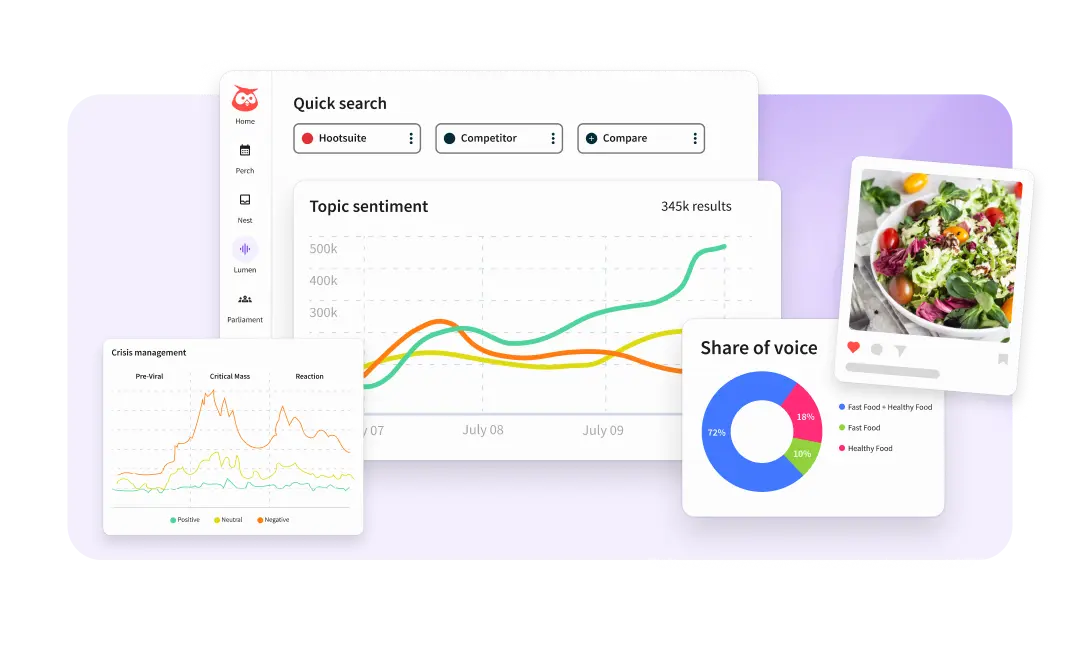
See the top-rated social listening tool in action
See for yourself how Lumen can revolutionize the way your team markets, researches, and reports. Schedule a zero-risk demo now.
What you measure depends on the kind of value you’re trying to prove. Here’s a quick rundown of each type of value and the signals worth tracking:
| Type of value | What to measure |
| Revenue | Conversions, leads, social-attributed revenue (via UTM tracking), and assisted conversions |
| Brand awareness | Reach, impressions, share of voice, mentions, and branded hashtag usage |
| Customer insight and market intelligence | Recurring themes in comments and DMs, sentiment trends, and common questions or complaints |
| Customer care | Response time, resolution rate, and customer satisfaction |
| Reputation and brand health | Sentiment, share of voice, negative mention spikes, and changes in brand perception |
| Content and campaign intelligence | Shares, saves, watch time, engagement rate, and performance by topic or format |
Psst: Revenue is usually the one leadership asks about first, and it’s also the trickiest to nail down. Head to our social media ROI guide for how to calculate it without breaking a sweat.
The best way to communicate social media’s value is to make the business impact easy to see. Pick the most important metrics, tie them back to your overall business goals, and give recommendations and next steps.
Here’s exactly how to do that, step by step:
- Translate metrics into business language
- Benchmark against goals, not vanity metrics
- Give the numbers context
- Make recommendations
1. Translate metrics into business language
Nobody in the C-suite is losing sleep over your engagement rate. They’re losing sleep over the business.
“From my perspective, leadership doesn’t truly care about social media metrics, not the way social media managers do. They care about what those metrics tell them about their business or brand,” says Dani Luffey, Communication Strategist at DVA Brand Communications.
So don’t stop at “engagement increased” or “sentiment decreased.” Explain what that change actually tells you. Are customer interests shifting? Is demand picking up? Is there a potential crisis on the horizon?
That’s what leadership actually cares about.
2. Benchmark against goals, not vanity metrics
A post going viral feels good. But it means very little if it doesn’t move the business forward in any meaningful way.
“One of the biggest misconceptions is that social media success should be measured by follower count or whether a post ‘goes viral,’” says Megan Wilson, Creative Director at Sweet Talk Strategy.
In reality, she says, a strong social media strategy isn’t about one big moment. It’s about consistently supporting larger marketing and business goals.
So ground your reporting in those goals, then show where social made a difference.
3. Give the numbers context
Numbers alone won’t tell leadership anything. What they need is context, and that’s on you to provide.
“Social media managers sometimes make leaders work way too hard,” says Luffey. “If an executive has to study your dashboard to uncover why the numbers matter, then you haven’t communicated your value yet.”
Instead, call out the metrics that matter, put them in context, and share the lesson behind it. In other words, don’t make leadership go digging for it.
4. Make recommendations
Anyone can make a social media report. Giving recommendations is what makes you a strategic partner.
“Don’t just report the numbers. Tell leadership what they should do next,” says Luffey. “That’s the difference between sounding like the person managing the social channels and sounding like a strategic advisor who also happens to have access to an incredibly valuable source of customer intelligence.”
Teams weaken their case when they include too much data, focus on activity over impact, and treat revenue as the only business outcome that counts.
Here’s what to watch out for:
1. Overloading leadership with data
It may sound counterintuitive, but handing leadership a 20-page report full of charts and spreadsheets isn’t “being thorough.” It’s just giving them information overload.
As Wilson puts it, “Reporting every metric can actually make the value of social harder to see, or lead to leadership zeroing in on numbers that don’t have much impact.”
Her advice? “Focus on a few meaningful metrics, explain why they matter, and share what you’re learning from them.”
2. Leading with activity, not impact
So you published 100 social media posts and launched four campaigns last month. That tells leadership you were busy, but it doesn’t tell them what any of that work accomplished. Make sure to draw that line for them.
3. Treating revenue as the only outcome that counts
If you only give social credit when it ends in a sale, you erase a lot of the value it created along the way.
Social might increase demand, build credibility, or keep your brand top of mind. Another channel may get the final click, but that doesn’t mean social didn’t help get them there.
Hootsuite makes it easy to prove the value of social media. Lumen tracks brand intelligence, Perch connects content output to performance, and Wisdom turns all that data into a clear story.
Track brand intelligence and share of voice with Lumen

Awareness and reputation are two of the hardest things to prove, mostly because they don’t live in your own analytics dashboard.
That’s where Lumen comes in. It tracks mentions, sentiment, share of voice, and emerging themes across 150 million websites and 30+ social channels.
That gives you a lot more to work with than surface-level engagement numbers. For example, you can share how your share of voice stacks up against competitors, or what’s shaping your brand perception right now.
Scale output without scaling headcount with Perch

More content usually means more headcount, more hours, and more stress. Perch changes that.
Teams can use Perch to plan, create, approve, and schedule content across every social media platform from one workflow. And because performance lives right alongside the work itself, you can see which posts and campaigns are pulling their weight, and how that performance changes from channel to channel.
So when it’s time to share results, you can show leadership exactly what your team shipped, what worked, and where to invest next.
Get plain-language impact summaries with Wisdom

A dashboard full of numbers isn’t exactly compelling. Someone still has to translate it into words a human will actually read.
Wisdom can take that off your plate. Ask it questions like “Why did engagement drop last week?” or “How did our Instagram Reels perform compared to last month?” and get answers grounded in your actual performance (with citations).
That makes it much easier to turn your data into a narrative, whether it’s explaining a sentiment shift, reporting on campaign performance, or turning a month of social activity into a stakeholder-ready summary.
FAQ: Social media value
What is the value of social media for a business?
Is social media value the same as social media ROI?
Why is it important to calculate social media value?
How can businesses measure the impact of their social media presence?
Content type also matters. Video content on TikTok can be judged by views and watch time, while a LinkedIn thought leadership post could be more about comments and shares.
How does Hootsuite help prove social media value?
Prove the value of social with Hootsuite. Use Lumen to uncover brand intelligence, Perch to connect content to performance, and Wisdom to turn the numbers into clear insights. Try Hootsuite free today.