Table of Contents
Key takeaways
- A social media crisis is a sudden shift in online conversation that threatens trust and reputation, not just a single negative comment.
- Effective social media crisis management starts before anything goes wrong, with clear roles, escalation tiers, and pre-approved response templates.
- The 15-20-60-90 response timeline helps teams acknowledge, respond, and update without losing credibility.
- Social listening tools like Lumen in Hootsuite Social OS help detect early warning signs before they escalate.
Social media crisis management is the way brands prepare for and manage negative moments that spread on social media.
Think about a public explanation or apology posted by a CEO when someone surfaces a problem. That response is part of a social media crisis strategy.

Source: Kris Rasmussen
The role of social media in crisis management goes far beyond publishing a heartfelt “we’re sorry” Reel. It includes:
- Creating a response plan
- Watching for early warning signs through social listening
- Managing what happens during and after the crisis to curb online hostility that threatens a brand’s safety.
It helps to draw a clear line between crisis management and crisis communication. Crisis management is the broader discipline: preparation, monitoring, response, and recovery. Crisis communication is narrower — it’s specifically what you say, and how you say it, during a crisis. A strong plan covers both.
What qualifies as a social media crisis?
A social media crisis is a sudden negative shift in online conversation that puts trust or reputation at risk. It’s more than just the odd rude comment or a complaint from a customer — it’s a flurry of negative responses or, worse, calls for a boycott.
Here are some online and offline events that qualify as social media crises:
- A widespread product failure, recall, or safety issue
- An insensitive or out-of-touch social media post
- Poor employee behavior off the clock
- False or misleading claims about a product or competitor
For example, in one of the most viral moments of 2025, tech company Astronomer found itself in the middle of an online scandal. It happened during a Coldplay concert, when the jumbotron caught the company’s CEO and Chief People Officer in an intimate moment.
The clip spread fast. So did the memes, speculation, and criticism.
Astronomer responded publicly a few days later, restating its company values and announcing an internal investigation. It’s a clear example of how an offline moment can quickly spiral into a level-10 social media crisis.

Source: Astronomer
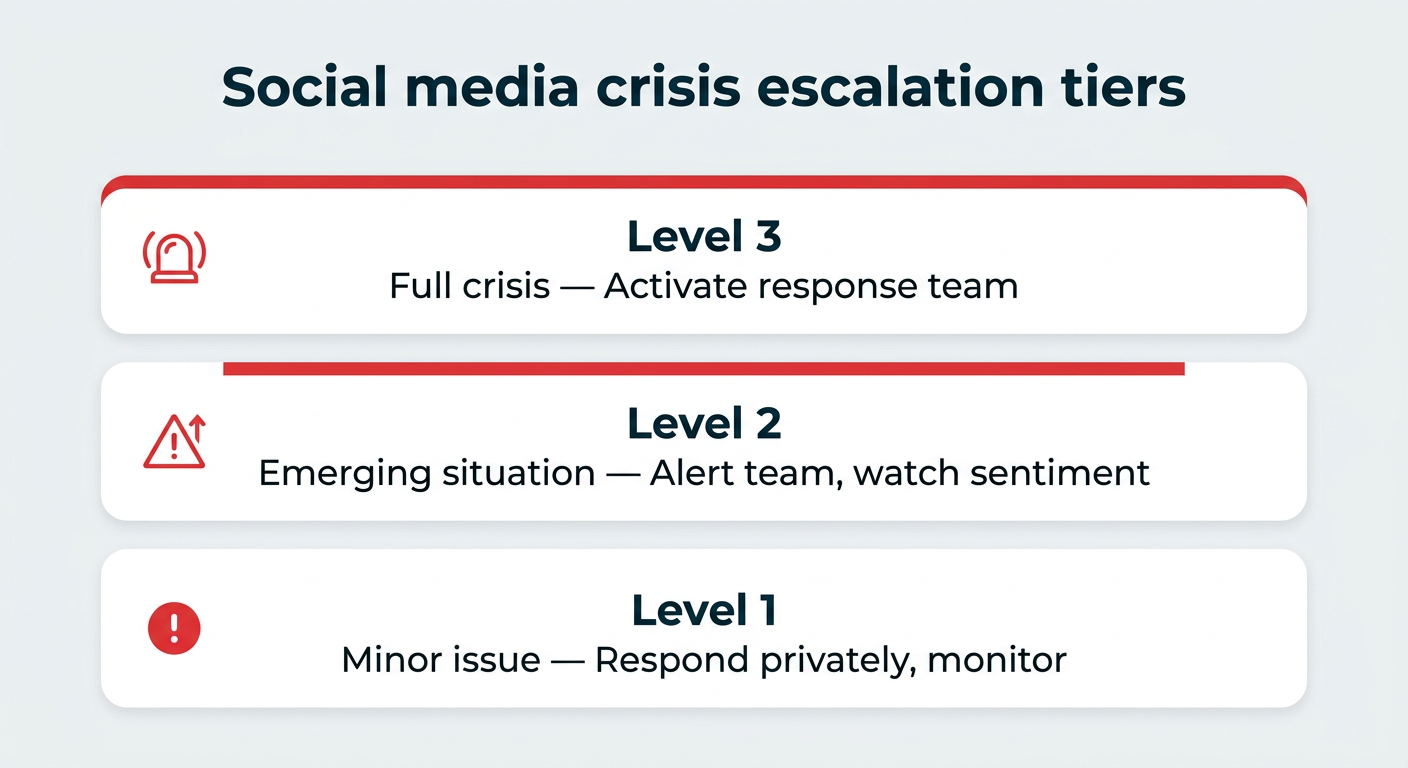
Not every negative moment carries the same weight. Sorting incidents into tiers helps your team decide how quickly and how visibly to respond. Here’s a simple escalation framework you can adapt:
| Tier | Description | Example | Recommended response |
|---|---|---|---|
| Level 1: Minor issue | An isolated complaint or negative comment with little reach. | A single customer venting about a late order. | Respond directly, resolve privately, and monitor for spread. |
| Level 2: Emerging situation | Growing attention or repeated complaints that could gain momentum. | Several users flagging the same product defect within hours. | Alert your team, prepare messaging, and watch sentiment closely. |
| Level 3: Full crisis | Widespread coverage, viral spread, and clear reputational risk. | A viral video prompting boycott calls and press coverage. | Activate your full crisis response team and follow your plan. |
Social media crisis management is important in 2026 because problems spread quickly, misinformation is harder to control, and customer trust is easier to lose.
Here’s why every team needs a social media crisis plan:
AI-generated misinformation and deepfakes are accelerating crises
Generative AI has made it far easier to create fake screenshots, fabricated quotes, and convincing deepfake videos that can trigger or amplify a crisis in minutes. With deepfake volume surging to approximately 8 million in 2025, a single doctored clip of an executive can spread across platforms before your team even knows it exists.
The scale of the problem is growing fast, and detection tools struggle to keep pace with new fakes.
For marketers, the takeaway is practical: false content now looks more credible than ever, and it moves faster than manual review can catch. That makes early detection through social listening and a clear plan for verifying and correcting false claims essential to protecting your brand.

Brand mentions, trending topics, and sentiment at your fingertips. Enhance your social strategy with the insights that matter.
Start your free trialIt stops misinformation from spreading
False stories move fast on social media. And with AI tools fueling an environment where 90% of online content could be synthetically generated by 2026, it’s getting harder to tell what’s real.
When a crisis hits, people start filling in the gaps. A solid crisis management plan helps brands step in early, share the facts, and correct false claims before they take on a life of their own.
It protects customer trust
The way a brand responds can make a real difference in whether customers stick around or start looking elsewhere. After all, building trust with customers takes time, and losing it happens way faster.
It’s why 63% of U.S. consumers will walk away after just one or two bad experiences. A misstep during a crisis could tip the scales in the wrong direction.
Not responding to a crisis can do more damage
When a brand goes quiet, people notice. According to Edelman’s 2025 Trust Barometer, 53% of consumers across 15 global markets say they’ll assume a brand is doing nothing (or even hiding something) if it doesn’t publicly communicate what it’s doing to address a societal challenge. The same logic applies during a crisis — silence invites doubt.
Ignoring the problem doesn’t always make it go away. Without a crisis management plan, you’re left to figure out what to say (or who should say it) in the moment.
Rebuilding takes time
Even after the noise fades, rebuilding trust takes time. Today’s consumers bring heightened skepticism toward brand messaging, so brands may need months (even years) of consistent communication, extra support for customers, and even new campaigns to recover from a crisis.
All of that takes time, money, and resources. It’s why getting the response right the first time matters.
The best time to build a social media crisis management plan is before you need it. Preparation gives your team the confidence to act quickly instead of scrambling in the moment. For that, we turned to Emily Flathers, Senior Marketing Manager at Alfred Coffee. As an experienced social media management professional, Flathers has waded through plenty of potentially spicy situations.
Monitor social media for early warning signs
The sooner you spot a potential issue, the easier it is to contain. Small problems can turn into big ones quickly if no one’s paying attention.
Flathers uses a simple two-part approach. First, she closely watches how people respond to new posts.
“At Alfred, I monitor the comments of a post within the first 30 minutes of sharing and then about once an hour thereafter for the first 24 hours,” says Flathers.
Second, she keeps an eye on brand mentions across platforms.
“I search ‘Alfred Coffee’ daily on X and TikTok,” Flathers explains. “If anything negative comes up, I know about it quickly and can nip it in the bud almost immediately.”
One more signal to watch for is a sudden spike in reshares. If a post starts spreading faster than usual, it’s worth investigating to make sure the attention isn’t negative.
Secure your accounts
A crisis is the worst possible time to lose control of your social media accounts. Locking things down ahead of time helps keep your response on track.
Start with the basics:
- Use strong passwords: Make sure every account has a secure password, and update it whenever someone leaves the company.
- Include two-factor authorization (2FA): Add a second factor of login authentication like an email, text message, or code generator.
- Centralize permissions: Tools like Hootsuite Social OS make it easier to control who can post, reply, and approve messages across your accounts.
You might be tempted to shut off comments during a crisis, but that can backfire, says Flathers. “In my experience, locking comments only fuels the fire.”
Have a social media policy in place
Strong crisis management starts before anything goes wrong. A clear social media policy helps set expectations for how your brand shows up online.
At a minimum, it should cover how branded accounts are used, what appropriate posting looks like, and how employees can talk about the company on their personal channels.
If you don’t already have a crisis communication plan, now’s the time to create one. Building it when things are calm makes it easier to think clearly and act with confidence.
That said, a plan should guide you, not lock you in. Flathers warns that while a plan is important to prevent future crisis communication, following it too rigidly — especially without a second opinion — could make things worse.
“You should feel comfortable pivoting,” says Flathers. “Stay nimble. A great rule of thumb is to always bring your manager or director in for their opinion if something is starting to get spicy. You’re not on an island.”
Pause and put the audience first
When a crisis hits, it’s tempting to respond right away. But rushing things can be risky.
“Take a breath (no, really!), and think about what you want to say,” Flathers shares.
Flathers suggests taking a minute to read the room and “look at what your audience is saying. What do they expect from you at this moment?”
As you assess things, Flathers says to think through if you even need to respond. “Will speaking out bring more attention than if you just removed the post or comment?”
Once you’re armed with empathy, reply based on the audience’s needs, not from your feelings. “Don’t get defensive,” Flathers adds. “Validate how your audience feels. Use it as a learning moment for you and your brand. And remember, this too shall pass!”
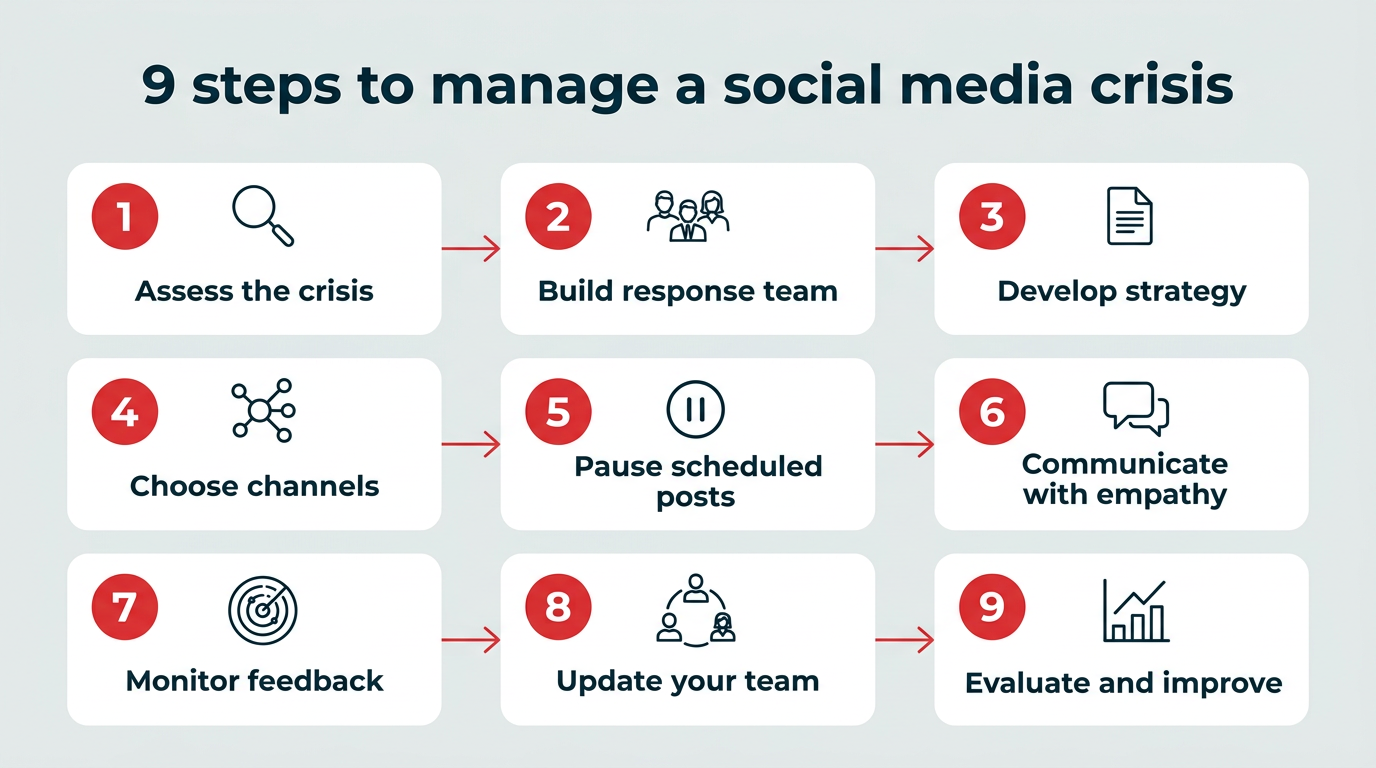
These nine steps cover how to assess a crisis, respond quickly, and protect trust before, during, and after the situation unfolds.
- Step 1: Assess the crisis and impact
- Step 2: Create a crisis response team
- Step 3: Develop a response strategy
- Step 4: Choose the right channels for communication
- Step 5: Pause scheduled posts
- Step 6: Communicate quickly and with empathy
- Step 7: Monitor and respond to feedback
- Step 8: Keep your team in the loop
- Step 9: Evaluate and improve
Step 1: Assess the crisis and impact
Before committing to any public or internal statement, take a beat to assess the situation.
Start by documenting the details of the event. This will help you visualize everything that’s happened and give your team a point of reference.
Think like a reporter and answer the five W’s:
- Who was involved in the initial event? And who has been involved since?
- What happened? Work like a detective and give “just the facts.”
- Where did the initial event take place? Was it on a particular social media platform or at a physical location?
- When did the event begin? Be as specific as possible since hours and minutes matter.
- Why did the crisis begin? Was it a legitimately upset customer venting on social media? Or did a marketing intern accidentally post a questionable post?
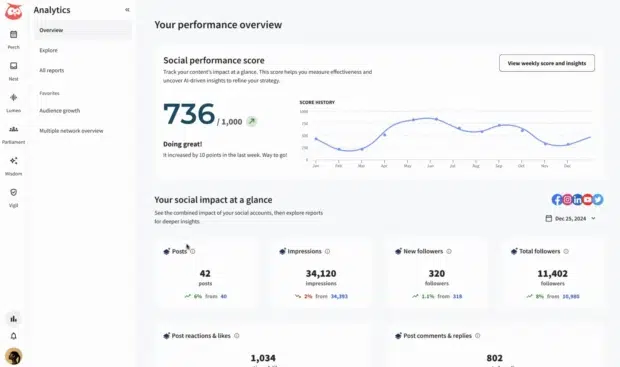
With the five Ws answered, the next task is to check the activity and sentiment of your brand mentions on social media.
With Lumen in Hootsuite Social OS, you’ll have access to social listening and AI-powered insights right from your dashboard.
Monitor for brand mentions outside of social media as well. Search for your business name and keywords relating to the event. And set up Google Alerts with those same queries.
Pro tip 💡: Don’t forget to keep a track of misinformation, including AI-generated content that may misrepresent your brand, so you can address it directly.
Finally, and most importantly, listen to your audience. Read and watch the posts and comments. Look for the negative comments and those defending you (they could help shape your response). And use the common threads and emotions to help guide your response.
Step 2: Create a crisis response team
Responding to a crisis takes a team, and they all need to be on the same page. Start by defining necessary roles, so everyone on your crisis response team knows their function.
Here are a few key roles to consider:
- Point or lead: This person will sit at the center of the response. They’ll organize communications and collaborate with other team members – like graphic designs or legal – to produce social media posts.
- Approvers: These are the people who review and sign off on public posts. For smaller issues, this might be the same person as the lead.
- Technical or product support: If the crisis involves a product or safety issue, you’ll want someone from the product team ready to share updates and answer questions.
- Legal: This person works with approvers to make sure messages are accurate and compliant.
You’ll also need to decide how your team will communicate and which tools they’ll use.
The governed workflows in Hootsuite Social OS make it easier to control who can post, reply, and approve messages — without slowing things down when time matters most.
Step 3: Develop a response strategy
Now that your team is in place, it’s time to craft your response strategy. (Kudos if you’ve included crisis management in your social media guidelines.)
Your response strategy should cover a few areas:
- Triage: What’s your first move? Will you delete the offending post? Do you share a quick acknowledgment before a full response?
- Key messaging: What will you say? This includes explaining what happened, what you’re doing about it, and what people can expect next.
- Channels: Where will you communicate? Think social platforms, email, and any other channels that make sense.
- Training: Who needs to be looped in? Make sure customer-facing teams know what to say.
- Incoming messages: How will you handle emails, direct messages, and comments on social media platforms?
- Monitoring: Which platforms and media sources will you continue to monitor during and after the crisis?
For more guidance, check out this resource on seven of the best online reputation monitoring tools.
Step 4: Choose the right channels for communication
Where you communicate matters just as much as what you say. The wrong channel can confuse your message or miss the audience entirely.
For example, Google chose X (formerly Twitter) to let people know its AI image generator “missed the mark” when it depicted people of color as early American colonists.

Source: Google
Start by listing the channels your audience actually uses. Then consider what each channel is best suited for.
TikTok may not be the right place to explain a serious product issue. LinkedIn, on the other hand, can be a better space for messages from leadership.
Step 5: Pause scheduled posts
Even if you had an amazing post scheduled for World Donut Day, it won’t hit quite right if you’re in the thick of a social media crisis. It’s time to put that great content on the back burner while you deal with the issue.
At best, an ill-timed scheduled post will make you look goofy. At worst, it could completely derail your ability to manage the risk.
After all, it’s critical for all communication to be planned, consistent, and appropriate in tone. A post you scheduled ahead of time is likely none of those things.
Don’t stop at organic content. Review any active ad campaigns and paid promotions too, since a live ad running during a crisis can amplify the wrong message or draw fresh criticism.
With a social media scheduler like Hootsuite, pausing your scheduled social media content is as simple as clicking the pause symbol on your organization’s profile and entering a reason for the suspension.
Step 6: Communicate quickly and with empathy
Your initial response should strike a balance between speed and careful consideration of the situation and the people involved.
The CEO of Kitebaby learned this lesson after a video went viral, saying the company denied an employee’s maternity leave request. The CEO, Ying Liu, posted an apology video which many viewers felt was too scripted and insincere.
Liu posted a follow-up video offering a more personalized apology for the incident.

Source: recoveredmom1
This is where a two-stage response can be helpful. Stage one is acknowledgment. Let people know you’re aware of the existence and gravity of the event, then provide a timeline for further action.
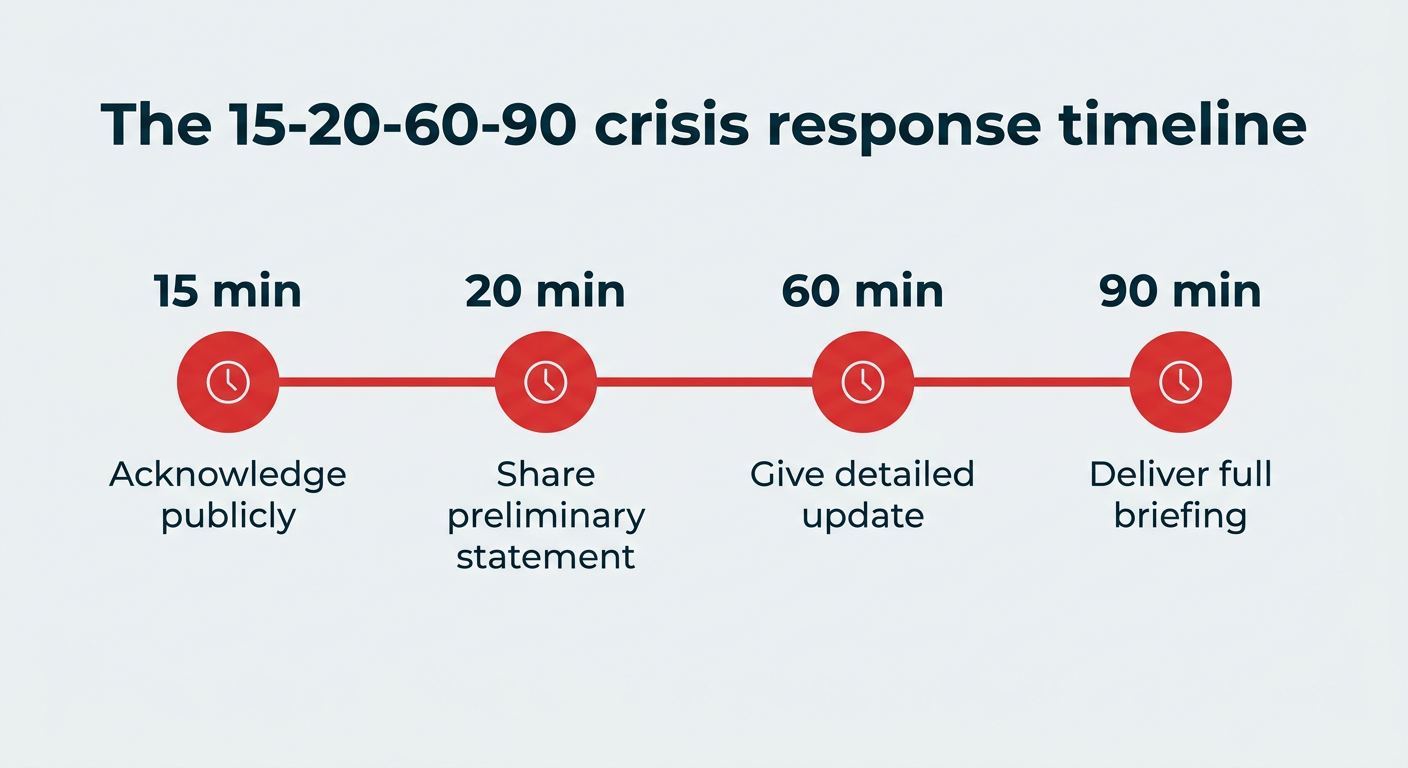
To move quickly without losing credibility, many teams follow the 15-20-60-90 response timeline. It sets clear checkpoints for the first 90 minutes of a crisis:
- 15 minutes: Acknowledge the situation publicly so people know you’re aware.
- 20 minutes: Share a preliminary statement with the facts you’ve confirmed so far.
- 60 minutes: Provide a detailed update that explains what you’re doing and the steps you’re taking.
- 90 minutes: Deliver a comprehensive briefing and commit to regular updates going forward.
Here’s a basic template you can tweak for your initial social media crisis response:
“We’ve just learned of [the event] on [date and time]. We’re keenly aware of the impact this may have on many of our valued customers and partners. We are reviewing all aspects of the event thoroughly so we can take meaningful steps to correct it. We’ll share a course of action on all of our social channels within 24 hours.”
Step 7: Monitor and respond to audience feedback
Once your response is live, your work isn’t done. You need to keep listening and responding as the situation unfolds.
Track changes in sentiment using social listening tools. That way, you can spot shifts in tone and adjust your message if needed. This gives you a glimpse into how people are actually reacting, not how you hope they are.
Luckily, Lumen in Hootsuite Social OS gives you the AI-powered insights you need to track sentiment in real time.

And as comments come in, use Nest, the customer care app in Hootsuite Social OS, to collect, assign, and respond to them. That will make it easier to catch every comment and make sure the right team member is involved.

It’ll be hard, but don’t ignore the anger or disappointment. Engaging is key to showing that you care about the public’s response and are hearing their concerns. Keep it short, and whatever you do, don’t argue.
If someone demands more of your attention, try to move the conversation into private messages, email, or a phone call.
In short, monitoring and responding helps you stay aligned with how audiences actually feel as a crisis unfolds.
Step 8: Keep your team in the loop
Misinformation can spread just as easily inside your company as it can outside. And when there’s silence from the top during a real time of crisis, the whispers tend to come fast and furious.
In other words, your crisis communication should include internal communication as well. This keeps everyone on the same page and alleviates tension and uncertainty.
Be clear about your intended actions, and make sure everyone in the organization knows exactly what they should (or should not) say about the crisis on social media.
Parliament, the employee advocacy app in Hootsuite Social OS, offers an easy way to distribute pre-approved company messaging to all employees that they can share on their own social accounts.

Step 9: Evaluate and improve
Once you’ve made it through the storm, debrief and examine just what happened.
It’s a chance to reflect on how your brand got into trouble and what was successful (or not!) as you dealt with the immediate fallout.
This is a good time to open up cross-function communication. Learn from your customer service and PR and comms teams, and show the important role of social media in crisis management with your leadership. The deeper work of rebuilding trust comes next.
Rebuilding trust after a social media crisis is a longer process than the initial response, and it’s where many brands lose momentum. Recovery isn’t about a single apology — it’s about consistent action over weeks and months. Here’s how to approach post-crisis recovery:
- Track sentiment recovery over time. Use social listening to watch how sentiment shifts in the days, weeks, and months after the crisis. Lumen in Hootsuite Social OS lets you map those changes against the actions you took.
- Run a full stakeholder debrief. Bring together everyone involved — social, customer care, legal, and leadership — to review what worked and what didn’t.
- Update your crisis plan. Fold the lessons you learned into your documented plan so your team is better prepared next time.
- Communicate ongoing improvements. Show the public what you’ve changed. Follow-through is what turns a crisis into a trust-building moment.
- Set realistic timeline expectations. Reputation recovery can take weeks or years depending on severity. Consistency matters more than speed at this stage.
In short, recovery is about proving through repeated action that you’ve learned from the crisis, not just saying so once and moving on.
Social media crisis management examples that got it right
If you do find yourself in a crisis, it’s good to know you’re not the first. These social media crisis examples show how three brands effectively used social media to soften the blow of a PR crisis.
1. Oatly
Trying to shove a crisis under the rug might work, but more often than not, it makes everything worse. Oatly, a Swedish maker of oat-based drinks, goes the opposite direction. It addresses negative feedback and PR crises head-on.
Here’s a recent example where people called out the company for selling its oat residue to farmers as livestock feed.

Source: Bullsi
The Oatly team replied quickly, comprehensively, and transparently. There’s an open explanation of what they do with spent oat remnants, a link to learn more, and even a link to offer suggestions for future use.

Source: Oatly
It’s an impressive response, but just the beginning from the brand. In fact, it’s created an entire website dedicated to the biggest dustups they’ve faced. There are lawsuits, social media storms, and global boycotts.
In each case, Oatly clearly explains the events’ origins and how they responded.

Source: Oatly
Oatly’s PR worked especially with Gen Z, who repeatedly say they value transparency over slick marketing. Younger consumers, and even social media influencers, express their respect for a brand that’s so willing to shine a light on its challenges.

Source: redflowerfactory
If you want to turn lemons into lemonade, get in front of a social media crisis with fast, transparent messaging.
2. Biore
Influencer marketing is a powerful strategy for a brand to connect with its audience authentically. Unfortunately, the influencer’s message sometimes misses the mark, leaving the brand’s damaged reputation as collateral damage.
That was the outcome when influencer Cecilee Max-Brown posted about her skincare routine. Max-Brown explains the importance of “getting it all out” while using the brand’s pour strip in the video.
She then says that it includes what’s on your mind and describes her anxiety from a school shooting that happened at her college campus.
Followers were quick to point out the insensitivity of suggesting a simple pore strip could solve mental health struggles.

Source: capt_thomas1492
Max-Brown pulled the post within a day of posting it. But the internet didn’t forget, and the ad spread across social media quickly.
Biore could have taken the low road and thrown its influencer under the bus. Instead, it posted a public apology, taking full ownership of the misaligned message.

Source: Biore
If you do make a similar mistake, be like Biore and own it publicly and sincerely.
3. Luke Combs
Celebrities are often the face of million-dollar brands, but they have teams of marketers and other professionals managing the business in the background. Occasionally, those teams make a decision that results in a crisis. And the celebrity has to decide how to address it.
Singer Luke Combs stepped up in a big way when he found himself in that position. A Florida woman, he found out, had been ordered by a federal court to pay the singer $250,000 as restitution for selling unlicensed drink tumblers with his name on it.
The woman had only learned of the judgment after returning home from a hospital stay while fighting congenital heart failure.
Combs didn’t waste time addressing the issue. According to a video he posted on both TikTok and Instagram, he contacted his team and the woman within two hours of finding out about the case.

Source: Luke Combs
What really put this solution in the social media crisis management hall of fame is the resolution he offered.
First, he made sure the lawsuit was dropped. Then he offered the woman $11,000 — double the sum that Etsy froze from her online shop. And finally, Combs invited her and her family to join him at a future concert where he could apologize in person.
The important lesson here is to make sure that whatever solution you offer has meaning. An empty social media post with no path to resolution could land you in worse shape than no reply at all.
FAQ: Social media crisis management
How do enterprise brands build a social media crisis management plan?
What are social media crisis management best practices for large organizations?
How do enterprise teams monitor and respond to social media crises?
What do effective social media crisis workflows look like for enterprise teams?
What tools support real-time social media crisis management?
What are the 5 C’s of crisis management?
What is the 15-20-60-90 rule in crisis communication?
What is the difference between a social media crisis and a PR crisis?
How long does it take to recover from a social media crisis?
What is the 5 5 5 rule for social media?
Save time managing your social media marketing strategy with Hootsuite. Publish and schedule posts, find relevant conversions, measure results, and more â all from one dashboard. Try it free today.