Key takeaways
- Social media compliance means following all applicable laws, industry regulations, and platform policies when your organization uses social media for marketing, customer engagement, or communications.
- Key regulations include GDPR, CCPA, HIPAA, FINRA, and FTC guidelines, and they vary by region and industry, so teams need to know exactly which rules apply to them.
- Common compliance risks include data privacy violations, improper advertising disclosures, AI-generated content without guardrails, intellectual property infringement, and poor archiving practices.
- A strong compliance program combines clear policies, role-based permissions, regular training, automated monitoring tools, and enterprise-grade platforms to enforce governance at scale.
Social media compliance means following all laws, regulations, and platform policies that apply to how your organization uses social media.
In reality, the “rules” come from many places: government laws, industry regulators, platform policies, and your own internal guidelines. That mix can get complicated fast, especially in regulated industries or enterprise organizations.
But at its core, compliance is about protecting your customers, your brand, and your team from avoidable risk.
Social media compliance is important because it protects your organization from legal issues, financial penalties, data breaches, and reputational damage.
When teams follow the rules, they reduce potential risks, keep customer data safe, and avoid the kinds of mistakes that can snowball quickly.
For regulated industries, the stakes are even higher. Compliance is what keeps your marketing efforts from violating privacy laws and advertising standards.
But compliance isn’t just about avoiding bad outcomes. Organizations with strong compliance programs tend to build more trust with customers, maintain more consistent brand messaging, and operate with greater confidence on social. When your team knows the guardrails, they can actually move faster, not slower.
On the flip side, the cost of getting it wrong is steep. HIPAA violations alone can result in penalties of up to $1.5 million per year, and the FTC has increasingly pursued enforcement actions against brands that fail to disclose sponsored content or use deceptive advertising practices on social media.
In short, compliance protects your organization from risk while giving your team the clarity they need to create effective social content.
The regulations that apply to your social media program depend on your industry, the regions you operate in, and the type of content you publish. There’s no single rulebook, which is part of what makes compliance so challenging.
Here’s a summary of the major regulations you should know about:
Regulation | Region | What it covers | Who it applies to |
|---|---|---|---|
EU/EEA | Data privacy, consent, user rights | Any organization handling EU residents’ data | |
California, USA | Consumer data privacy, opt-out rights | Businesses collecting California residents’ data | |
USA | Children’s online privacy | Sites and services directed at children under 13 | |
USA | Commercial messaging, email, and electronic communications | Any business sending commercial messages | |
USA | Advertising disclosures, endorsements, fake reviews | Brands, influencers, advertisers | |
USA | Protected health information (PHI) | Healthcare providers, insurers, business associates | |
USA | Financial services communications, archiving | Broker-dealers, financial advisors | |
Canada | Anti-spam, commercial electronic messages | Any business sending messages to Canadian recipients | |
Canada | Personal data protection | Private-sector organizations in Canada | |
EU | AI transparency, risk classification, disclosure | Any organization deploying AI in the EU | |
EU | Data protection enforcement and interpretation | Organizations subject to GDPR | |
Global | Cross-border data privacy | Organizations transferring data across borders |
Despite the differences across regions and industries, most of these regulations share a few core principles:
- Do not send unsolicited commercial messages
- Notify users when collecting and storing their personal data
- Allow users to access, edit, and delete their data
- Ensure users’ personal data is secure and used responsibly
- Disclose sponsored content and material relationships clearly
For a more detailed look at how these regulations apply to specific industries, see the industry-specific sections later in this guide.
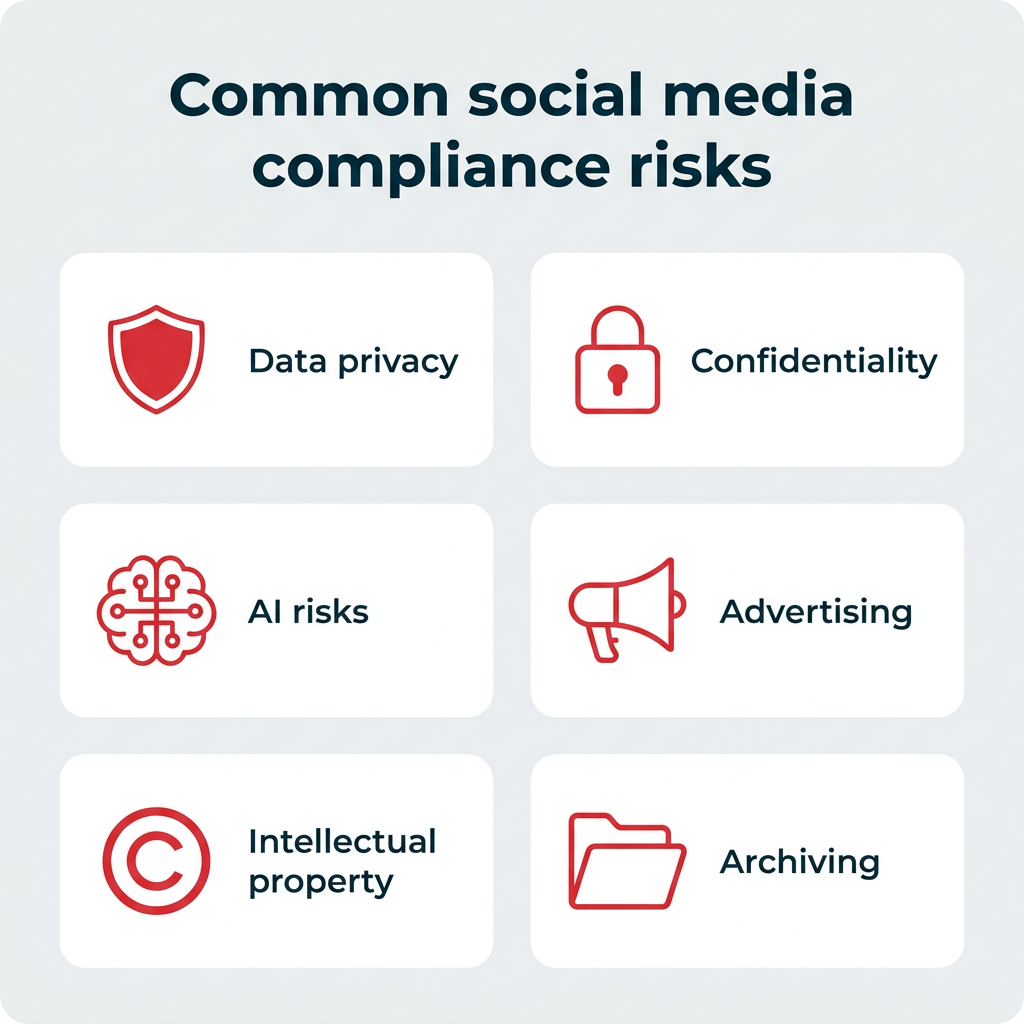
The most common social media compliance risks include data privacy violations, confidentiality breaches, advertising violations, AI-related risks, and improper archiving.
Let’s dive into each of these risks:
What are data privacy and protection risks?
Social media platforms collect a lot of personal data from users. Businesses can and do use this info for targeted marketing and advertising.
But businesses must work within data privacy laws, with cumulative GDPR fines exceeding €7.1 billion since 2018. That includes obtaining appropriate consent and protecting the data from unauthorized access.
For a full breakdown of the specific regulations by region, see the regulations table above. The general principles have a lot of overlap:
- Do not send unsolicited messages
- Notify users when collecting and storing their personal data
- Allow users to access, edit, and delete their data
- Ensure users’ personal data is secure and used in a responsible way
What are confidentiality risks?
Marketers need to understand all the confidentiality expectations in their industry, not just the data privacy piece. Confidentiality includes all information about people involved with a business, online or offline.
Take education, for example. Anyone marketing for a school has to follow both:
- The Family Educational Rights and Privacy Act (FERPA), and
- The Protection of Pupil Rights Amendment (PPRA).
In healthcare, there’s the Health Insurance Portability and Accountability Act (HIPAA) Privacy Rule. Even resharing a social post without signed consent could be a compliance violation. (More on this below.)
For instance, a physician’s assistant student was recently called out on X. The student was posting patients’ radiographs and other confidential images on social media.
Screenshot of a social media post discussing HIPAA violations by a healthcare student.
This case involved a student, rather than an employee. But it still puts the university involved at compliance risk. Everyone involved with your organization needs to understand social media compliance. Even if they don’t work in social media.
For more details, check out our post on using social media for healthcare.
What are AI-related compliance risks?
While AI can make teams faster and more efficient, it also introduces a whole new layer of compliance considerations that didn’t exist a few years ago.
And here’s the tricky part: there are AI regulations (especially in places like the EU). But many regions are in a gray area where AI is governed by a mix of privacy laws, industry-specific rules, and whatever internal guardrails an organization decides to put in place.
In short: a lot of the responsibility still falls on you and your team to make sure you’re using AI responsibly.
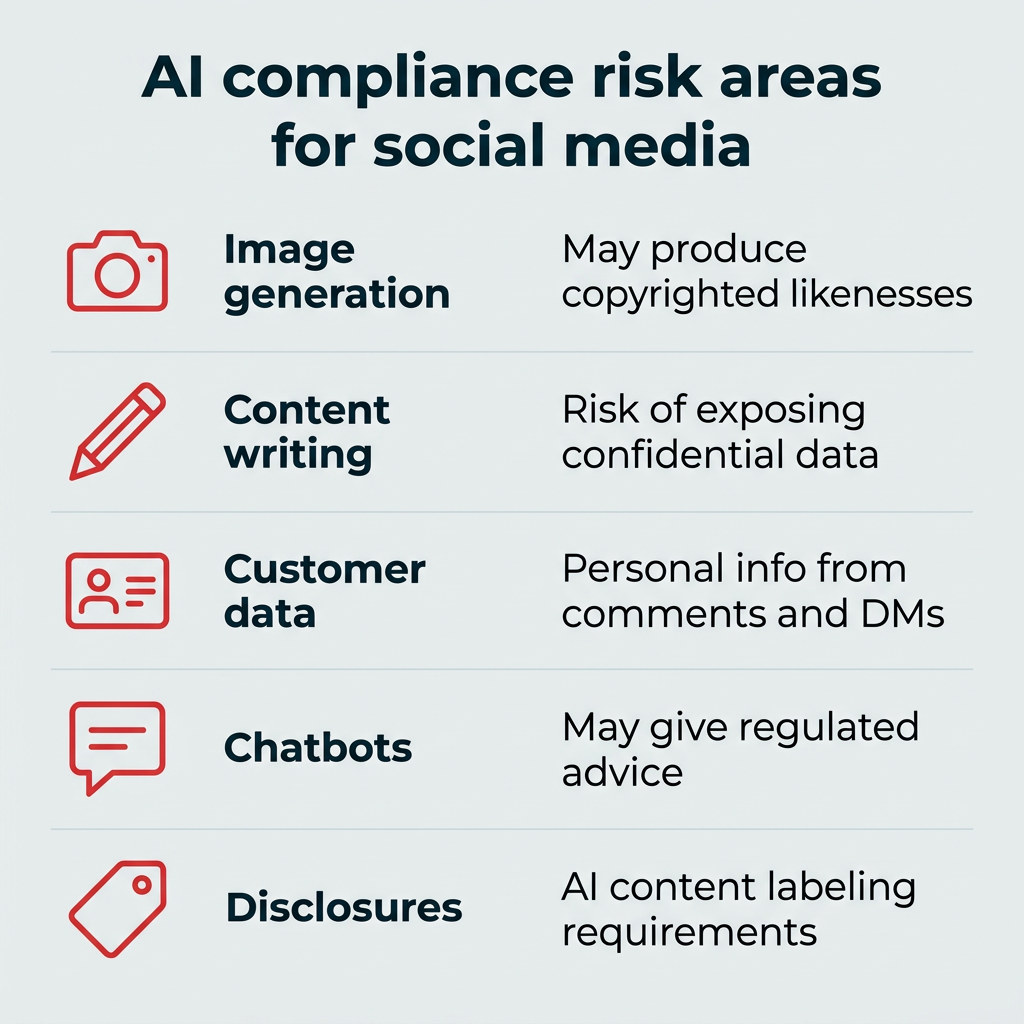
Here are a few areas to pay close attention to:
- Image generation: AI tools can accidentally generate images that resemble real people, include sensitive details, or recreate copyrighted material.
- Content writing: If you’re using AI to help write posts, captions, or replies, make sure you’re not feeding it anything confidential.
- Customer data: AI-powered tools can pick up personal info from comments, DMs, reviews, and mentions. You’re still responsible for how that data is collected and used.
- Chatbots and automated responses: If you use an AI assistant on social media, make sure it’s not giving medical, financial, or legal advice.
- Disclosures: Some regions already require AI-generated or AI-modified content to be labeled. Others are moving in that direction. It’s better to build transparency into your process now.
That said, AI isn’t only a risk. It can also be a powerful compliance tool. AI-powered monitoring can automatically flag high-risk language, missing disclosures, or unapproved claims across your social channels in real time. When paired with human review, it helps teams catch issues faster and at a scale that manual processes can’t match.
What advertising regulations apply to social media?
Marketers must understand social media ad compliance regulations for promoting their businesses. That means being upfront about sponsored content and making sure every claim you make is accurate and not misleading.
When brands skip these steps, the fallout can get serious. The FTC’s Consumer Review Rule alone carries penalties of up to $53,088 per violation.
In the United States, organizations like the Food and Drug Administration (FDA) and Federal Trade Commission (FTC) regulate social media posts. The FDA monitors claims related to food, beverage, and supplement products. The FTC scrutinizes online reviews, endorsements and testimonials, including those from social media influencers.
The Financial Industry Regulatory Authority (FINRA) monitors financial services businesses in the US. FINRA says that social media posts must be “fair, balanced, and complete.”
In the UK, the Advertising Standards Authority (ASA) regulates advertising. They work with codes created by the Committees of Advertising Practice (CAP).

Source: CAP and CMA
Since 2021, the ASA has publicly listed influencers who regularly fail to disclose paid posts. They can also ban ads that don’t meet the guidelines.
What are platform community standards?
All major social media platforms, including Meta, X, LinkedIn, and TikTok, have community guidelines. When you create an account, you’re essentially agreeing to play by those rules. So as marketers, it’s crucial to keep them in mind before hitting “post.”
Here are links to the community guidelines for the major platforms:
- Meta (Facebook and Instagram) Community Standards
- X Rules and Policies
- LinkedIn Professional Community Policies
- TikTok Community Guidelines
The risks can be serious if you violate a platform’s content guidelines. A platform might quietly take your post down, stop recommending your content, or restrict your monetization options. In more serious cases, they can even ban your account altogether.
Community guidelines also change frequently, especially around areas like political content, AI-generated content, and misinformation. It’s important to stay on top of these updates so you can avoid accidental violations.
What are intellectual property risks?
Marketers must be careful about intellectual property rights when posting content online.
Anything created by someone else may be subject to copyright. This includes images, video clips, music, quotes, and more. Don’t risk using other people’s content without permission.
Memes are a bit of a gray area for intellectual property risks. In fact, both a meme and its original materials can be copyrighted or trademarked. Images that include real people are particularly risky.
Remember the “Success Kid” meme?
The child’s mother took the picture and therefore owns the copyright. She sued the campaign committee of then-congressman Steve King for using the image without permission in his 2020 reelection campaign. After a long legal process, the committee lost its appeal against an original finding of infringement in a 2024 ruling.
To be safe, stick to using your own images. Or, look for royalty-free images or those with an appropriate Creative Commons license.
What are accessibility requirements?
Accessibility is both a legal requirement and a best practice for social media content. Laws like the Americans with Disabilities Act (ADA) in the U.S. and the European Accessibility Act in the EU require organizations to make digital content accessible to people with disabilities.
On social media, that means taking steps to ensure your content can be consumed by everyone, including people who use screen readers, have low vision, or are deaf or hard of hearing.
Key accessibility practices for social media include:
- Alt text: Add descriptive alt text to every image so screen readers can convey the content
- Captions: Include captions or subtitles on all video content
- Color contrast: Ensure text and graphics meet minimum contrast ratios so they’re readable
- Plain language: Avoid overly complex language or jargon that creates unnecessary barriers
- CamelCase hashtags: Capitalize the first letter of each word in multi-word hashtags (e.g., #SocialMediaCompliance) so screen readers can parse them correctly
Most major platforms now offer built-in accessibility features like alt text fields and auto-captioning. Building these steps into your content workflow helps you stay compliant and reach a wider audience.
What are access and archiving requirements?
Archiving compliance requirements ensure organizations have a record of social media activities. In regulated industries, this isn’t optional.
The Financial Industry Regulatory Authority (FINRA) and Securities and Exchange Commission (SEC) both require financial services firms to archive social media communications in context. Healthcare organizations face similar requirements under HIPAA.
Archiving requirements vary by industry, but the principle is consistent: if your organization is regulated, you need a reliable system for capturing and storing all social media communications, including posts, replies, DMs, edits, and deleted content.
Staying compliant on social media means building consistent systems that ensure every post, workflow, and interaction follows the rules that apply to your organization.
Here’s a quick overview of the eight key steps, with detailed guidance below:
- Understand the laws and regulations relevant to your industry
- Control access to social accounts
- Build a social media compliance monitoring strategy
- Archive everything
- Create a content library
- Disclose sponsored content
- Invest in regular training
- Create compliance and social media policies
Let’s break down each piece of a strong social media compliance program.
1. Understand the laws and regulations relevant to your industry
If you use any social media channels in a regulated industry, you likely have in-house compliance experts. They should be your go-to resource for any questions about what you can (and can’t) do on social networks.
Your compliance officers have the latest information on compliance requirements. You have the latest information on social tools and strategies. When these teams work together, you can maximize the benefits for your brand and reduce the risks.
Make sure your compliance team understands your content creation and approval process (including any AI tools you’re using). This will allow them to identify risks. Clarify when you should consult them or if you need to change your procedures.
2. Control access to social accounts
Limiting access to your accounts is critical to keeping your content under control. It’s also an important way to reduce compliance risks.
Sharing passwords among team members creates unnecessary risk. It’s especially problematic when people leave their role. A password management and permissions system is a must.
For example, Hootsuite allows different levels of access for each person who works on your social content. There are several compliance benefits to these permissions:
- Ensure that all content posted is accurate, truthful, and on brand.
- Allow all social team members to embrace their creativity. At the same time, approval safeguards ensure content passes compliance checks.
- Prevent unauthorized access to confidential information. This is especially important when you use social media DMs for customer service.
On top of that, every integration, app, or plugin should be reviewed to make sure it follows your organization’s compliance and security requirements.
3. Build a social media compliance monitoring strategy
In regulated industries, monitoring is especially important. You may need to respond to comments within a specified time. You may also have to report comments to a regulatory body. For instance, those involving adverse drug reactions.
It’s also important to look for social accounts related to your organization but not under corporate control.
This might be a well-intentioned advisor or affiliate creating a non-compliant account. Or, it might be an imposter account. Each can cause its own kind of compliance headaches.
Any brand that works with outside salespeople needs to watch for inappropriate claims. For example, the Direct Selling Self-Regulatory Council (DSSRC) conducts regular monitoring. They recently found sellers for the multilevel marketing brand Limbic Arc making inappropriate product and income claims on social media. The council notified Limbic Arc, who contacted sellers to remove the claims.
The result was a lot of extra work that could have been avoided if the company caught the claims before the DSSRC got involved.
Start with a social media audit to uncover social accounts related to your brand. Then put a regular social monitoring program in place.
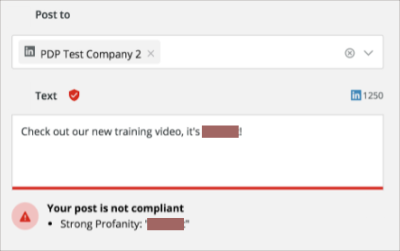
To make monitoring easier, many orgs now use AI-powered tools to automatically flag high-risk language, misinformation, complaints, or unapproved claims in real time. Enterprise teams can also use social listening tools (like Talkwalker, available through Hootsuite) to track brand mentions, sentiment shifts, and potential compliance issues across channels at scale.
While AI shouldn’t replace human review, it can dramatically reduce the risk of missing something important, especially if you’re managing multiple channels, large volumes of comments, or distributed teams.
4. Archive everything
In regulated industries, all communications on social media need to be archived. That includes ads, replies, comments, Stories, Reels, DMs, edits, and even deleted content.
This matters because any of these records may be required during a social media audit, an investigation, or an industry-specific examination (e.g., HIPAA/HHS).
We know this can sound daunting. Luckily, social media compliance tools (like Hootsuite’s Proofpoint integration) can help.
5. Create a content library
A pre-approved content library provides your whole team with compliant social content. Employees, advisors, and contractors can share these without introducing compliance risk.
Armanino, one of the top 20 independent CPA and consulting firms in the U.S., built a content library of brand-approved content to share with a network of internal brand ambassadors. After launching the library, they saw more than 14,700 website clicks from employee posts. More than 19 million people were reached through that approved employee content. That’s a 638% increase year over year.
6. Disclose sponsored content
When you partner with influencers, proper disclosure is non-negotiable.
The FTC requires content creators to disclose all “material connections” to brands. This includes personal, family, and employment relationships, not just financial relationships.
Disclosures need to be displayed where people will actually see them (not buried under a “more” button). For example, a compliant sponsored post might include the #ad hashtag at the very beginning, plus the platform’s built-in “Paid Partnership” label.
The FTC most recently updated its Endorsement Guides in 2023 to provide clearer guidance on disclosures for social media influencers and branded content.
7. Invest in regular training
Social media compliance training should be mandatory for everyone who creates, approves, or publishes content on behalf of your organization.
Regular training ensures your team stays current on evolving regulations, platform policies, and internal guidelines. It also helps prevent costly mistakes before they happen.
Training should cover the specific regulations that apply to your industry, platform-specific compliance features, approval workflows, archiving requirements, and how to handle high-risk scenarios like responding to customer complaints or sensitive topics.
8. Create compliance and social media policies
A comprehensive social media policy documents your organization’s rules, expectations, and procedures for using social media.
Your policy should cover who can post on behalf of the organization, what topics are off-limits, how to handle sensitive information, disclosure requirements, approval workflows, and consequences for violations.
Make your policy accessible to everyone who uses social media for work. Review and update it regularly as regulations, platforms, and business needs change.
FAQ: Social media compliance
What is social media compliance and why does it matter for enterprise organizations?
Which regulations apply to my organization’s social media activities?
How can we monitor social media for compliance risks at scale?
What should we archive from our social media channels?
How do we balance social media compliance with creative marketing execution?
What are the most common social media compliance mistakes enterprise teams make?
Save time managing your social media marketing strategy with Hootsuite. Publish and schedule posts, find relevant conversions, measure results, and more — all from one dashboard. Try it free today.