Table of Contents
Key takeaways
- Influencer marketing is a fast-growing market. The global influencer marketing platform market is projected to reach $97.55 billion by 2030, up from a projected $34.25 billion in 2025.
- Smaller creators often outperform big names. Nano-influencers see the highest engagement rates on Instagram, at 6.23%, usually at a fraction of a mega-influencer’s cost.
- A measurable influencer marketing strategy needs three things: clear goals, proper creator vetting, and tracking tied to business outcomes like conversions and cost per acquisition.
- Long-term partnerships beat one-off posts. Ongoing creator relationships build more trust and more durable return on investment than a single sponsored post.
What is influencer marketing?
Influencer marketing is a social media strategy where brands partner with content creators to promote their products or services to their engaged audience. It’s a projected $12.17 billion market in the U.S. alone, and it sits inside almost every major brand’s media plan now.
Think of it as digital word-of-mouth marketing — instead of your neighbor raving about their new air fryer over the fence, it’s someone with 20,000 TikTok followers influencing your next purchasing decision.
Celebrity endorsements were the original form of creator partnership. But today, social content creators with niche audiences can be even more powerful marketing tools.
These influencers often have stronger relationships with their followers, making their recommendations more impactful.
Why is influencer marketing growing so fast?
Influencer marketing is growing because brands are shifting toward authentic, trust-based engagement over traditional advertising.
More organizations are partnering with creators each year, according to Hootsuite’s latest Social Media Trends survey — an impressive trajectory for a strategy that began with bloggers reviewing free samples.

Source: Grand View Research
And the growth isn’t slowing down. The global influencer marketing platform market was valued at $25.44 billion in 2024, is projected to hit $34.25 billion in 2025, and is expected to reach $97.55 billion by 2030.
That pattern holds at the regional level, too. In the UK, annual influencer ad spend is projected to reach $1,442.78 million in 2025, which works out to roughly $1.4 billion a year on creator partnerships alone.
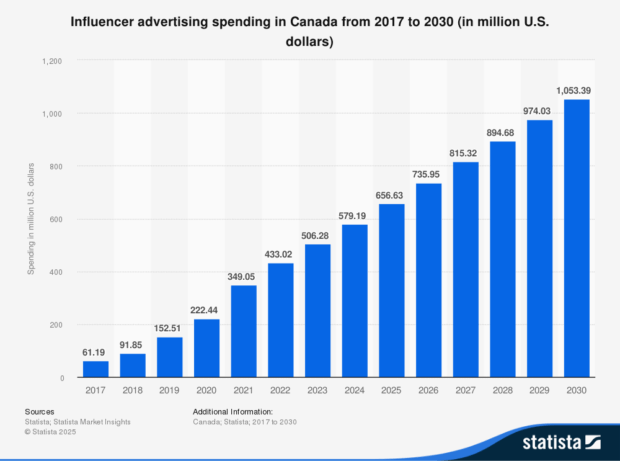
Source: Statista
While influencer marketing continues to grow, it looks different every year.
“When influencer marketing was first starting out, it was all about one-off sponsored posts. Since then, we’ve seen a lot of brands get creative with PR boxes, brand trips, IRL activations, and more,” says Eileen Kwok, former Social Media & Influencer Marketing Strategist at Hootsuite.
Heading into 2026, influencer marketing is shifting toward more integrated campaigns, with brands experimenting across platforms — from TikTok and Instagram to LinkedIn and YouTube.
“As influencer marketing evolves, we’ll start to see brands create these ecosystems of influence online, and continue to discover ways they can have many touch points and collaborations with thought leaders,” Kwok adds.
In other words, there’s no one-size-fits-all approach to making influencer marketing work. With the right social media strategy and research, just about every brand’s message can benefit from a little influencer amplification.
What are the benefits of influencer marketing?
The main benefits of influencer marketing are building trust, reaching the right audiences, and increasing brand visibility.
At a glance, creator partnerships help you:
- Build trust: Recommendations from a familiar creator land differently than a brand ad.
- Reach niche audiences: You borrow an audience that already self-selected into your category.
- Increase exposure and ROI: Creators put your brand into conversations you aren’t part of yet.
Here’s how it delivers:
Builds trust and authenticity
60% of consumers now trust what a creator says about a brand more than what the brand says about itself.
Why? Because when people watch a creator for months (or years), their recommendations feel more like advice from a friend than a brand message. Call it the friend factor.
But this only works when the content feels genuine.
For example, prebiotic soda brand Poppi faced significant backlash after sending vending machines to 32 high-profile influencers like Alix Earle and Jake Shane for its Super Bowl campaign.
Critics called the move extravagant and out of touch, arguing that gifting such lavish items to already affluent creators alienated the brand’s community.

While some people argued that the online chatter made the campaign a success, as Rachel Karten says, “Good marketing doesn’t exist in the context of bad sentiment.”
Key takeaway: This misstep shows that effective influencer marketing isn’t just about disclosure. It’s about aligning campaigns with your audience’s values and ensuring inclusivity in your approach.
Reaches highly targeted audiences
Influencer partnerships allow brands to connect directly with niche communities. Traditional advertising, on the other hand, is like using a megaphone as you walk around downtown. Sure, you’re reaching a lot of people, but are they your people?
Take a vegan skincare brand partnering with plant-based creators. This helps them reach people who’ve already shown interest in similar values and lifestyle choices. That’s audience alignment doing the heavy lifting.

Source: veganzinga
Increases brand exposure and ROI
Influencers help your brand show up in conversations you wouldn’t normally be part of, and that can do wonders for visibility and revenue.
“With so much chatter online, influencers are one of the best ways to break the noise and capture the attention of your audience,” says Kwok.
Influencer marketing vs. affiliate marketing
The difference comes down to how creators get paid. Influencer marketing pays a creator a flat fee to promote your brand to their audience, while affiliate marketing pays them a commission on the sales or sign-ups they generate through a tracked link or code.
That one change shifts who carries the risk. With a flat fee, you pay for reach and content whether or not anyone converts. With an affiliate arrangement, you only pay on results, but you give up control over how often and how enthusiastically the creator posts.
Influencer marketing | Affiliate marketing | |
|---|---|---|
Payment model | Flat fee per post, package, or retainer | Commission per sale or qualified action |
Relationship type | Negotiated partnership with agreed deliverables | Open or invite-only program, often self-serve |
Primary goal | Awareness, consideration, brand association | Direct conversions and revenue |
Typical content | Briefed posts, Reels, videos, events | Links, discount codes, review and roundup content |
Most mature programs run both. Use paid partnerships to introduce the brand and build credibility, then layer an affiliate program on top so your best-performing creators keep earning after the campaign window closes.
Types of influencers
The main types of influencers are nano-, micro-, macro-, and mega-influencers, along with emerging influencer types.
Here’s a quick overview of how they compare:
Influencer type | Follower range | Best for | |
|---|---|---|---|
Nano-influencers | 1K–10K | Local businesses, niche products, testing campaigns | $20–$200 |
Micro-influencers | 10K–100K | Growing brands, targeted campaigns | $200–$2,000 |
Macro-influencers | 100K–1M | National campaigns, product launches | $5,000–$15,000 |
Mega-influencers | 1M+ | Global campaigns, major launches | $15,000–$50,000+ |
Before investing in influencer collaborations, it’s important to understand how audience size and platform influence campaign success. While celebrities offer massive reach, smaller creators often deliver higher engagement and more targeted audiences.
Different creators also perform better on different platforms, so choosing the right influencer depends on your audience and where they spend time online.
Nano-influencers (1K to 10K followers)
A nano-influencer is a creator with a small but highly engaged audience, typically between 1,000 and 10,000 followers.
These creators often have strong personal connections with their followers, which can lead to higher engagement rates. For example, nano-influencers see the highest engagement rates on Instagram, at 6.23%, according to eMarketer.
Average cost per post: $20 to $200 (rates vary by platform and niche)
Why choose them: Hyper-engaged audiences, authentic connections, budget-friendly
Best for: Local businesses, niche products, testing campaigns
Example: @sustainable_sarahb (8.1K followers on TikTok) showcases her eco-friendly lifestyle with posts on thrift shopping, her switch to veganism, and news about climate developments. She’d be a great partner for an eco-friendly brand looking to connect with an audience of people trying to live a greener life.

Source: @sustainable_sarahb
Micro-influencers (10K to 100K followers)
A micro-influencer is a creator with a moderately sized audience and strong niche authority.
They’re essentially the sweet spot of influence. Big enough to grow reach, but still close enough to their audience to feel authentic.
Average cost per post: $200 to $2,000
Why choose them: Strong niche authority, high engagement, reasonable rates
Best for: Growing brands, reaching a specific audience segment
Example: @jmillydg (10.6K followers on Instagram) is obsessed with disc golf. Any disc golf brands out there looking for a passionate partner in the field? Here’s your guy.

Source: @jmillydg
Macro-influencers (100K to 1M followers)
A macro-influencer is a high-reach creator with a large, established audience. At this stage, we’re entering celebrity territory — well, internet celebrity at least.
These creators have turned content creation into a full-time career, complete with managers and media kits. They can deliver polished content and the scale needed for larger campaigns.
Average cost per post: $5,000 to $15,000
Why choose them: Major reach, professional content quality
Best for: National campaigns, product launches
Example: @yourgirlneens (182K followers on YouTube) built a following with her diary-style posts and creates videos about fashion, travel, food, and life with her partner and two young kids.

Source: @yourgirlneens
Mega-influencers (1M+ followers)
A mega-influencer is a creator with over 1 million followers. These creators — whether they’re Instagram influencers, TikTok creators, or making waves on LinkedIn — can make products sell out faster than concert tickets, but they come with a price tag to match.
Average cost per post: $15,000 to $50,000+
Why choose them: Massive reach, instant credibility
Best for: Global brands, major launches
Example: Mega-influencers can include OG social media stars like Addison Rae, as well as @carlarockmore (1.3M followers on TikTok), who are probably slightly more financially accessible to brands. Fans of the fashionable 50-something @carlarockmore call her the “real-life Carrie Bradshaw.”

Source: Carla Rockmore
Emerging influencer types
Beyond the follower tiers, three creator categories are worth watching as you plan 2026 budgets.
Employee influencers
Employee influencers are employees who promote their company by sharing content on their own social accounts or appearing in branded content.
Just take a note from companies like Microsoft and IBM, who regularly feature employees in their social posts to add a more human, behind-the-scenes perspective.

Source: lifeatibm
“Employee-generated content is on the rise and for a good reason,” says Kwok.
Employee advocacy helps build trust, since people trust other people more than brands. It’s also cost-effective, since you don’t have to rely entirely on paid media. Plus, advocacy boosts your brand’s reputation. When employees speak up, it comes across as more genuine.
B2B influencers
B2B influencers are industry experts who influence business decisions, usually on platforms like LinkedIn — and 85% of B2B marketers already work with them.
For instance, Dave Gerhardt is one of LinkedIn’s stars, with a following of more than 177,000. His posts about marketing leadership reach exactly the buyers most B2B brands are trying to talk to.

Source: Dave Gerhardt
B2B influencer marketing tends to run on credibility rather than reach, so a 5,000-follower analyst in your category can outperform a general business creator with ten times the audience. Having a solid LinkedIn strategy in place makes those partnerships land harder.
Virtual and AI influencers
Virtual influencers are computer-generated characters, designed to engage with real people on social media platforms.
These virtual influencers have realistic, human-like appearances and personalities. Maybe you’re following one and you don’t even know it.

Source: Lil Miquela
As generative AI tools get cheaper and reshape the creator economy, more brands are building their own virtual characters instead of licensing someone else’s. That introduces two practical considerations worth settling before you commit budget. First, disclosure: audiences and regulators increasingly expect it to be clear when a persona is synthetic. Second, brand safety: a character you own means you control the message, but it also means every misstep is yours.
Top platforms for influencer marketing in 2026
The best influencer marketing platform is the one where your buyers already spend time. That said, each of the four major networks plays a different role, and knowing which is which saves a lot of wasted spend.
When you’re choosing, weigh:
- Audience fit: Does your target customer actually use this platform?
- Content format: Does your product need demonstration, explanation, or just visibility?
- Measurement options: Can you attribute clicks, codes, or conversions cleanly?
- Creator supply: Are there enough credible creators in your niche to test more than one?
Instagram is still the default home for influencer marketing, especially in beauty, fashion, food, fitness, and travel. Reels drive discovery beyond a creator’s existing followers, Stories work well for time-sensitive offers and link taps, and in-feed carousels suit product detail and before-and-after content.
It’s also the platform where creator tiers matter most. Nano-influencers post the strongest engagement rates on Instagram, at 6.23%, so a portfolio of smaller creators often outperforms a single macro deal at the same budget.
TikTok
TikTok is the fastest-moving platform for creator partnerships, largely because reach is driven by content quality rather than follower count. A creator with 15,000 followers can land a million views, which makes it a good place to test concepts cheaply before scaling.
Short-form video suits demonstration-heavy products, and TikTok Shop gives you a direct path from video to checkout in supported markets. One practical note for 2026 planning: TikTok’s ownership and regulatory status has shifted in several markets, so keep a second platform in your media mix rather than concentrating all creator spend in one place.
YouTube
YouTube is the strongest option for long-form, evergreen creator content. A detailed review or tutorial keeps surfacing in search results months after publication, which makes the cost per view fall over time rather than spike and disappear.
Shorts handle top-of-funnel reach, while 10-minute-plus videos handle consideration, especially for higher-priced or more technical products. Expect higher production values, longer timelines, and higher rates.
LinkedIn has become the main platform for B2B creator partnerships.
“LinkedIn provides a fresh way to partner with credible industry leaders, business owners, and educators that are seen as true experts in niche industries,” Kwok says. “If you’re looking to roll out conversion ads and speak directly to decision makers, LinkedIn is the best platform to do so.”
Formats that work here skew toward text posts, carousels, newsletters, and co-hosted live sessions rather than polished video.
How to create an influencer marketing strategy
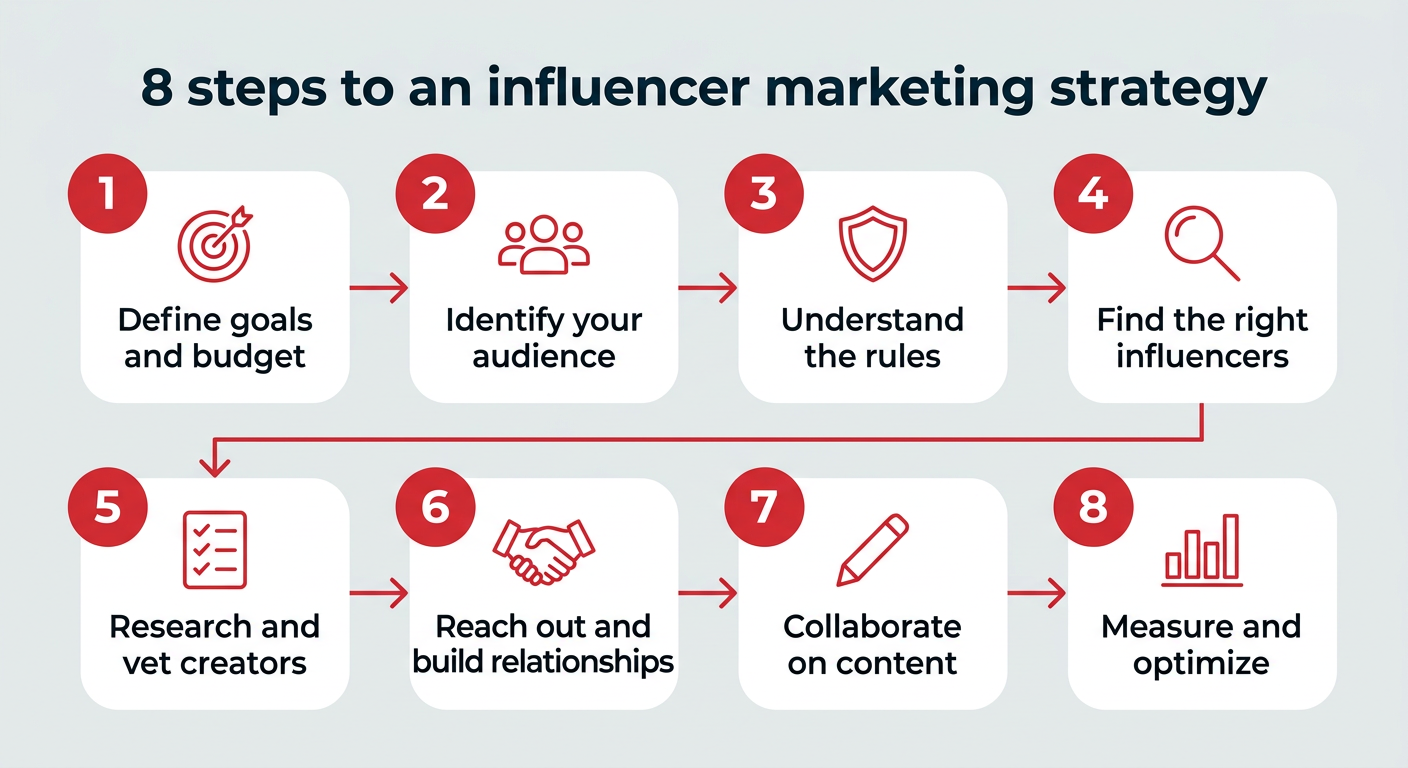
To create an effective influencer marketing strategy, follow these steps:
- Define your goals and budget
- Identify your target audience
- Understand platform rules and regulations
- Find the right influencers
- Research and vet creators
- Reach out and build relationships
- Collaborate on campaign content
- Measure results and optimize
Step 1: Define your goals and budget
Before you slide into any influencer’s DMs, start by defining the overall goals of your influencer marketing strategy.
Are you:
- Launching a new product?
- Trying to reach a new audience?
- Building brand awareness?
- Driving direct sales?
Your goals will determine everything — from the influencers you choose to the content you create. And please set a realistic budget. If you’re working with a limited budget, focus on smaller creators who can deliver strong engagement.
Step 2: Identify your target audience
At the end of the day, you’re not just looking for any influencer — you’re looking for the right influencer for your specific audience.
Developing audience personas is a great way to make sure you understand who you’re trying to reach, whether it’s your existing audience or a new segment. The right influencer should already have an audience that overlaps with your target market.
Step 3: Understand rules and regulations
Before you dive into influencer marketing, it’s essential to read up on different rules and regulations.
In the United States, those rules come from the Federal Trade Commission. Similar rules also exist globally.
Disclosure is one of the most important requirements. Social media influencers must identify sponsored posts. Undisclosed paid promotion can expose both the brand and the creator to regulatory enforcement.
While rules vary slightly by country, the core principle is the same: be clear and upfront so audiences know when content is sponsored. Build the disclosure requirement into your contract and your brief, not just your approval checklist.
Step 4: Find the right influencer
When finding influencers, look at a variety of factors beyond follower count. Think about relevance, engagement, and audience alignment — according to eMarketer, 43.9% of marketers say finding the right creator is their top challenge.
Here’s what to look for:
- Audience demographics: Are they actually reaching your target market?
- Content quality and style: Does it align with your brand?
- Engagement rate: Likes, comments, shares compared to follower count.
- Past partnerships: Have they worked with your competitors?
Many organizations that work with influencers already use social listening tools to find creators who are already talking about their brand or industry.
“Social listening helps brands monitor real-time conversations and sentiment, but what many don’t realize is that it’s one of the best ways to identify high-impact influencers — especially in niche industries.”
Step 5: Research and vet creators
Before diving into influencer outreach, take a minute to do your homework. Look at their recent posts. How often are they sharing sponsored content? How does their audience respond?
What you’re really looking for is balance. Creators who mix sponsored and organic content tend to feel more authentic, and that shows in their performance.
For example, @shawnjohnson on Instagram isn’t just a “momfluencer” with millions of followers, she’s also an Olympian and author. Knowing that context changes how you approach the collaboration.

Source: @shawnjohnson
Step 6: Reach out and build relationships
When you reach out, keep it personal and to the point. Explain who you are, what your brand does, and what you’re hoping to collaborate on.
Before you send that message, warm things up. Engage organically with their posts. “Like” their content and leave thoughtful comments to build rapport before reaching out via DM or email with your partnership pitch.
Be clear about what you’re offering and what you’re asking for. Outline your campaign goals, and make sure the value goes beyond just payment. The best partnerships feel like a fit, not a transaction.
Pro tip 💡: You may not actually want to use the word “influencer” when reaching out to potential partners. Content creators prefer to be called just that — creators — and may view “influencer” as a bit of an insult that belittles their work.
Step 7: Collaborate on campaign content
Next, work with influencers to co-create content. This isn’t about controlling every detail. Influencers are content creation experts, so you’ll get the best value from their work by allowing them to showcase those skills.
A strong creative brief includes:
- Key messaging points
- Must-have elements (product features, hashtags)
- No-go zones (things to avoid)
- Examples of content you love
- Technical requirements (video length, image ratio)
“Present your brief to your creator and see if there are any tweaks they would make to make the partnership more authentic on both ends,” says Kwok.

Source: Vicki Duong
Just remember: don’t over-direct. Comedian @heyfreesamples weaves product placements into her skits. Asking her to do a straight-to-camera product review would feel off-brand, and her audience would notice.

Source: @heyfreesamples
Step 8: Measure results and optimize
The true measure of a campaign’s success lies in its return on investment. Use a social media ROI calculator to put real numbers to your campaign’s performance, and ensure you have the right tools in place to:
- Set up unique tracking links
- Create campaign-specific discount codes
- Establish your baseline metrics
- Define your KPIs
- Track deeper engagement metrics
How to measure influencer marketing ROI
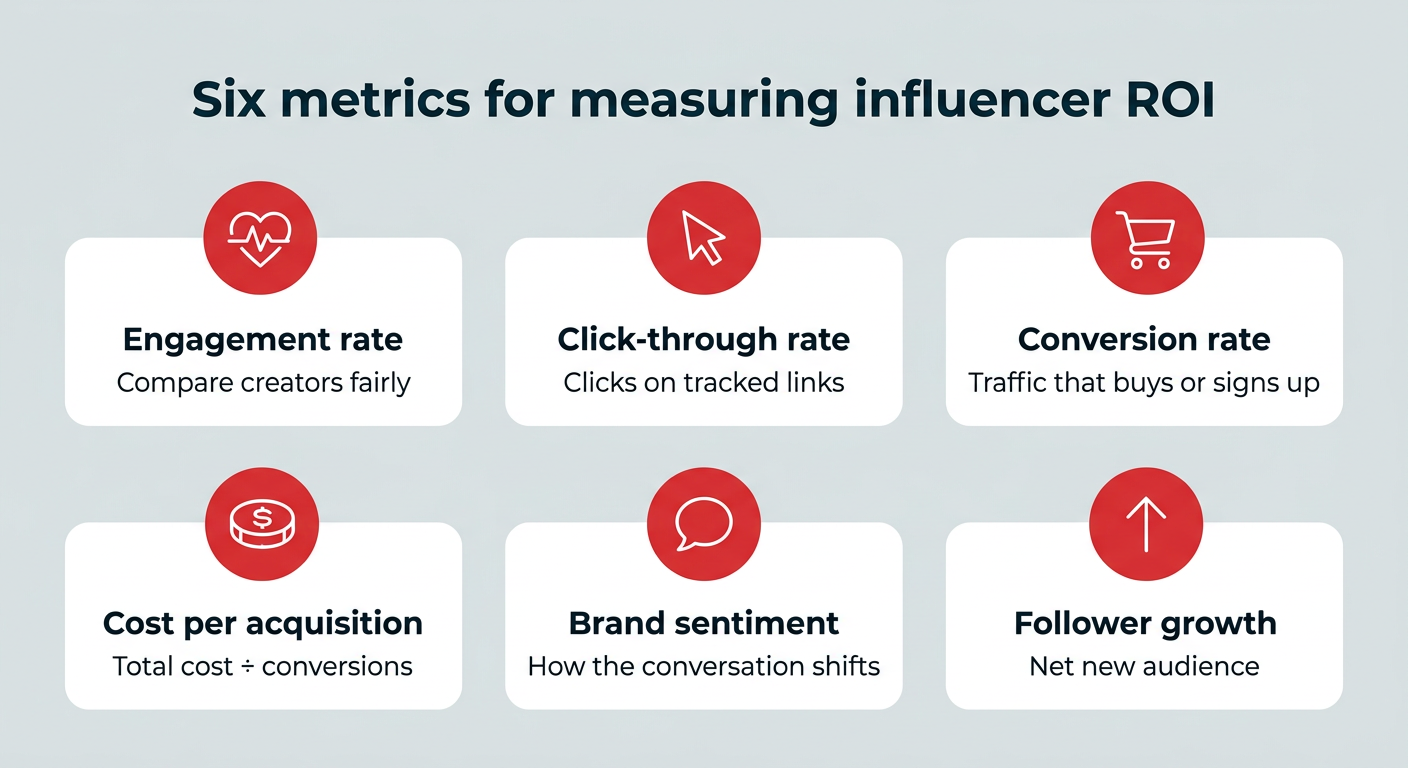
You measure influencer marketing ROI by tying creator activity to business outcomes, not just reach. That means deciding your KPIs before launch, instrumenting every link and code, and comparing results against a benchmark rather than a gut feeling.
Track these metrics:
- Engagement rate: Use a calculator to compare creators on a level playing field.
- Click-through rate: Measured on tracked links and affiliate links in bios, captions, and Stories.
- Conversion rate: How much influencer traffic turns into sign-ups, carts, or purchases.
- Cost per acquisition: Total partnership cost divided by conversions attributed to it.
- Brand sentiment: Whether the conversation around your brand improved during and after the campaign.
- Follower growth: Net new audience on your own accounts during the campaign window.
Pro tip 💡: Look beyond the raw numbers to understand their significance. A 5% engagement rate on a TikTok post might seem low until you realize it’s more than three times the 1.5% industry average.
Challenges of influencer marketing
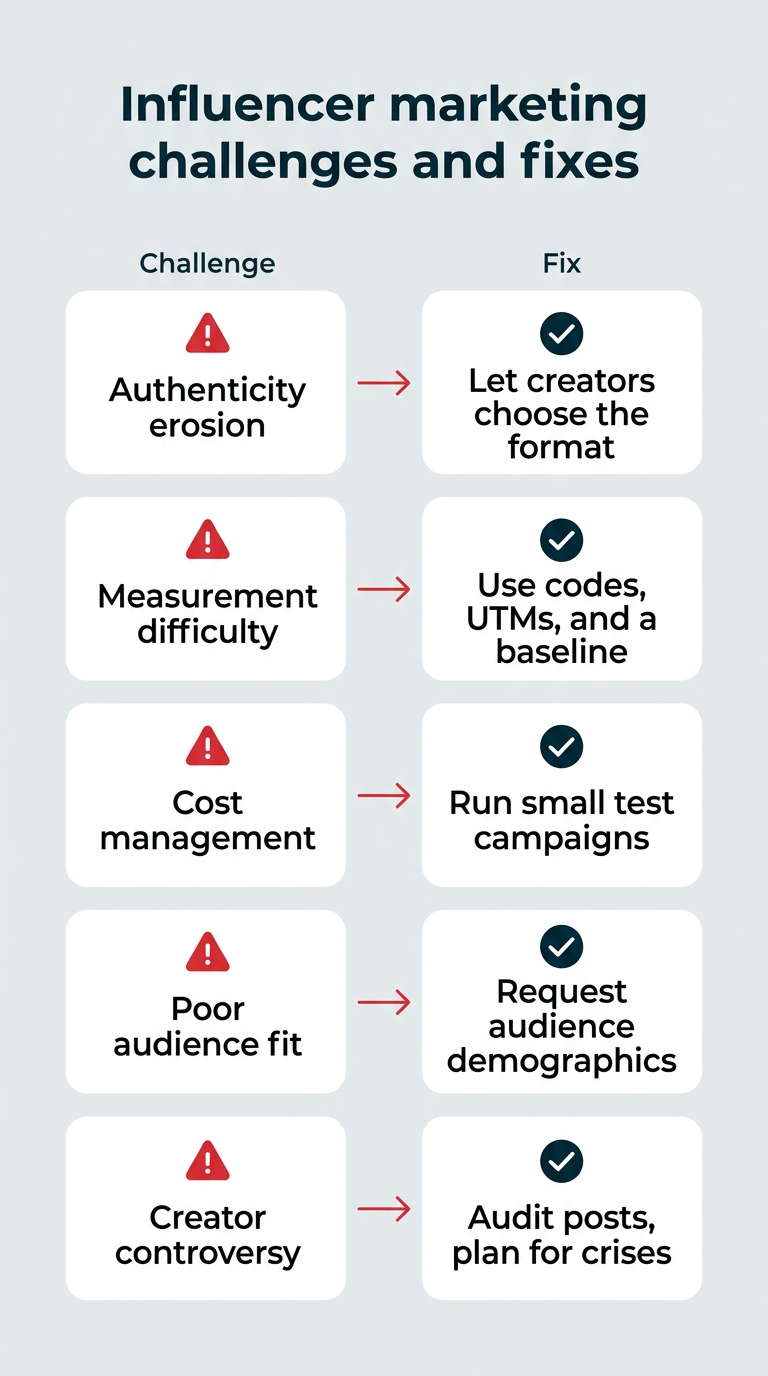
Influencer marketing works, but it isn’t risk-free. These are the five problems that come up most often:
- Authenticity erosion: Over-scripted content reads as an ad and performs like one. Fix it by letting the creator decide the format.
- Measurement difficulty: Awareness-led campaigns are hard to attribute. Fix it with unique codes, UTMs, and a pre-campaign baseline.
- Cost management: Rates vary wildly. Fix it by running small test campaigns before committing a year’s budget.
- Poor audience fit: A beautiful feed means nothing if the audience isn’t yours. Fix it by requesting audience demographics before you negotiate.
- Creator controversy: A creator’s behavior becomes your problem. Fix it by auditing the last six months of posts and having a crisis response plan ready.
Advanced influencer marketing best practices
Whitelist influencer content
When influencer content performs well organically, you can run it as an ad from their account. It’s like getting the best of both worlds: influencer authenticity with paid reach precision.
Layer in affiliate incentives
Affiliate programs give influencers incentive to keep promoting your product long after the initial campaign ends.
Run always-on campaigns
Successful brands are building long-term partnerships with creators, creating consistent content that feels natural and authentic.
Think beyond a single post
“One-off sponsored posts don’t do it anymore,” says Kwok. Work with your influencer to build an ongoing campaign, maybe even one that moves offline, like a curated collection of products available in-store.

Source: @omgheysam
Repurpose creator content across channels
A single well-made creator video can become a paid ad, a product page asset, an email header, and a retail display. Build those rights into the contract from day one.
Influencer marketing examples that worked
IBM: employee influencers at scale
IBM’s @lifeatibm account regularly features employees talking about their own work rather than company messaging. The lesson: your best creators may already be on payroll.
Dave Gerhardt: B2B thought leadership on LinkedIn
Gerhardt’s audience is almost entirely marketers and founders. Partnerships with creators like him work because the credibility transfers to a specific buying decision. The lesson: in B2B, relevance beats reach every time.
Niche creator partnerships: @jmillydg and disc golf
A micro-influencer who posts almost exclusively about one sport is a near-perfect match for brands in that category. The lesson: when your product is specific, pick a creator whose entire feed is about that specific thing.
Poppi: what a misread audience costs
Poppi’s Super Bowl campaign generated enormous conversation, but much of it was criticism that the gesture was extravagant and disconnected from the brand’s community. The lesson: reach without sentiment isn’t a win.
Influencer marketing tools to manage campaigns
Influencer marketing tools help you handle finding creators, vetting them, managing content and approvals, and reporting on results. Look for a platform that covers discovery, vetting, content management, and performance analytics.
Hootsuite Social OS brings those pieces together. Wisdom, the AI layer, helps surface trends, while Lumen handles listening and insights so you can spot high-impact creators and track how a partnership shifts sentiment. The Upfluence integration adds dedicated creator discovery and campaign management on top.
Meet the Suite
Understand what matters, decide what to do next, and take action across every social workflow — all from one connected suite.

Where influencer marketing goes from here
The influencer marketing landscape is always evolving (think: AI influencers), but the core principles remain unchanged: prioritize authenticity, focus on strategy, and always track your results. Start building those influencer relationships today — just ensure your budget aligns with your ambitions.
FAQ: Influencer marketing
What is influencer marketing and how does it work for businesses?
How do brands build a successful influencer marketing strategy?
What types of influencers should brands work with for marketing campaigns?
How do companies measure ROI from influencer marketing?
Is 10,000 followers enough to be an influencer?
Which social media platform is best for influencer marketing?
Save time managing your social media marketing strategy with Hootsuite. Publish and schedule posts, find relevant conversions, measure results, and more â all from one dashboard. Try it free today.