Table of Contents
Key takeaways
- Enterprise social media management is how large organizations coordinate publishing, listening, customer care, compliance, and reporting across multiple teams, brands, and regions from one connected system.
- A strong enterprise social media strategy ties social activity to business outcomes like revenue, pipeline, and brand reputation, not just engagement metrics.
- AI-powered insights, governed workflows, and real-time listening are now table-stakes capabilities for enterprise social media platforms in 2026.
- Choosing an enterprise platform means evaluating governance controls, integration depth, multi-region support, and how well the tool connects insight to action.
Enterprise social media is the practice of managing an organization’s social presence at scale, across many accounts, brands, regions, and internal departments, using shared systems for publishing, listening, customer care, governance, and reporting.
Enterprise social media management differs from small-business social media in three ways. First, the number of people involved: marketing, communications, customer care, legal, HR, and regional teams all touch the same channels.
Second, the level of control required: approvals, permissions, and archiving are mandatory, not optional. Third, the reporting standard: leadership expects social performance tied to business results, not screenshots of engagement.
A small business might run five accounts from one login. An enterprise might run 200 accounts across 30 markets, each with local language needs, different regulatory obligations, and separate stakeholders signing off on content. That gap is why enterprise platforms exist.
In short, enterprise social media is less about posting and more about coordinating social work safely and measurably across a large organization.
Social has become one of the few channels where an enterprise can see its market, its competitors, and its customers in real time. That makes it a business function, not just a marketing one.
The volume is part of the reason. As of early 2025 there were 5.24 billion social media user identities worldwide, roughly 63.9% of the global population, according to DataReportal’s Digital 2025 Global Overview Report. At that scale, conversations about your brand happen whether or not you are listening.
The cost of getting it wrong has also risen. Reputational issues surface publicly and move quickly, and fragmented tooling makes coordinated response harder. When five teams use five different platforms, nobody has the full picture.
Handled well, enterprise social media drives outcomes leadership cares about:
- Revenue and pipeline: Social content and social selling feed qualified leads into the funnel
- Brand protection: Early detection of sentiment shifts limits the scale of a crisis
- Competitive intelligence: Share of voice and competitor benchmarking inform product and positioning
- Advocacy reach: Employee networks extend brand reach beyond owned audiences
- Customer satisfaction: Faster, more consistent social care reduces churn risk
Those outcomes are also how teams prove social ROI and earn continued investment.
Enterprise social media software isn’t just a “bigger” version of a small-business tool. It needs to handle larger teams, layered approvals, compliance requirements, global audiences, and executive-level reporting.
Ultimately, the right platform will bring structure and control to all that complexity, and keep teams anchored to executive priorities like revenue growth, customer retention, and brand trust.
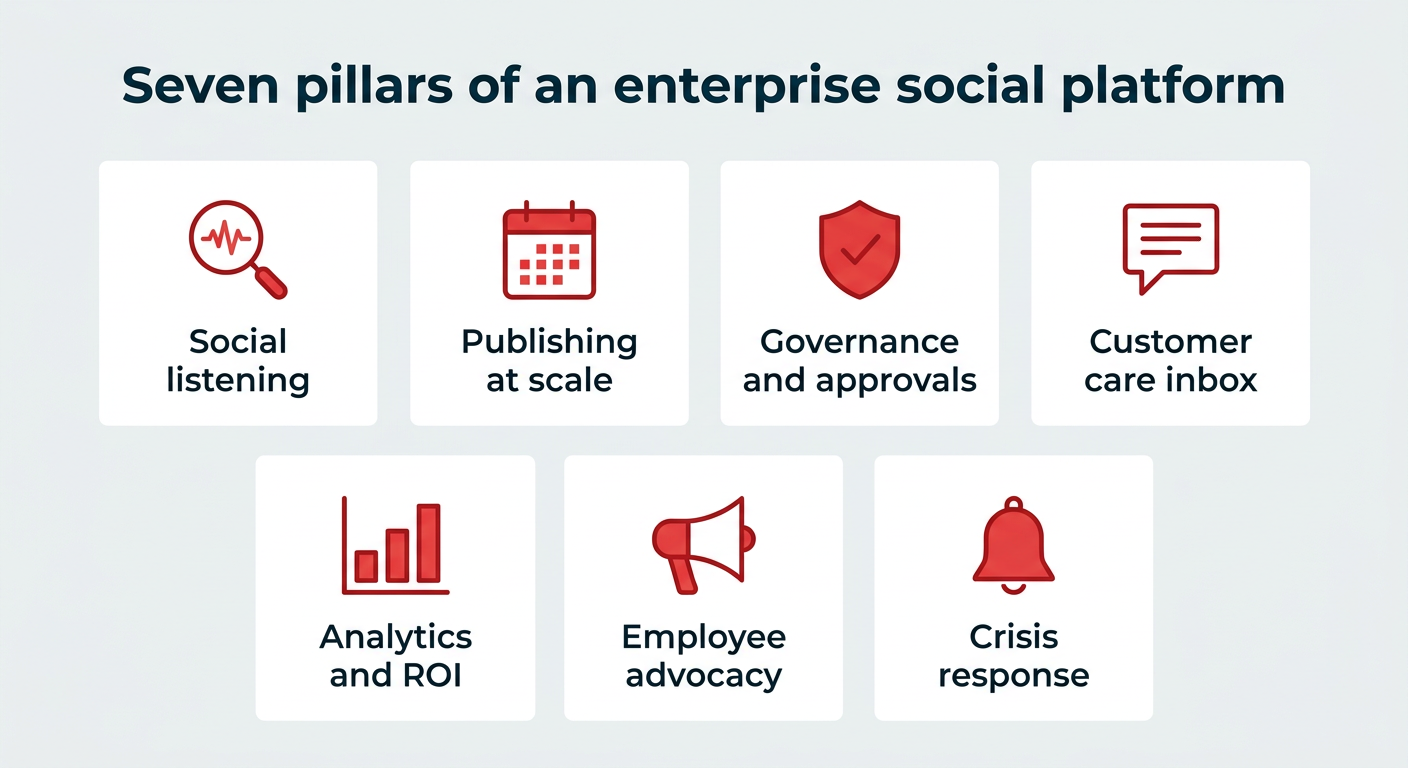
If your platform can’t support these seven areas, it’s not enterprise-ready:
- Social listening and real-time intelligence
- Content publishing and collaboration at scale
- Governance, compliance, and approval workflows
- Customer care and social inbox
- Analytics, reporting, and ROI measurement
- Employee advocacy and amplification
- Crisis communications and rapid response
Social listening and real-time intelligence
Tracking direct and indirect brand mentions gets difficult fast when you run dozens of accounts across multiple regions. Listening is what turns that noise into real-time intelligence your teams can act on.
Enterprise-grade listening should cover more than social networks. Look for coverage across news, blogs, forums, and review sites, with the ability to search millions of sources in many languages so regional teams see conversations in their own market.
Practical use cases include:
- Audience research: Understand what your target audience actually talks about
- Sentiment analysis: Use sentiment analysis tools to see how people feel, not just how often they post
- Competitive intelligence: Track share of voice against named competitors
- Trend detection: Spot emerging topics before they peak
- Crisis early warning: Get alerted to spikes in mentions or sudden negative shifts
Being aware of negative feedback early is what gives your team time to respond well instead of reacting late.
Content publishing and collaboration at scale
Publishing looks simple until you multiply it by every brand, market, and team in your organization. At enterprise scale, the platform has to hold the calendar together.
Look for multi-channel scheduling, a shared content calendar with region and brand filters, collaborative drafting, asset libraries, and clear ownership on every post. Regional teams should be able to localize approved content without rebuilding it from scratch.
The goal is one source of truth for what is going out, when, and from which account, across a multi-team, multi-brand structure.
Governance, compliance, and approval workflows
Regulated industries know compliance is non-negotiable. But every enterprise brand faces advertising, privacy, and consumer protection obligations on social, and breaches can carry legal and financial consequences.
The difference is whether you manage it proactively. Start with a social media policy, and update it regularly.
An enterprise-ready social media tool should take security further with:
- Role-based permissions: Clear user roles so people only access what they need
- Approval steps: Multi-layer sign-off before anything publishes
- Archiving: Automatic post and message archiving for audit and discovery
- AI governance: Traceable sources behind AI-generated insights and drafts, with human review before publishing
- Data handling: Documented data residency and retention practices for the regions you operate in
We’ve got a whole blog post on how to stay compliant on social media, but here are a few extra tips to keep in mind:
- Stay on top of privacy, data security, and confidentiality requirements. These affect how you store or share information and photos, and getting them wrong can breach the law.
- Disclose sponsorships, influencer relationships, and other marketing agreements as required by advertising regulators.
- Make sure you control access to your social accounts and keep your social media policy current.
Approval workflows matter because they protect your brand while keeping content moving at scale. The goal isn’t more red tape, though. It’s finding the right balance between speed and control, with approvals built directly into the workflow so content can move from social to legal and back without stalling.
Customer care and social inbox
For large organizations, social media isn’t just a marketing channel. It also functions as a customer service channel, and without the right system, messages get missed.
An enterprise inbox should pull public comments, private DMs, mentions, and reactions into one place so teams have full visibility into every conversation. From there, look for:
- Automated routing: Messages go to the right team member or region
- AI-assisted replies: Chatbots and saved replies handle routine questions
- Priority by sentiment: Escalate the conversations most likely to become issues
- Reassignment: Hand off conversations without losing history
- Performance tracking: Response times and CSAT by team
If you’re comparing options, our roundup of the best social inbox tools walks through what to look for. Together, these features reduce response times and improve consistency across conversations.
Analytics, reporting, and ROI measurement
Analytics show whether social media is working. Which is important, since executives want to see real impact. They care about leads, sales, and return on investment, not just vanity metrics.
Enterprise software should:
- Unify paid and organic: Track both together instead of in separate tools
- Measure conversion: Tie activity to conversions and leads
- Connect to business goals: Report the metrics leadership already tracks
- Benchmark competitors: Show performance in market context
- Export cleanly: Produce stakeholder-ready reports without manual rebuilding
This helps your team demonstrate impact and secure more budget, resources, and executive support over time.
Employee advocacy and amplification
Do you have an employee advocacy program at your company? Employee advocacy is one of the few ways to grow reach without buying it.
When employees share updates on platforms like LinkedIn, where 4 out of 5 members drive business decisions, your brand reaches new audiences in an authentic way. Advocacy tools also support onboarding by helping new employees understand company initiatives quickly, and they showcase your culture to potential employees and customers alike.
Enterprise tools can elevate your social media advocacy program by:
- Approved content libraries: Give employees pre-cleared posts to share
- Performance tracking: See reach, clicks, and top contributors
- ROI measurement: Tie advocacy activity to pipeline and hiring outcomes
Without structure in place, employee sharing feels scattered and hard to manage. With the right tool, it becomes consistent, organized, and measurable, and it lifts internal engagement along the way.
Crisis communications and rapid response
Most large companies face a crisis at some point. When that happens, social media is your fastest distribution channel, letting you respond in real time and adapt as the situation evolves.
But speed without structure creates risk. A strong platform allows teams to post updates across channels at once, monitor comments in real time, track brand sentiment, and use approved response templates.
Remember: in a crisis, coordination matters more than speed alone.
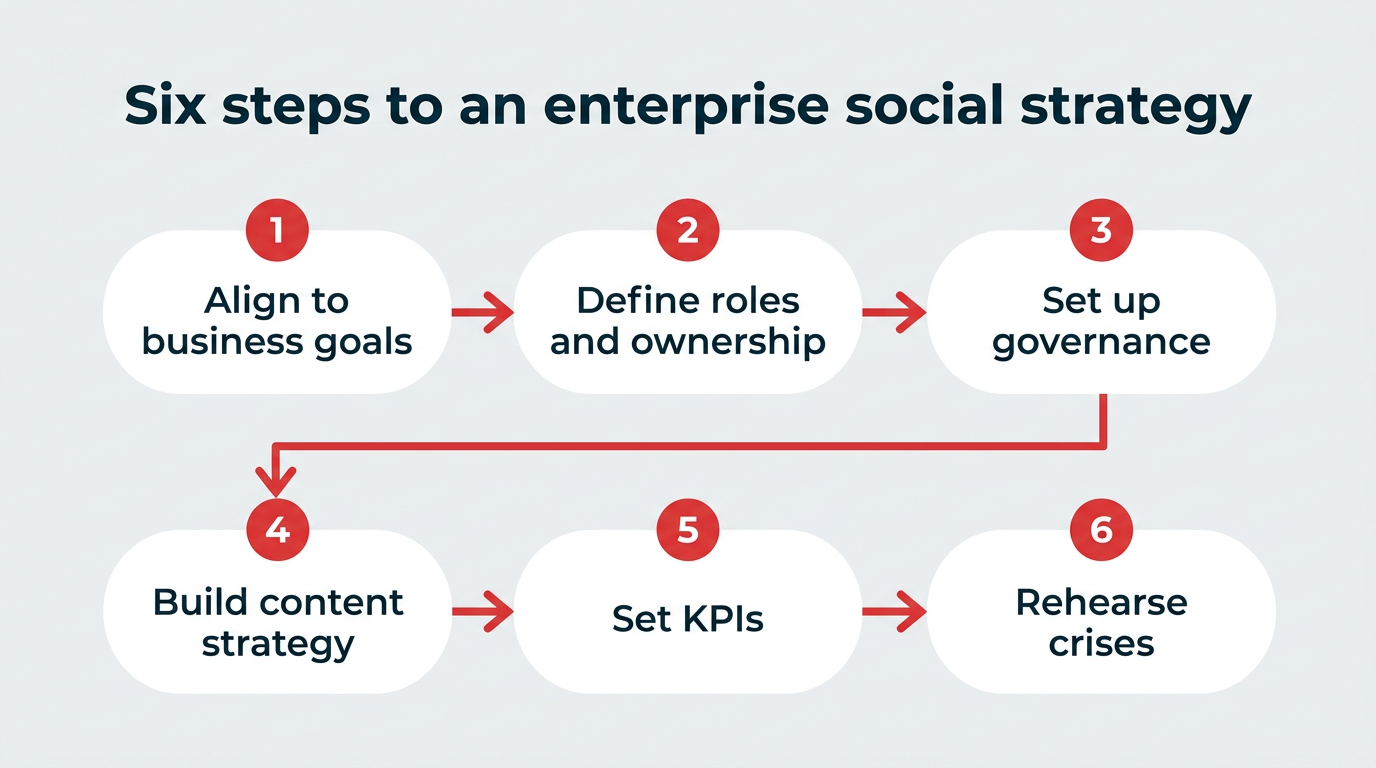
An enterprise social media strategy is the operating model that decides who does what, on which channels, with which approvals, measured against which goals. Here’s the short version of the process:
- Align social objectives to business objectives
- Define team structure, roles, and ownership
- Establish your governance framework
- Build a content strategy that works across brands and regions
- Set KPIs tied to business outcomes
- Plan and rehearse crisis scenarios
Here’s what each step looks like in practice.
1. Align social objectives to business objectives
Start with the goals leadership already has for the year. Map each social objective to one of them, whether that’s revenue growth, lead generation, retention, or brand trust. If a social activity doesn’t ladder up to one of those, question whether it belongs in the plan.
2. Define team structure, roles, and ownership
Decide what sits centrally and what sits locally. Central teams usually own brand standards, paid strategy, listening, and reporting. Regional teams own localization, community, and market-specific campaigns. Write down who publishes, who approves, and who escalates.
3. Establish your governance framework
Document your policy, permission levels, approval routes, and archiving requirements, then build them into the platform rather than a separate spreadsheet. Governance that lives outside the workflow gets skipped when deadlines get tight.
4. Build a content strategy across brands and regions
Create a shared content framework with room for local adaptation. Define your core content pillars, the mix of organic and paid social, and how sales teams use social selling content. Publish the calendar somewhere every team can see it.
5. Set KPIs tied to business outcomes
Choose a small set of metrics per objective and report them consistently. Pipeline contribution, share of voice, sentiment trend, response time, and advocacy reach travel well with executives. Long lists of platform metrics don’t.
6. Plan and rehearse crisis scenarios
Draft response templates, approval chains, and escalation paths before you need them. Run a tabletop exercise once or twice a year so the process is familiar under pressure.
Done together, these steps turn social from a set of channel activities into a coordinated business function.
AI has moved from a content shortcut to the layer that connects social work together. For enterprise teams, the useful applications are less about generating posts and more about surfacing what matters and routing it to the right person.
Where it’s making the biggest difference:
- AI-powered insights: Listening data is summarized into themes and shifts instead of raw mention counts
- Content assistance: Drafting, variant creation, and localization move faster, with human review before publishing
- Conversational care: Routine questions are handled automatically, while complex issues route to agents with full context
- Workflow orchestration: Alerts, approvals, and handoffs trigger across teams without manual chasing
- Governed AI: Outputs cite their sources and log their decisions, so compliance teams can audit them
The interface is changing too. Rather than hunting through dashboards, teams increasingly ask questions and get answers with the underlying data attached. The value comes from contextual intelligence, insight that arrives already tied to the account, campaign, or conversation it affects.
AI doesn’t remove the need for social teams. It reduces the time they spend assembling information so they can spend it on judgment calls.
Choosing an enterprise social media platform starts with an honest audit of what your current stack can’t do. Map the gaps first, then evaluate vendors against them rather than against feature lists.
Use this checklist as your evaluation criteria:
- Governance controls: Role-based permissions, multi-layer approvals, archiving, and audit trails
- Integration depth: CRM, business intelligence, DAM, collaboration tools, and API access
- Multi-region support: Language coverage, local publishing rights, and regional reporting views
- AI capabilities: Whether AI is embedded in listening, care, and reporting, or bolted on as a content generator
- Scalability: Account limits, user seats, and performance at your actual volume
- Vendor support: Onboarding, migration help, and named support for enterprise accounts
- Total cost: Seats, add-ons, and the tools you can retire once consolidated
Two practical steps make the decision easier.
- First, run a real trial with a small cross-functional group, using your own accounts and approval chains rather than a demo environment.
- Second, involve legal, IT, and customer care in the evaluation, since they inherit the consequences of the choice.
If collaboration is your weak point, our guide to collaboration and productivity tools is a useful companion read during evaluation.
Running social at the enterprise level involves various moving parts across your organization. To manage everything efficiently, you need tools that standardize processes, protect your brand, and save your team time.
Here’s how the leading enterprise social media platforms compare.
| Platform | Core strength | Listening | Publishing | Customer care | Employee advocacy | Governance | Best for |
|---|---|---|---|---|---|---|---|
| Hootsuite Social OS | End-to-end social operating system | Yes (Lumen) | Yes (Perch) | Yes (Nest) | Yes (Parliament) | Yes (Vigil) | Enterprises consolidating publishing, care, listening, and advocacy in one connected system |
| Sprinklr | Broad customer experience suite | Yes | Yes | Yes | Yes | Yes | Very large organizations with dedicated ops resources |
| Brandwatch | Consumer intelligence and research | Yes | Limited | Limited | No | Partial | Insights and research teams |
| Khoros | Community and social care | Yes | Yes | Yes | No | Yes | Brands running owned communities alongside social care |
Hootsuite Social OS
There’s a reason Hootsuite is used by employees at more than 80% of the Fortune 1000 enterprises. Hootsuite Social OS brings social media management, listening, customer care, advocacy, and governance into one connected system, so teams stop stitching insight and action together by hand.
The platform is organized into apps, each covering one part of the enterprise workflow.
Lumen: insights and listening
Lumen is the integrated insights and listening app inside Hootsuite Social OS. It tracks brand and competitor conversations across social, news, forums, and review sites, with sentiment analysis so you can see how people feel rather than just how loudly they post.
Teams can set real-time notifications for spikes in mentions and sudden shifts in sentiment, which is what makes early crisis detection possible.
Perch: content and publishing
Perch handles planning, scheduling, and publishing across accounts and regions, including paid and organic together. Teams can manage social advertising alongside organic content and compare performance in one place instead of two.
Reporting connects back through advanced analytics, with visual charts you can turn into custom reports for different stakeholders.
Everyone gets exactly the information they need, presented in a way that’s easy to understand.
Nest: customer care
Social media is no longer an optional channel for customer service. With Nest, teams manage all social messages in one workspace, including private messages and DMs, public comments on your profiles, dark and organic comments, mentions, and emoji reactions.
The agent workspace makes it easier to:
- Track the history of any individual’s interactions with your brand across accounts and platforms, giving your team the context to personalize replies
- Add notes to customer profiles, with integrations for Salesforce and Microsoft Dynamics
- Handle messages as a team using message queues, task assignments, statuses, and filters
- Track response times and CSAT metrics
It also supports automated message routing, saved replies, triggered customer satisfaction surveys, and AI-powered chatbot features.
Parliament: employee advocacy
Parliament is Hootsuite’s employee advocacy app. It gives your workforce a safe, structured way to share pre-approved content with their own networks, and gives you visibility into what that sharing delivers.
Beyond reach, it keeps employees connected to company news, product launches, and project milestones, which supports engagement and onboarding at the same time.
Wisdom and Vigil: AI orchestration and governance
Wisdom is the AI layer that surfaces recommendations and moves work between apps, so insight turns into action without manual handoffs. Vigil covers governance: permissions, approval routes, and the audit trail your legal and compliance teams need.
Together they support governed workflows, where AI assists the work and every decision remains traceable.
Integrations
Hootsuite Social OS connects to the systems your enterprise already runs, including Salesforce, Adobe Marketo Engage, Microsoft Dynamics, and Slack, plus MCP connectors for AI assistants. The Slack app lets employees send social posts straight to a channel, user, or group from the Hootsuite dashboard, with sentiment and comments attached.
If you’re moving off a retired platform, our guide on replacing Salesforce Social Studio covers what migration involves.
Meet the Suite
Understand what matters, decide what to do next, and take action across every social workflow — all from one connected suite.

Sprinklr
Sprinklr is a unified customer experience management platform covering social publishing, listening, care, and advertising. Its breadth is its main advantage and its main tradeoff, since larger deployments typically need dedicated operations resources to configure and maintain. It suits very large organizations that want one vendor across marketing, care, and research.
Brandwatch
Brandwatch is strongest in consumer intelligence, with deep listening, research, and audience analysis capabilities. Publishing and customer care are lighter by comparison, so teams often pair it with another tool for execution. It’s a good fit for insights and research functions that need depth over workflow.
Khoros
Khoros focuses on community management and social customer care for large brands, with strong case handling and moderation features. Marketing publishing and analytics are capable but less central to the product. It fits enterprises running owned communities alongside their social channels.
Marketo, Salesforce, and Slack integrations inside Hootsuite Social OS.
Most enterprise social problems aren’t about content quality. They’re about coordination, and they show up in predictable places.
- Low adoption across departments: Customer care, HR, and sales often stay outside the social program. Fix it by giving each function a defined role and a reason to log in, whether that’s case handling, advocacy, or lead alerts.
- Global consistency versus local relevance: Central control frustrates regional teams, and full autonomy fragments the brand. A shared content framework with approved local adaptation usually resolves it.
- Proving ROI: Engagement metrics don’t survive a budget review. Agree on business metrics with finance and leadership before the reporting cycle, not during it.
- Compliance across jurisdictions: Different markets have different advertising, privacy, and disclosure rules, and non-compliance carries real legal exposure. Build the requirements into approval workflows and archive everything.
- Tool fragmentation: Separate tools for publishing, listening, and care mean no single view of the customer. Gartner now treats management and listening as one market, and consolidating onto one platform reduces both cost and blind spots.
- Keeping pace with platform changes: APIs, formats, and algorithms shift constantly. Assign clear ownership for monitoring changes and updating playbooks quarterly.
None of these are solved once. They’re managed continuously, which is why the operating model matters more than any single campaign.
What is enterprise social media and how does it differ from small business social media?
How do enterprises manage social media at scale across teams and regions?
What features should enterprises look for in a social media management platform?
What are enterprise social media best practices for governance and compliance?
How do enterprises measure ROI from social media programs?
What is the difference between enterprise social media management and enterprise social networking?
How does AI improve enterprise social media management?
What social media platforms do enterprise brands typically manage?
How do enterprises handle social media crises?
What integrations should an enterprise social media platform support?
Save time managing your social media marketing strategy with Hootsuite. Publish and schedule posts, find relevant conversions, measure results, and more â all from one dashboard. Try it free today.