Table of Contents
Key takeaways
- Social media engagement measures how people interact with your content, and a good engagement rate falls between 1% and 5% depending on the platform.
- The most effective tactics for increasing engagement in 2026 include interactive content, strategic posting times, social listening, and AI-powered workflows.
- Platform-specific strategies matter because what drives engagement on TikTok differs significantly from what works on LinkedIn or Instagram.
- Tracking engagement metrics across platforms in one place helps teams spot patterns, prove ROI, and adjust faster.
Social media engagement refers to the interactions people have with your content or brand on social media platforms—things like comments, shares, clicks, saves, or messages. It shows whether people are paying attention and taking action on the content you post.
Here’s a quick overview of each engagement type and what it means.
Engagement type | What it is | What it means |
|---|---|---|
Likes & Reactions | One-tap responses to your content | Your content resonated enough to get a quick acknowledgment |
Comments & Replies | Written responses to your posts or conversations | People are invested enough to join the conversation |
Shares & Reposts | When someone redistributes your content to their audience | Your content is engaging enough that people want to pass it along |
Saves & Bookmarks | When someone flags your content to revisit later | Your content is useful or interesting enough to revisit |
Link clicks | Taps on a URL in your post | Users want to learn more or take action beyond the platform |
Profile visits | When someone checks out your profile after seeing your content | Your content sparked curiosity about your brand |
Direct messages (DMs) | Private messages sent to your brand | Something you posted prompted someone to reach out directly |
Mentions | When someone tags or references your brand in their content | People are actively bringing you into their conversations |
Story interactions | Taps, replies, poll votes, or sticker clicks on your Stories | Your Stories content is holding attention and prompting action |

How do you measure social media engagement?
The easiest way to measure social media engagement is by calculating your engagement rate. Engagement rate shows how many people interacted with your social content compared to how many people saw it, expressed as a percentage.
The basic engagement rate formula is:
Engagements divided by followers, reach, impressions, or views, multiplied by 100.
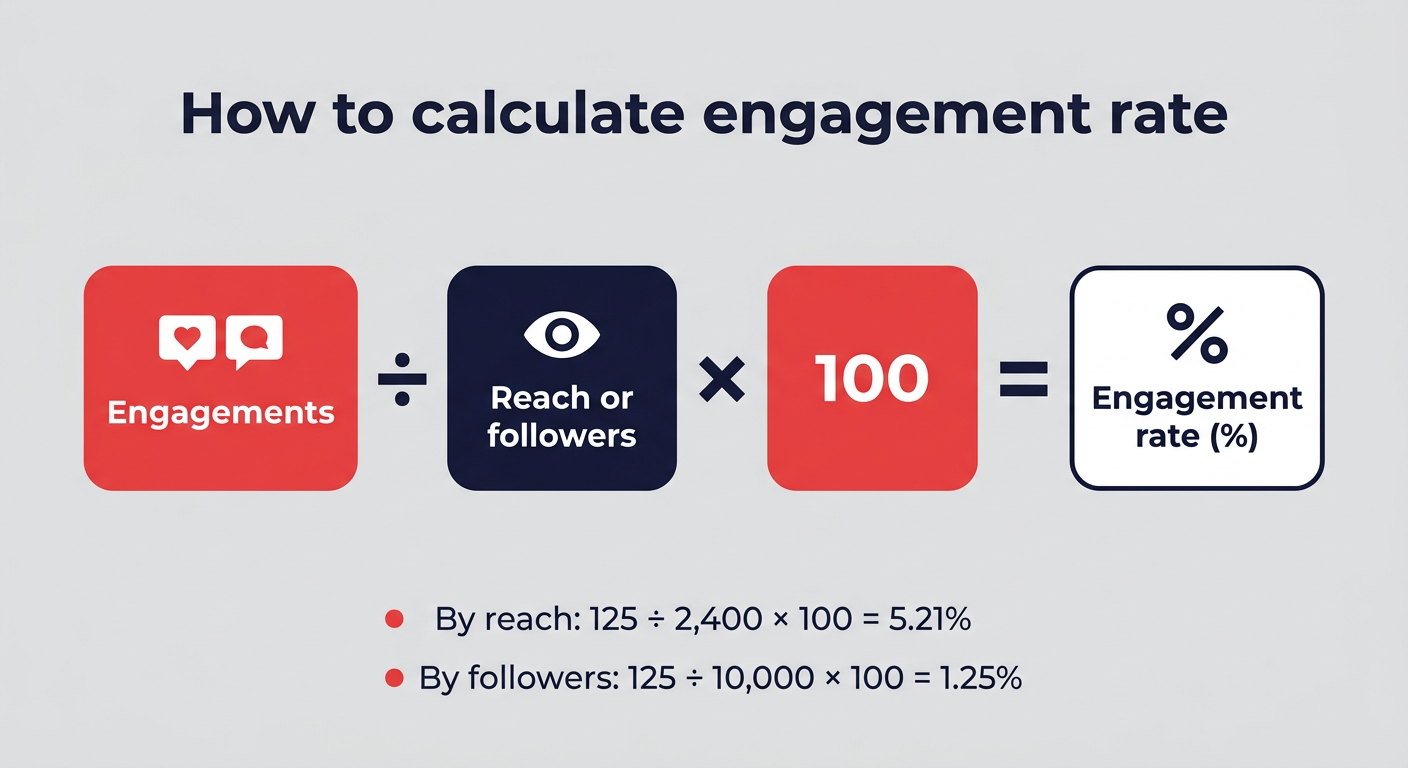
For example, if a post gets 125 engagements, reaches 2,400 people, and you have 10,000 followers:
- By reach: 125 ÷ 2,400 × 100 = 5.21%
- By followers: 125 ÷ 10,000 × 100 = 1.25%
Here’s what an engagement rate calculation could look like on various platforms:
- Instagram: (Likes + Comments + Saves + Shares) ÷ Followers or Reach × 100
- TikTok: (Likes + Comments + Shares + Favorites) ÷ Views × 100
- LinkedIn: (Reactions + Comments + Shares + Clicks) ÷ Impressions × 100
- X (Twitter): (Likes + Replies + Reposts + Link clicks) ÷ Impressions × 100
If all these numbers are making your head spin, don’t worry. Use Hootsuite’s free engagement rate calculator to do the math for you.
What is a good engagement rate on social media?
A good engagement rate on social media falls between 1% and 5%, depending on the platform, according to recent Hootsuite data. It’s one of the clearest signals of whether your social media marketing strategy is working.
Engagement rates also vary by industry and platform. Instagram’s median engagement fell from 16.9% to 9.7% through 2025, so the right target depends on your space. See average engagement rates across industries for a more specific benchmark.

Social media engagement can help your brand in four big ways: it increases your reach, drives customer loyalty, generates leads, and improves your campaign performance.
Here’s how each benefit works.
Increasing brand awareness
When people like, comment, or share your social media posts, they introduce your brand to their own networks. That’s a signal to algorithms that your content deserves more visibility.
Take this recent LinkedIn post from Hootsuite that generated more than 1,000 interactions.

A short, relatable line turned into over 1,000 interactions. Each repost expanded the post’s reach, while the comments created conversations with new and existing followers.
Takeaway: Engagement moves your content outside the bubble of your own audience and onto the feeds of their networks, multiplying your reach.
Driving customer loyalty and trust
Engagement turns posts into conversations, and that’s what builds brand loyalty. A like is quick, but a comment or DM takes effort. When you respond to those signals, people feel seen, and that’s how a casual follower becomes part of your community.
As Trish Riswick, Hootsuite’s Former Social Team Lead, explains, “Comments show effort. Followers show intrigue. Likes show reaction. Impressions show spread.”

Source: Trish Riswick
And it’s not just about replying on your own feed. Joining conversations elsewhere matters, too.
41% of brands now leave proactive comments on other posts to boost visibility, according to Hootsuite’s Social Trends report. When those comments spark a reply, engagement jumps 1.6x higher on average.
Takeaway: Every comment you reply to or DM you answer is a chance to build trust and turn followers into a community.
Supporting lead generation and sales
When people engage with your posts, they’re showing interest. Likes and views are nice, but comments, saves, and clicks are stronger signals of purchase intent. They suggest someone is moving from “just browsing” to “ready to buy.”
Each interaction type works a little differently:
- Comments: Open the door to conversation. A simple question under a post can lead to a DM, demo, or purchase.
- Shares: Expand your reach into new networks, exposing your brand to people who may never have found you otherwise.
- Clicks: Drive traffic straight to your website or landing page, creating conversion opportunities.
- Messages: Allow for direct, personalized exchanges that can build relationships and shorten the sales cycle.
The data backs it up:
- 30.9% of people worldwide made a purchase on social media in the past year.
- 82% of consumers use social media platforms to discover and research products.
- Social commerce is projected to reach over $840 billion by 2029.
Takeaway: Engagement warms up leads. A click or comment today can turn into a purchase tomorrow.
Improving campaign performance
Social media algorithms reward posts that readers interact with—shares, comments, saves—because that engagement tells platforms your content deserves more reach.
Here are a few ways to use engagement data to fine-tune performance:
- Compare formats: Carousel posts are currently leading the pack on Instagram, driving higher engagement rates than both video and static images.
- Check comment quality: Posts that generate mid-length comments (50–99 characters) see 151.6% more engagement on average, according to Hootsuite’s Social Trends report.
- Know your benchmarks: The average engagement rate across platforms hovers between 1% and 5%, according to Hootsuite data. Use this as a baseline to measure whether your content is really pulling its weight.
Takeaway: Engagement is your campaign’s pulse. Track it closely, and you’ll know when to push harder or change direction.
Businesses can increase social media engagement by making content interactive, posting at the right times, using platform features, and actively participating in conversations.
The key is to make it easy and appealing for people to interact with your brand. Here are the 13 tactics we cover below:
- Create content that drives interaction
- Post at the right times and frequency
- Use interactive features to spark participation
- Leverage social listening to join conversations
- Study your metrics and double down on what works
- Create a specific engagement strategy
- Encourage user-generated content
- Tap into influencers and employee advocacy
- Respond quickly across every channel
- Be authentic
- Lead with video and short-form content
- Make your content accessible
- Repurpose top-performing content across platforms
1. Create content that drives interaction
The easiest way to boost engagement is to make content that invites people to react, comment, or share. Posts that encourage participation tend to perform better because algorithms reward active engagement.
Here are a few ways to create interaction-driven content:
- Ask questions: Simple prompts like “Which would you choose?” or “What’s your best tip?” invite comments.
- Use storytelling: Relatable, human stories get people talking more than product promos.
- Add clear CTAs: Even a small nudge like, “Save this for later” or “Tag a friend who needs this,” can boost replies and shares.
- Mix formats: Experiment with carousels, polls, and short-form video to see what earns the most responses from your audience.
Things to avoid: Don’t fall into engagement baiting. Posts that say things like “Comment ‘yes’ if you agree” or “Tag 3 friends to win” can feel spammy or inauthentic.
2. Post at the right times and frequency
Timing and consistency are two of the biggest factors in whether your posts actually earn engagement.
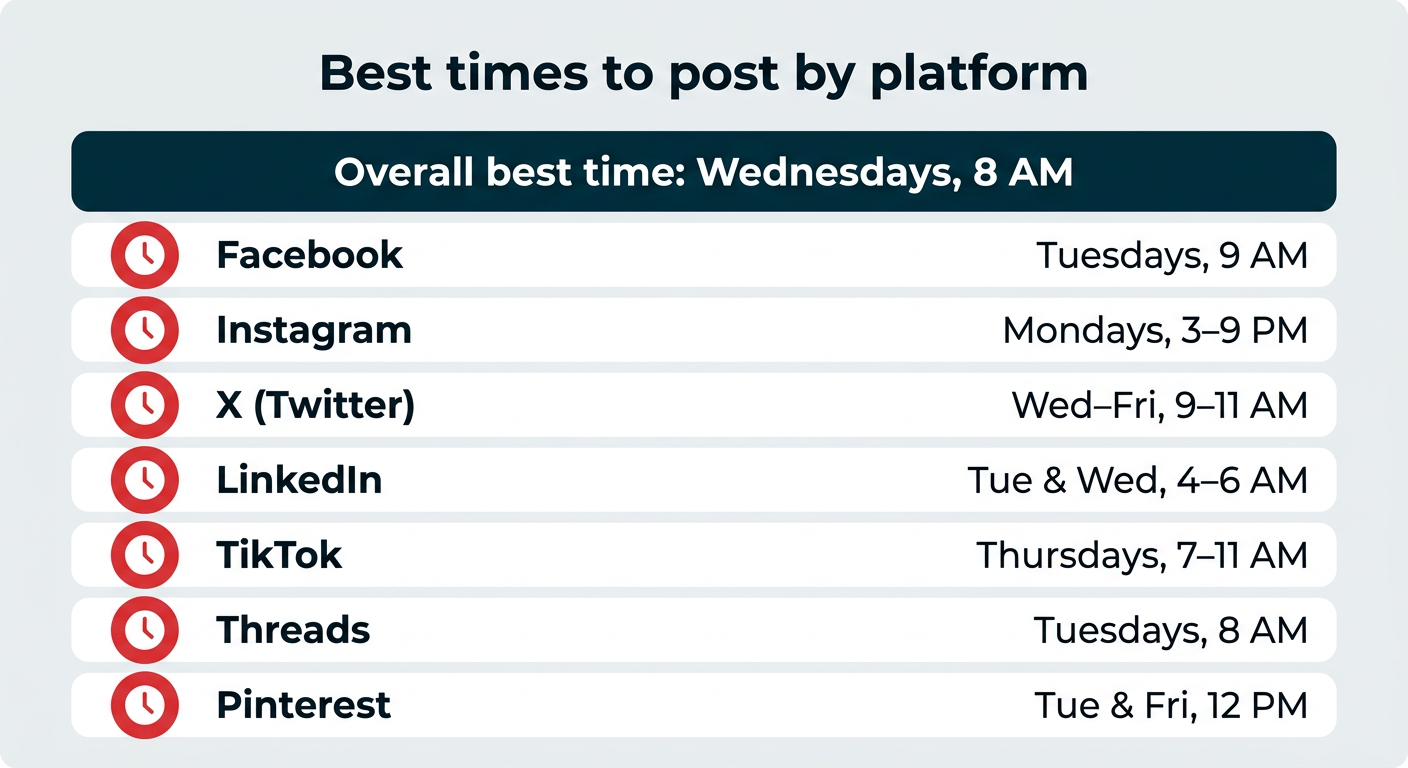
The overall best time to post on social media is 8 AM on Wednesdays, according to recent Hootsuite data. But every platform has its own peak engagement window:
- Facebook: 9 AM on Tuesdays
- Instagram: 3 PM to 9 PM on Mondays
- X (Twitter): 9 AM to 11 AM on Wednesdays, Thursdays, and Fridays
- LinkedIn: 4 AM to 6 AM on Tuesdays and Wednesdays
- TikTok: 7 AM to 11 AM on Thursday
- Threads: 8 AM on Tuesdays
- Pinterest: 12 PM on Tuesdays and Fridays
Note: These times are based on localized data from 118 countries, so they’re accurate across time zones.
Of course, “best time” benchmarks are a starting point. Your audience may behave differently.
Here are a few ways to find the best posting schedule for your audience:
- Check your analytics: Use Hootsuite Analytics to see when your followers are most active and which posting times drive the most social media interactions.
- Lean on automation: Hootsuite’s Best Time to Publish feature analyzes your past performance and suggests the best times for each network.
- Test and adjust: Start with recommended times, then experiment. Compare engagement rates week to week to find your sweet spot.
- Stay consistent: A regular cadence (for example, posting 3–5 times per week per channel) keeps your brand top of mind without overwhelming people.
Hootsuite research also found that Instagram posts with strong engagement in the first hour tend to perform better long-term than posts with slower early engagement.
If you have ad budget, boosting posts (i.e. paying money to get them in front of more people) can be a great way to increase visibility and engagement on Instagram.
Takeaway: The right timing gives your content a head start with both audiences and algorithms. Use data to guide your posting schedule.
3. Use interactive features to spark participation
Interactive features are one of the easiest ways to spark engagement. These include polls, quizzes, Q&As, and stickers—all of which let your audience respond, vote, react, or create their own content.
Most major social media platforms now offer built-in engagement tools:
- Instagram Stories: Polls, quizzes, emoji sliders, and “Add Yours” stickers make it simple to get quick reactions.
- LinkedIn and X (Twitter): Polls encourage lightweight participation and can be used to test ideas or gather opinions. Infographics also promote engagement on LinkedIn.
- TikTok: Duets, stitches, and comment replies turn engagement into new content.
- Facebook: Polls, reactions, giveaways, and Q&A posts are easy ways to boost replies and shares.
Pro tip 💡: Use polls and questions to test content ideas before launching bigger campaigns. For example, ask your audience which product feature they want explained next, or what trend they’re most curious about. Giveaways can also help drive engagement.
4. Leverage social listening to join conversations
Social listening is one of the fastest ways to increase social media engagement because it helps you spot and join the conversations that matter most to your audience.
Instead of waiting for people to comment on your posts, you can track keywords, hashtags, and competitor mentions across social media to find new opportunities to engage.
Here’s how to use social listening to boost engagement:
- Watch for mentions of your brand (tagged and untagged) so you can reply quickly.
- Track trending hashtags or industry terms to jump into wider discussions.
- Monitor what people say about your competitors to learn what works for them.
- Collect questions or complaints and turn them into helpful posts or FAQs.
Pro tip 💡: Lumen, the integrated insights and listening app inside Hootsuite Social OS, lets you set up listening streams that follow keywords, hashtags, and competitor mentions across all your social media platforms in one place.
5. Study your metrics and double down on what works
Look at your social media analytics to see which posts spark the most interaction and which fall flat. Patterns usually appear quickly: maybe Reels drive more saves than static posts, or carousels get more comments than videos.
Social media metrics like comments, shares, saves, and DMs give you a clearer picture of what your audience cares about than likes alone.
AI-powered insights speed this up. Wisdom, the intelligence layer inside Hootsuite Social OS, surfaces patterns across your accounts so you can see which formats, topics, and posting times are driving engagement without manually combing through reports.
Hootsuite Analytics makes this process simple. Use it to:
- Track engagement by post or campaign to spot top performers.
- Monitor comments, DMs, and mentions to see what questions or topics come up most often.
- Identify brand advocates—the followers who consistently interact with your content—and consider collaborating with them.
- Measure conversion rates to connect engagement with real business outcomes.
Pro tip 💡: If customers are asking the same questions in your DMs, turn those into post content. Not only does it save time on replies, but it also shows you’re paying attention.
6. Create a specific engagement strategy
A social media engagement strategy is a plan for how your brand sparks and responds to interactions. Here’s what to include:
- A clear goal: What are you trying to achieve? Examples: shift brand perception, generate leads, collect product feedback, or educate your audience.
- Target metrics: Choose 2–3 metrics that map to that goal (comment volume, DM response time, share rate, click-throughs).
- Content pillars: Identify 3–5 recurring themes your engagement content will revolve around. Make sure to organize it in a social media calendar.
- A response plan: Define who replies to what, how fast, and on which channels.
You don’t need a separate content strategy doc. Just bake these elements into your existing social media plan.
Pro tip 💡: Be sure you’re setting SMART social media goals.
7. Encourage user-generated content
User-generated content is one of the strongest signals of social proof on social media platforms. When your audience creates posts about your brand—whether it’s a Facebook review, a TikTok unboxing video, or a LinkedIn testimonial—you extend your reach to their networks.
UGC tends to drive high engagement because it feels more authentic than branded content. And that authenticity pays off: 62% of consumers have purchased a product because of an influencer recommendation.
The simplest way to spark UGC is by creating a clear call to action. Branded hashtags, photo challenges, or feature campaigns (“Share your setup for a chance to be featured”) make it easy for followers to contribute.
Once the content starts rolling in, reshare it. This is a great way to build a sense of community around your brand.
Adam Mosseri, Head of Instagram, has repeatedly emphasized that content that inspires people to create and remix tends to earn more distribution in feeds. In other words: UGC doesn’t just increase engagement—it can also help you beat the algorithm.
8. Tap into influencers and employee advocacy
Influencers and employees can both expand your reach and boost engagement. The difference is how they connect: influencers introduce you to new audiences, while employees make your content feel more personal and trustworthy.
On LinkedIn, employee posts often get more engagement than brand accounts. Plus, 60% of consumers trust what creators say about a brand more than what the brand says about itself. When your people share stories, post insights, or reshare content, the conversation feels authentic.
Influencers also play a key role, especially micro- and nano-influencers. Their audiences are smaller but more engaged. In fact, they often see engagement rates higher than celebrity accounts.
Don’t keep engagement limited to your brand account. Empower employees with tools like Hootsuite Parliament to share content, and collaborate with influencers who already have the trust of your target audience.
9. Respond quickly across every channel
The fastest way to increase social media engagement is to actively respond to your audience. Comments, replies, and live chats all send strong signals that your brand is present and paying attention.
Plus, if you talk to people, they tend to talk back.
Here’s what audience engagement looks like across major platforms:
- Instagram & Threads: Reply to comments and DMs quickly. Broadcast Channels and replies are great for sparking two-way conversations.
- TikTok: The TikTok Creator Academy recommends engaging through comments, TikTok LIVE, Duets, and Stitches.
- LinkedIn: Thoughtful replies on posts (your own or others’) help build credibility and attract new followers.
- Facebook: Messenger and Groups remain top spaces for one-to-one or community-driven engagement. Quick responses here can make or break customer trust.
- X (Twitter): Replying to trending conversations can help increase visibility and relevance.
- YouTube: Comments sometimes move slower, but answering questions can encourage more engagement and nurture long-term community trust.
The hard part: engagement doesn’t stay in one app. Comments, mentions, and DMs spread across every social platform you use, and it’s easy to miss things.
That’s where Hootsuite Nest comes in. Nest pulls all your messages, mentions, and comments into one place so your team can respond quickly, assign conversations, and track response times.
10. Be authentic
Your audience follows you for a reason. Whether they find your content educational, entertaining, or downright inspiring, it’s important to remain authentic if you want to retain your audience.
“As corny as it sounds, truly being ourselves and letting our personalities and humor shine goes a long way in creating authentic content and building an engaging audience,” says JD Alewine, Food Blogger.
“If a trend doesn’t feel like us, we don’t do it. We can’t fake it, and we know doing stuff that doesn’t excite us will result in boring content,” she adds.
11. Lead with video and short-form content
Short-form video is usually the highest-engagement format on social, and it’s where most platforms still push the most distribution. Reels, TikToks, YouTube Shorts, and LinkedIn video all give you a shot at reaching people who don’t already follow you, which is harder to do with static posts.
Instagram’s ranking documentation notes that Reels are recommended to people who don’t follow you, based on signals like watch time and whether viewers engage with the video. That makes video one of the few formats that can grow both reach and engagement at the same time.
A few things that help video earn interaction:
- Hook fast: Give people a reason to stay in the first two seconds.
- Design for replays: Short loops and quick tips tend to get rewatched, which lifts watch time.
- Ask something at the end: A direct question in the final frame or caption prompts comments.
- Reply with video: Turning a comment into its own clip keeps the conversation going and gives you a new post.
12. Make your content accessible
Accessible content reaches more people, and more reach means more chances to earn engagement. Captions help the large share of people who watch video with the sound off, and alt text gives screen reader users a way into your posts.
Accessibility basics worth building into your workflow:
- Captions: Add them to every video, and check auto-captions for errors before publishing.
- Alt text: Describe what’s actually in the image, not just the topic.
- Color contrast: Keep text readable against busy backgrounds and photos.
- Plain language: Skip jargon and keep sentences short.
- Camel case hashtags: Write #SocialMediaEngagement so screen readers can parse each word.
13. Repurpose top-performing content across platforms
If a post already proved it can earn engagement, give it a second life somewhere else. A LinkedIn carousel that drove a lot of comments can become an Instagram carousel, a Reel, or a Threads post with a different hook.
Repurposing is efficient, but it works best when you adapt the format instead of copy-pasting. Match the aspect ratio, rewrite the caption for the platform’s tone, and lead with the part that got the strongest reaction the first time.
Check your analytics monthly for the top three posts by engagement, then plan one adaptation for each. It’s a low-effort way to keep your calendar full of content you already know works.
AI can help increase social media engagement by speeding up the parts of the job that slow teams down: drafting and testing content, spotting conversations worth joining, replying fast, and finding patterns in performance data.
Here’s where AI makes the biggest difference to engagement work:
- Content creation and optimization: AI can generate caption variations, suggest hooks, and adapt one idea into formats for several platforms, so you can test more angles without adding hours.
- Real-time listening: AI-powered listening flags spikes in brand mentions, sentiment shifts, and emerging topics while they’re still relevant, which is when joining a conversation actually earns engagement.
- Faster responses: Automated replies and DM workflows handle repeat questions so your team can spend its time on the conversations that need a human.
- Pattern detection in analytics: AI-powered insights connect engagement data across accounts and surface what’s driving interaction, rather than leaving you to reverse-engineer it from reports.
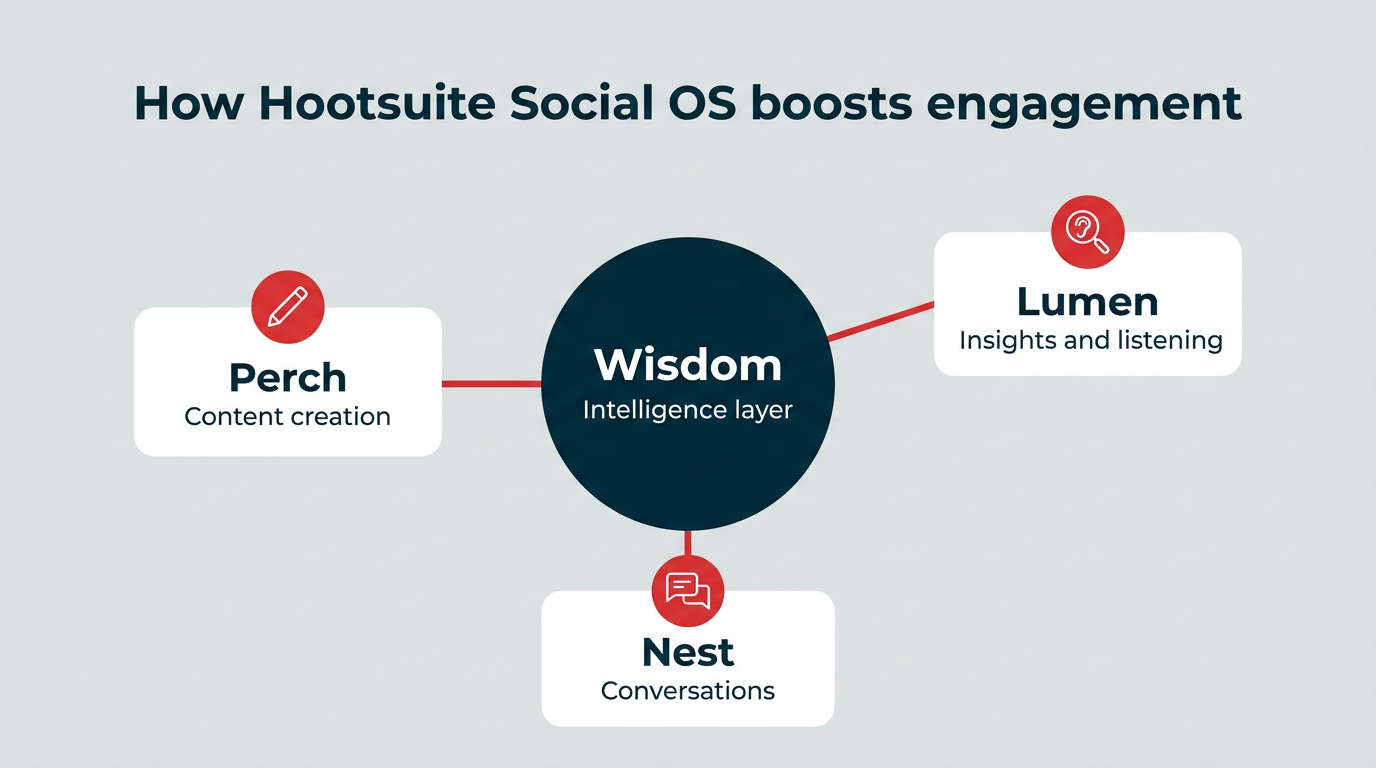
Inside Hootsuite Social OS, these pieces work as connected systems rather than separate tools. Perch supports content creation, Lumen handles insights and listening, Nest centralizes conversations, and Wisdom acts as the intelligence layer that ties the signals together so your team can act on them with context.
AI won’t replace the judgment that makes engagement feel human. What it does well is shorten the gap between noticing an opportunity and responding to it.
Meet the Suite
Understand what matters, decide what to do next, and take action across every social workflow — all from one connected suite.

What are platform-specific tips to boost engagement?
Engagement tactics don’t transfer cleanly between platforms, because each one rewards different behavior. Here’s a quick reference for the five networks most brands work in.
Platform | Highest-engagement formats | Best engagement lever |
|---|---|---|
Carousels, Reels, Stories | Sticker interactions and early replies | |
TikTok | Short video, Duets, Stitches | Comment reply videos |
Document posts, polls, text + image | Employee sharing and commenting | |
Groups posts, live video | Community discussion | |
X (Twitter) | Threads, quote posts | Timely replies to live conversations |
How do you increase engagement on Instagram?
You increase engagement on Instagram by leaning on carousels and short-form video, then using Stories to keep the conversation going between posts.
- Use carousels for anything that benefits from a swipe, since multi-slide posts currently outperform video and static images on engagement rate.
- Add polls, quizzes, sliders, or question stickers to Stories to collect low-effort interactions daily.
- Reply to comments in the first hour after publishing, when early engagement has the biggest impact on longer-term performance.
- Use collab posts with partners or creators so the content lands in two audiences at once.
How do you increase engagement on TikTok?
You increase engagement on TikTok by joining what’s already moving on the platform instead of publishing in isolation.
- Turn comments into content with video replies, which often outperform the original post.
- Use Duets and Stitches to build on creator content in your niche.
- Post frequently and test a range of ideas, since TikTok distribution depends more on the individual video than your follower count.
- Pin your best comment or question to steer the conversation.
How do you increase engagement on LinkedIn?
You increase engagement on LinkedIn by prioritizing formats that keep people on-platform and by getting individual employees involved.
- Publish document posts (PDF carousels) for frameworks, data, and how-tos.
- Run polls to gather opinions quickly and give people a one-tap way to participate.
- Encourage employees to share and comment, since personal profiles typically see more engagement than brand pages.
- Leave thoughtful comments on other people’s posts. It’s one of the fastest ways to get your brand in front of a new audience.
How do you increase engagement on Facebook?
You increase engagement on Facebook by treating it as a community platform rather than a broadcast channel.
- Build or participate in Groups, where discussion volume is far higher than on Pages.
- Go live for Q&As, launches, or behind-the-scenes moments, and answer comments in real time.
- Use Messenger for fast one-to-one responses to questions and complaints.
- Ask open questions in captions instead of posting links with no context.
How do you increase engagement on X (Twitter)?
You increase engagement on X by being fast and conversational, since the platform rewards timeliness over polish.
- Reply to relevant trending conversations while they’re still active.
- Use threads to break longer ideas into readable, repliable chunks.
- Quote post to add a point of view rather than just resharing.
- Keep posts short and specific, and end with something people can respond to.
The best social media engagement strategies in 2026 focus on authenticity, community-building, and showing up consistently. Tactics and platform tips get you moving, but these habits are what make engagement sustainable.
To learn what’s actually working right now, I spoke with Elissa Wardrop, Global Social Media Specialist at a major retail brand, who oversees content for 31 markets.
Here are her top social media engagement strategies:
- Drop the hard sell
- Focus on building community, not just collecting comments
- Create content that adds value to the scroll
- Develop a distinct brand voice
- Build recurring content series
1. Drop the hard sell
Brands increase social media engagement when their content feels authentic. It’s why Wardrop describes the foundation of strong engagement as “Being authentic and not making everything a very obvious, polished sales pitch.”
She encourages brands to show the work behind the work: the people, the ideas, and the moments that don’t make it into a campaign. “Bring people on a journey to build an emotional connection with them,” she says.
To illustrate, she points to SULT, a new electrolyte brand whose founders document their startup process on social.
“They’ve been creating super-engaging content from day one, showing the ups and downs and even involving their followers in decisions. It’s helped to build trust and loyalty even before launching their product.”
2. Focus on community, not just comments
Strong social media engagement comes from building meaningful community relationships, not just increasing comment counts.
“Place a high importance on interacting with your audience and building a community across multiple platforms in a meaningful way,” Wardrop says.
That means answering comments, asking questions, and joining conversations related to your industry, not just reacting to whatever is trending.
“Don’t focus on commenting on big viral videos that have nothing to do with your brand,” she warns. Instead, engage with the people who actually care about what you do.
3. Create content that adds value to the scroll
Audiences are harder to impress than they used to be, Wardrop says, and the bar keeps rising.
“Gone are the days where just a single image post with a caption cuts through,” she says. “They expect content that’s educational, entertaining, interesting, and inspirational. If you aren’t adding value to their scroll, don’t expect them to engage.”
But adding value doesn’t mean spending big. “Sometimes the most simple post can turn out to be the most engaging post, so don’t overthink it,” Wardrop adds.
One of her best-performing posts for a major retail brand was shot in a few hours, on her phone, with no lighting. “It was just taken on a stool, but the idea was strong enough and I moved with speed—which is one of the most important things when tapping into trends or cultural moments.”
4. Develop a distinct brand voice
Brands build stronger long-term engagement when they develop a consistent brand voice, instead of mimicking whatever tone is trending online.
“Maybe I’m going to sound like the fun police with this one,” Wardrop says, “but I see brands trying too hard to replicate Duolingo and Wendy’s unhinged, chaotic vibe and responding to comments in a sarcastic way.”
That kind of humor can grab eyes, but it doesn’t always hold them.
“It can be very funny, but sometimes I personally think it comes off as cringe and trying to be something they aren’t. You can still make high-quality content without mascots and sarcasm. Be an innovator, not an imitator.”
Authenticity, she says, is what drives sustained engagement. When a brand knows its tone, every reply and comment feels consistent, trustworthy, and human. “Be true to your core brand personality and tone of voice,” she says.
To make that practical, Wardrop uses a metaphor her teams rely on: “Imagine your brand as a guest invited to a dinner party—how would they get there, how would they dress, what would they bring, what and how would they talk to the other guests at the dinner table?”
5. Build a recurring content series
Regular, recurring content can increase social media engagement by giving audiences a reason to keep coming back.
“A big opportunity for brands right now is to focus on creating a regular content series, posted on the same day and time each week,” Wardrop says.
That routine creates a rhythm audiences can rely on. And, it builds a loyal audience over time. “We’ve had a huge amount of love from fans,” she says. “People are even leaving comments on unrelated content because they’re eagerly waiting for the next episode to drop.”
The best tools to track social media engagement are the ones that make it easy to measure what matters, compare results across platforms, and spot opportunities to improve.
Here are our top picks:
Free social media engagement rate calculator
Pro tip 💡: If you’re calculating your social media account’s total engagement, include information about all your posts (e.g., total number of posts published, total number of likes, and so on).
If you’re calculating the engagement rate of a specific social media campaign, only include the details of the social media posts that were part of the campaign.
Native platform analytics
Every major platform gives you free built-in analytics, which makes them a reasonable starting point if you’re managing one or two accounts.
- Instagram Insights: Reach, interactions, saves, and story taps
- TikTok Analytics: Video views, watch time, shares, and follower activity
- LinkedIn Analytics: Impressions, reactions, comments, and follower demographics
- Meta Business Suite: Facebook and Instagram performance in one view
- X Analytics: Impressions, engagement rate, and link clicks
The catch is that the data stays siloed. Comparing engagement across five platforms means five logins, five export formats, and a lot of manual work in a spreadsheet.
Hootsuite Analytics
Tracking social media engagement is only useful if you have clear, reliable data. Hootsuite Analytics makes it easy to track engagement across Facebook, Instagram, LinkedIn, TikTok, and X (Twitter) in one dashboard.
Instead of piecing together numbers from different platforms, you get a complete view of your social media performance, so you can see what’s working, compare results, and prove engagement (and ROI) with confidence.
With Hootsuite Analytics, you can easily:
- Track engagement metrics (comments, saves, clicks, DMs, mentions) across all social media channels in one place.
- Create custom reports to show results by campaign, post type, or social networks.
- Benchmark against industry averages to see if you’re ahead of the curve.
- Connect engagement data to traffic and conversions to prove ROI.
FAQ: Social media engagement
What is social media engagement and why does it matter for businesses?
What is a good social media engagement rate by platform and industry?
How do you calculate social media engagement rate?
How do brands increase social media engagement at scale?
Which types of content drive the highest social media engagement?
What is the best time to post on social media for engagement?
How can AI help improve social media engagement?
How do you get more comments on social media posts?
Does posting frequency affect social media engagement?
Social media engagement vs reach: which metric matters more?
Save time managing your social media marketing strategy with Hootsuite. Publish and schedule posts, find relevant conversions, measure results, and more â all from one dashboard. Try it free today.